AI Is Creating Super Researchers and Transforming the Modern Buying Journey
In the rapidly evolving landscape of digital commerce, artificial intelligence has emerged not as a simple shortcut, but as a transformative force empowering consumers to become unprecedentedly sophisticated researchers. Far from streamlining the buying journey into a single, swift transaction, AI is subtly, yet profoundly, expanding it, turning casual browsers into super researchers armed with deeper insights and a sharpened intent to verify. This shift is reshaping everything from product discovery to final purchase decisions, fundamentally altering the way brands must engage with their audiences.
New research paints a clear picture: shoppers are embracing AI to add steps, not skip them. This counterintuitive trend signals a mature approach to digital assistance, where AI is valued for its ability to enrich understanding and facilitate more informed choices, rather than merely accelerating a transaction. The implications for marketers are profound, demanding a re-evaluation of everything from initial touchpoints to attribution models.
The Genesis of Discovery: AI as the New Front Door to Commerce
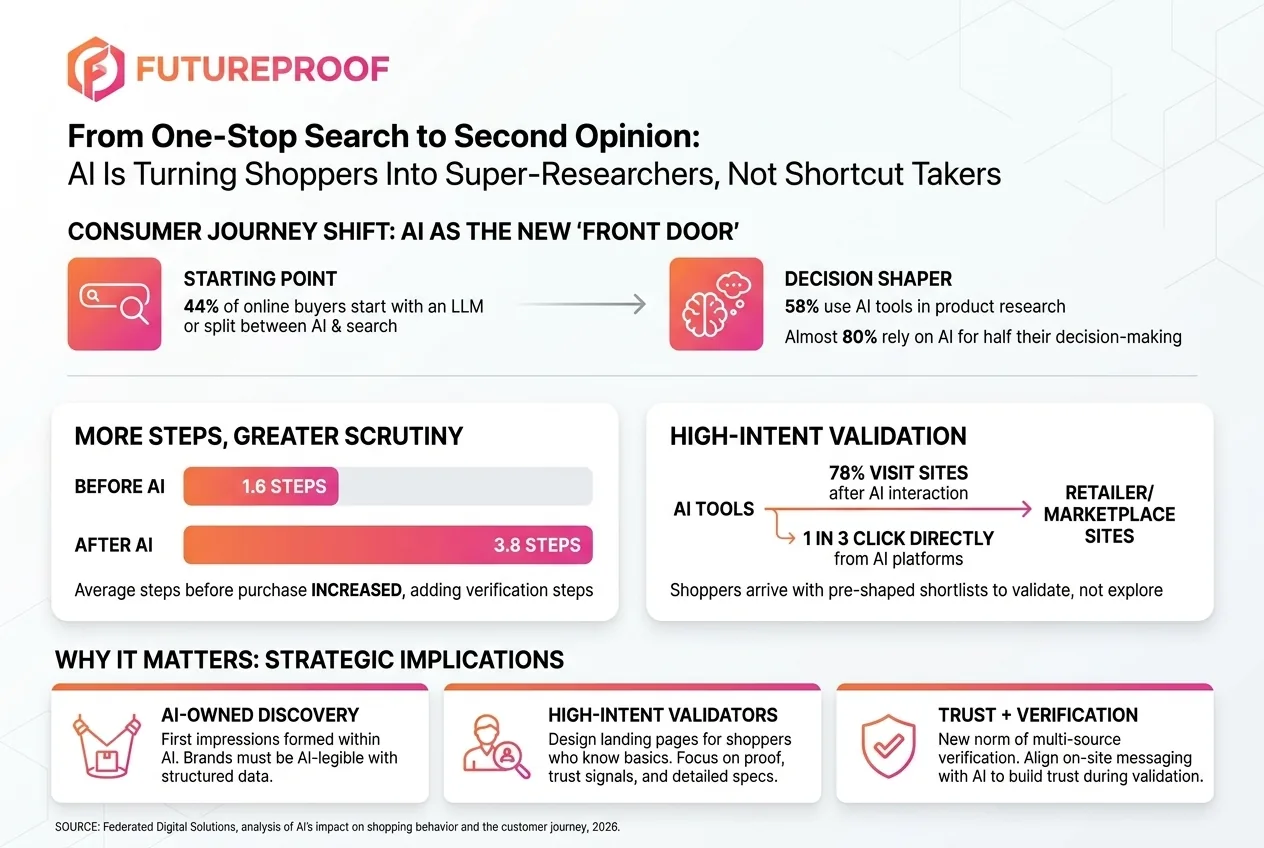
The journey for a significant portion of online buyers no longer begins with a traditional search engine query or a direct visit to a known brand site. Instead, a new gateway has opened: the large language model (LLM). Bain and Company reveals that a striking 44 percent of online buyers now initiate their product discovery in LLMs or integrate AI into their initial exploration alongside conventional search methods. This isn't just a niche behavior; it's a mainstream adoption that establishes AI as a critical starting point in the consumer's pre-purchase voyage.
Imagine a shopper contemplating a new smart home device. Instead of typing "best smart speaker" into Google, they might ask a generative AI, "What are the key differences between various smart home ecosystems, and which one would be best for a beginner in a small apartment?" The AI’s response is not merely a list of links; it’s a synthesized, conversational, and often personalized overview that immediately provides context, comparisons, and potential recommendations. This interaction cultivates an understanding that is far richer and more nuanced than what a quick scan of search results might offer.
Further cementing AI's role in early-stage decision-making, a 2025 study cited by Federated Digital Solutions highlights that 58 percent of people now actively use AI in their product research. Even more compelling, nearly 80 percent of consumers report relying on AI for approximately half of their decision-making process. This means that AI is not just providing initial information; it's deeply influencing consideration long before a shopper ever lands on a brand's owned digital properties. It’s shaping their criteria, validating their assumptions, and even subtly steering them towards certain features or product categories.
For brands, this signals a critical paradigm shift. The battle for initial awareness and preference is increasingly being fought within the conversational interfaces of AI tools. Being present, accurately represented, and favorably positioned in these environments becomes paramount. This requires a proactive strategy that goes beyond traditional SEO, delving into the realm of structured data, semantic accuracy, and reputation management within AI-generated outputs.
From 1.6 to 3.8 Steps: The Expanded Journey of the Super Researcher
Perhaps the most counterintuitive, yet illuminating, finding is how AI impacts the length of the buying journey. Conventional wisdom might suggest that AI, with its capacity for instant information retrieval and personalized recommendations, would compress the path to purchase. However, the opposite is true. The average shopper, prior to integrating AI into their process, typically took 1.6 steps before making a purchase. With AI's involvement, this figure more than doubles, jumping to an average of 3.8 steps.
This expansion is the hallmark of the "super researcher." Consumers aren't using AI to bypass due diligence; they're using it to enhance it. AI provides a sophisticated starting point, a well-formed hypothesis, or a curated shortlist of options. But rather than blindly accepting these recommendations, modern shoppers are leveraging AI’s insights as a springboard for deeper investigation. They are arriving with a foundational understanding, but also with a heightened intent to verify, scrutinize, and ultimately, validate what AI has presented.
Consider the dynamic: an AI assistant might recommend three specific models of laptops based on a user's stated needs and budget. Instead of immediately choosing one, the shopper now has a precise set of products to investigate. This sets off a new phase of research, where the consumer actively seeks out additional information to confirm the AI's recommendations. This validation process is not a sign of distrust in AI, but rather a sophisticated approach to decision-making, where the AI serves as an expert consultant whose advice is then cross-referenced and substantiated.
The data supports this unequivocally: 78 percent of AI users visit retailer or marketplace sites specifically to validate what the AI recommended. This isn't random browsing; it's targeted verification. Furthermore, a significant one in three users clicks through directly from AI tools to these validation sites. This demonstrates a clear line of influence, where AI initiates a highly qualified lead who arrives at a brand’s site with a specific purpose: to confirm, compare, and ultimately, convert.
This behavior spans all age demographics, dispelling any notion that AI adoption in shopping is limited to tech-savvy younger generations. More than half of shoppers aged 65 and older now actively use AI shopping assistants. This underscores AI’s intuitive nature and its broad appeal, indicating that its benefits in providing clarity and informed options resonate across the entire consumer spectrum. It’s not about technological prowess; it’s about the universal human desire for confidence in a purchase decision.
The Modern Marketer’s Mandate: Adapting to the AI-Enhanced Consumer
The emergence of the super researcher and the expanded buying journey necessitates a fundamental recalibration of marketing strategies. The traditional funnel, with its distinct stages of awareness, consideration, and conversion, remains relevant, but its internal mechanics have been profoundly altered by AI.
1. First Impressions Now Form Inside AI, Not on Owned Channels:
The battle for consumer attention and initial preference has moved upstream, into the conversational interfaces of AI. Brands can no longer solely rely on their websites or paid media to make that critical first impression. Instead, they must actively work to ensure their products and brand narrative are accurately, favorably, and prominently represented within AI responses. This involves:
- Structured Data Optimization: Feeding AI systems with rich, well-organized product data (specifications, features, pricing, availability) using schema markup (e.g., product schema, review schema).
- Content Relevance and Authority: Ensuring that brand content is perceived as authoritative and trustworthy by AI models. This means creating high-quality, fact-checked, and comprehensive product information that AI can confidently draw upon.
- Reputation Management in AI Outputs: Monitoring how AI models discuss your brand and products, and actively working to correct misinformation or enhance positive associations through public data, reviews, and expert content.
- Semantic Optimization: Moving beyond exact keyword matching to optimizing for conversational queries and semantic understanding, ensuring AI can grasp the intent behind complex questions related to your offerings.
2. The Discovery-Validation Split: Tailoring Content for Each Stage:
The buying journey is now distinctly bifurcated. The "discovery" phase often happens within AI, where shoppers gather initial information and develop a shortlist. The "validation" phase occurs subsequently, primarily on brand and retailer sites. Marketers must now craft content strategies that cater to both.
- AI-Optimized Discovery Content: Focus on providing AI with clear, concise, and comparable data points that allow it to effectively summarize and recommend. This content should be easily digestible for AI systems.
- Website-Optimized Validation Content: Once shoppers arrive at a brand site, they aren't looking for basic product information. They've already got that from AI. Instead, they seek deep dives, social proof, expert testimonials, comprehensive FAQs, transparent policies, and compelling brand stories that build trust and affirm their pre-formed intentions.
3. Brand Sites Must Serve as Proof Layers, Not Just Brochures:
In this new paradigm, a brand's website transforms from a mere digital storefront or brochure into a sophisticated "proof layer." Shoppers are arriving with a shortlist and a specific agenda: to confirm, compare, and ultimately justify their potential purchase. What does a proof-layer site look like?
- Enhanced Product Detail Pages: Go beyond basic features. Offer in-depth explanations, use cases, high-quality media (360-degree views, video demonstrations), and technical specifications.
- Robust Review and Q&A Sections: Make customer reviews highly visible and searchable. Implement a comprehensive Q&A section that directly addresses common queries and concerns, anticipating validation needs.
- Transparency and Trust Signals: Clearly display pricing, shipping information, return policies, warranties, and security badges. Highlight certifications, awards, and expert endorsements.
- Comparison Tools: If applicable, offer on-site comparison tools that allow shoppers to easily cross-reference your products against competitors or within your own product line, empowering their validation process.
- Educational Content: Provide content that reinforces the AI's recommendations, perhaps with "Why Choose Us" sections that speak directly to the criteria AI might have highlighted.
4. Evolving Attribution Models to Reflect AI's Upstream Influence:
Traditional last-click attribution models are woefully inadequate for measuring the true impact of AI in the buying journey. If a shopper starts their research in an LLM, gets a shortlist, then clicks directly to a brand site for validation and purchases, the last-click model might attribute the conversion solely to the brand site or even a specific ad campaign that drove the click. This overlooks the foundational influence of AI in shaping demand upstream.
- Multi-Touch Attribution: Marketers must adopt sophisticated multi-touch attribution models that credit AI environments for their role in initial discovery and consideration. This could involve tracking unique identifiers, understanding referral patterns from AI tools, or leveraging surveys to ask about AI influence.
- Measuring "AI-Influenced Conversions": Develop metrics to quantify how often AI initiates the buying process or significantly impacts a purchase decision. This might involve tracking engagement within AI tools themselves (where possible) or analyzing the behavior of users who report using AI in their journey.
- Investing in AI Data Integrations: As AI platforms mature, there will likely be opportunities for deeper data integrations that allow brands to track user journeys more comprehensively, giving credit where credit is due.
Navigating the AI-Enhanced Commerce Landscape
The data is undeniable: AI is not a fleeting trend but a fundamental recalibration of consumer behavior in commerce. The shift from 1.6 to 3.8 steps in the buying journey, with 78 percent of AI users validating recommendations on retailer sites and one in three clicking through directly, underscores the depth of this change. Consumers are becoming super researchers, leveraging AI to gain an informational edge, and then diligently verifying those insights to make more confident purchases.
For marketers, this is both a challenge and an immense opportunity. It demands a proactive embrace of AI, not as a threat, but as a pivotal new channel for consumer engagement. Brands that recognize AI as the new first impression, optimize for its unique requirements, and transform their owned channels into robust proof layers will be best positioned to capture the attention and trust of these increasingly sophisticated shoppers.
The future of commerce is conversational, validated, and profoundly influenced by AI. Brands must adapt their content, their sites, and their measurement strategies to meet the super researcher where they are: informed by AI, and ready to verify before they buy. Ignoring this shift is to risk being invisible at the new front door of commerce, and irrelevant to the consumer determined to make the most informed decision possible. The age of the super researcher is here, and their journey is only just beginning.