AI Is Now the Front Door of Shopping and the New Gatekeeper of Consumer Demand
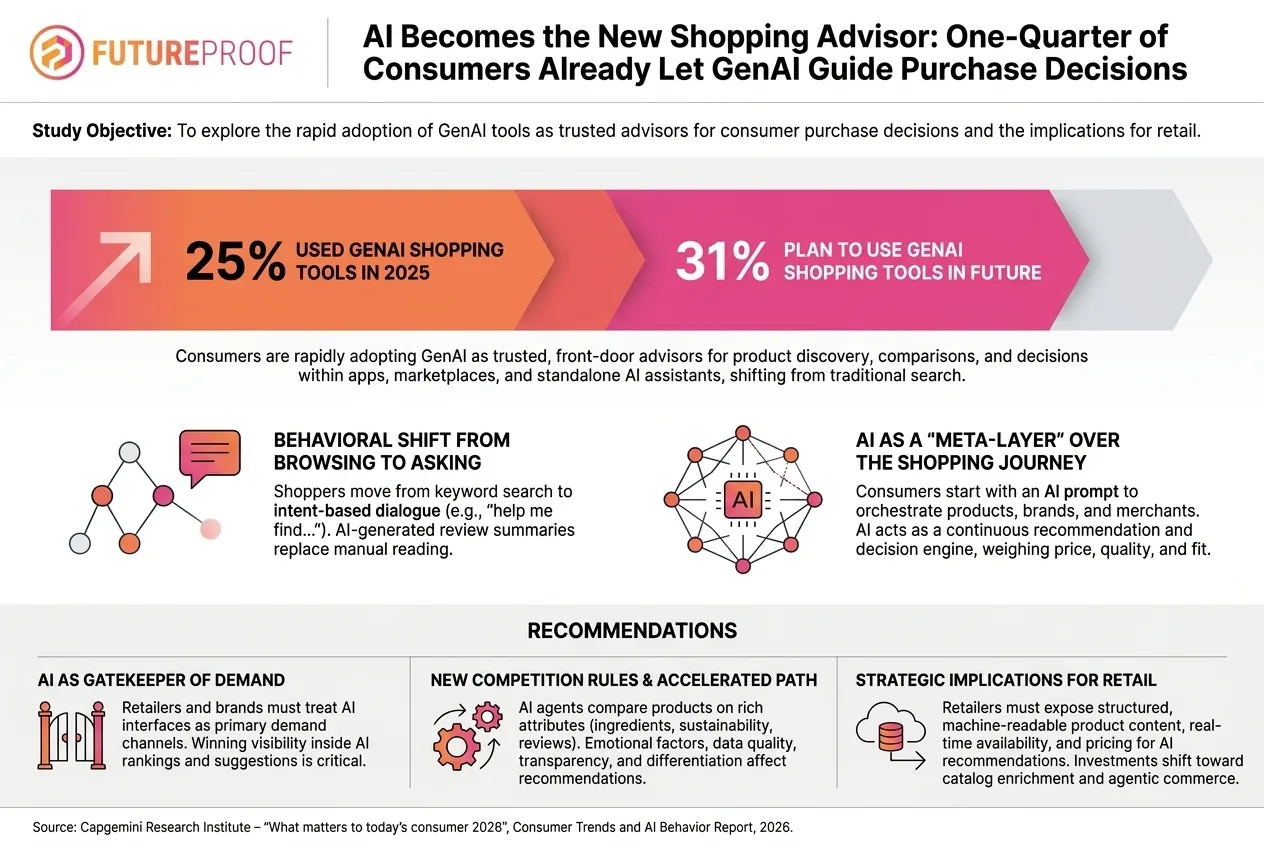
The landscape of consumer commerce is undergoing a seismic transformation, fundamentally altering how individuals discover, evaluate, and acquire products. Gone are the days when the shopping journey invariably began with a direct visit to a retailer's website or a generic query typed into a traditional search engine. A new era has dawned, one where Artificial Intelligence, specifically Generative AI, has ascended to the role of the primary shopping advisor, acting as the indispensable front door to the vast marketplace. This shift, from passive browsing to proactive asking, from broad search to precise GenAI guidance, is not a distant prediction but a current reality, underscored by compelling new data.
According to the Capgemini Research Institute's "What matters to today’s consumer 2026" report, a significant 25 percent of consumers have already embraced generative AI shopping tools as early as 2025. This figure is poised for rapid escalation, with an additional 31 percent expressing clear intentions to adopt these innovative tools in the near future. This cumulative indication points towards an undeniable trend: over half of all consumers will soon be leveraging AI to navigate their purchasing decisions. Such widespread and rapid adoption signals a profound recalibration of consumer behavior, demanding an urgent re-evaluation of strategies for every retailer and brand aiming to remain relevant and competitive.
The implications are far-reaching. The initial touchpoint of the shopping journey is increasingly an AI prompt, rather than a web address or search bar. Consumers are no longer content with sifting through endless product listings or generic search results. Instead, they are turning to AI assistants to articulate complex needs, seek tailored recommendations, and streamline the entire purchasing process. These sophisticated GenAI tools do more than just present options; they actively plan, meticulously compare myriad products across various parameters, intelligently filter irrelevant choices, and even possess the capability to auto-fill shopping carts with precision. Imagine asking an AI for "a sustainable, hypoallergenic dog food for a picky, small-breed puppy with sensitive digestion, priced under $40, available for same-day delivery," and instantly receiving not just a list, but a curated recommendation, complete with an explanation of why it’s the best fit and an option to add it directly to your cart. This is the promise and power of GenAI guidance.
The true marvel of these AI shopping advisors lies in their unparalleled ability to distill vast quantities of information into actionable insights. They can summarize thousands of customer reviews within seconds, sifting through subjective opinions to identify common themes, recurring issues, and standout features. They weigh intricate factors like price and quality, often drawing upon external data points and historical purchasing patterns to provide an objective assessment. Furthermore, their capacity for personalization is unprecedented. By understanding a consumer's past preferences, stated needs, and implicit behaviors, these AI gatekeepers can recommend the absolute best-fit product or merchant, optimizing for factors ranging from value and sustainability to brand loyalty and delivery speed. This hyper-personalization, delivered with lightning speed, creates an incredibly efficient and satisfying shopping experience, fundamentally raising consumer expectations for all future interactions.
As AI firmly establishes itself as the gatekeeper of demand, controlling the flow of potential customers to products and services, retailers and brands face a critical paradigm shift in how they conceptualize visibility. The traditional pillars of retail success—prime shelf space in brick-and-mortar stores and high search engine rankings in the digital realm—are now being augmented, if not outright superseded, by the imperative of AI visibility. Just as a product once needed to catch a shopper's eye on a physical shelf or appear on the first page of Google, it now must be discoverable and recommendable by an AI assistant. This new form of visibility is not merely about being found, but about being chosen by the AI as the optimal solution for a consumer's query.
Achieving this crucial AI visibility hinges on several foundational elements, demanding a strategic overhaul of how product information is managed and presented. Firstly, strong product data is no longer a mere operational necessity but a competitive differentiator. AI thrives on structured, accurate, and comprehensive data. This means going far beyond basic product descriptions and SKUs. It encompasses detailed specifications, high-resolution imagery and video, material sourcing information, sustainability credentials, ethical manufacturing practices, user manuals, warranty details, and an exhaustive list of attributes and features. The richer and more granular this data, the better an AI can understand, categorize, and recommend a product with confidence and precision. Incomplete or ambiguous data acts as a barrier, effectively rendering a product invisible to the AI.
Secondly, clear differentiation becomes paramount. In a world where AI can compare hundreds of similar products instantly, a brand's unique selling propositions must be articulated with absolute clarity. What makes your product stand out? Is it superior quality, innovative design, a unique feature, an exceptional brand story, a specific ethical stance, or unparalleled customer service? This differentiation must be embedded within the product data in a way that AI can easily parse and present to the consumer. Generic products with indistinguishable attributes will struggle to surface, as AI prioritizes those that genuinely meet a specific, nuanced need or offer a distinct advantage. Brands must invest in defining and digitally encoding their unique value proposition.
Thirdly, transparent attributes are increasingly critical. Modern consumers, empowered by AI, demand to know more about what they buy. They want to understand the origins of materials, the environmental impact of production, the social responsibility of the brand, and the certifications a product holds. AI tools are equipped to surface these details, and consumers are likely to prompt for them. For instance, a query like "find me ethically sourced coffee beans from a fair-trade certified brand" requires an AI to access and verify specific, transparent attributes within product data. Without this transparency, an item might be overlooked, even if it objectively meets the core product requirements. This also extends to detailed ingredient lists, allergen information, repairability scores, and end-of-life recycling guidance, all of which enhance an AI's ability to match consumer values with product offerings.
The strategic implications for businesses extend beyond merely optimizing product data. The shift towards GenAI guidance compresses the consumer's intent to purchase into a remarkably few, highly efficient steps. This acceleration of the buying journey means that the window of opportunity to influence a consumer's decision is smaller than ever. Consequently, investing in three interconnected capabilities is rapidly evolving from a strategic advantage to a fundamental competitive requirement: structured product content, AI-powered search and guidance, and agentic commerce capabilities.
Structured product content forms the bedrock of success in this AI-driven commerce landscape. It’s about creating a robust, semantic, and easily digestible data architecture for every product. This involves adopting industry standards for product information management (PIM), leveraging rich metadata, implementing schema markups (like Schema.org JSON-LD) to clearly define product attributes for AI and search engines, and enriching content with diverse media types – 360-degree views, augmented reality experiences, detailed spec sheets, comprehensive FAQs, and engaging narrative descriptions that articulate benefits over features. This content must be centrally managed, consistently updated, and readily accessible to various AI systems, both proprietary and third-party. The goal is to ensure that when an AI ingests information about a product, it receives a complete, unambiguous, and compelling picture.
Secondly, the integration and enhancement of AI-powered search and guidance within a brand’s own digital ecosystem becomes crucial. While external GenAI tools will guide consumers to initial recommendations, the on-site experience must continue this advanced, personalized journey. This means deploying sophisticated internal search engines that go beyond keyword matching, understanding natural language queries, discerning user intent, and offering proactive, AI-driven recommendations based on browsing history, past purchases, and expressed preferences. Retailers need to build their own intelligent assistants, chatbots, and recommendation engines that can seamlessly integrate with the insights provided by external GenAI advisors, ensuring a consistent and elevated experience once the customer lands on their platform. This creates a powerful feedback loop, allowing the brand to further personalize and enhance future AI interactions.
Finally, the development of agentic commerce capabilities represents the apex of this evolution. Agentic commerce refers to AI systems that can not only provide recommendations but also execute tasks on behalf of the consumer. This moves beyond merely suggesting a product to facilitating its purchase, managing subscriptions, arranging services, and even handling post-purchase inquiries and returns with minimal human intervention. Imagine an AI advisor not only recommending the best smart thermostat but also scheduling its installation with a trusted local technician, processing the payment, and sending maintenance reminders – all initiated by a single prompt from the consumer. For retailers, this means integrating robust APIs, secure payment gateways, inventory management systems, and customer service platforms that allow AI agents to act autonomously and efficiently. Building trust in these agentic capabilities is paramount, as consumers will increasingly rely on AI to manage their entire purchasing lifecycle, from discovery to ownership.
The imperative to invest in these areas is not a choice but a necessity for competitive survival. Brands and retailers who fail to adapt will find themselves increasingly marginalized, their products rendered invisible by the very technology designed to connect consumers with optimal solutions. The AI-driven marketplace favors agility, data-centricity, and a deep understanding of evolving consumer expectations. It requires a shift from a product-out approach to a customer-in perspective, where every piece of information and every interaction is designed to facilitate a personalized, efficient, and intelligent shopping journey.
Looking ahead, the evolution of AI as a shopping advisor will only accelerate. We can anticipate even more sophisticated multimodal interactions, combining voice, image, and text to understand and fulfill complex desires. The integration of augmented reality and virtual reality will allow consumers to "try on" clothes, visualize furniture in their homes, or test drive cars virtually, all guided by AI. The lines between online and offline shopping will blur further, with AI advising on in-store navigation, product availability, and personalized promotions delivered directly to a smartphone as a customer walks through a physical store.
Ultimately, the future of commerce is one where the customer relationship is increasingly mediated, enabled, and enhanced by AI. This isn't just about technology; it's about fundamentally reshaping how trust is built, value is communicated, and transactions are completed. For businesses, the challenge and opportunity lie in embracing this paradigm shift, meticulously structuring their data, investing in intelligent guidance systems, and empowering AI to act on behalf of the discerning, digitally-native consumer. Those who master AI visibility and agentic commerce will not only survive but thrive, leading the charge in the exciting new frontier of personalized, intelligent shopping. The time to adapt is now, as the AI gatekeeper of demand has already opened its doors.