AI Shoppers Want Guidance Not Control How Brands Can Win the New Discovery Era
The digital commerce landscape is undergoing a profound transformation, subtly yet significantly reshaping how consumers discover and choose products. At the heart of this evolution is artificial intelligence, which is rapidly moving from a futuristic concept to an indispensable tool in the shopper's arsenal. Today, shoppers are increasingly comfortable delegating the laborious task of product discovery and shortlisting to AI agents, leveraging their unparalleled ability to sift through vast inventories and present tailored options. This intelligent assistance streamlines what was once an overwhelming process, freeing consumers from endless scrolling and decision fatigue. However, this embrace of AI is not absolute; a critical nuance emerges when the moment of truth – the transaction – arrives. Consumers, it turns out, still crave ultimate control and a direct connection to the brand when it comes to finalizing their purchases.
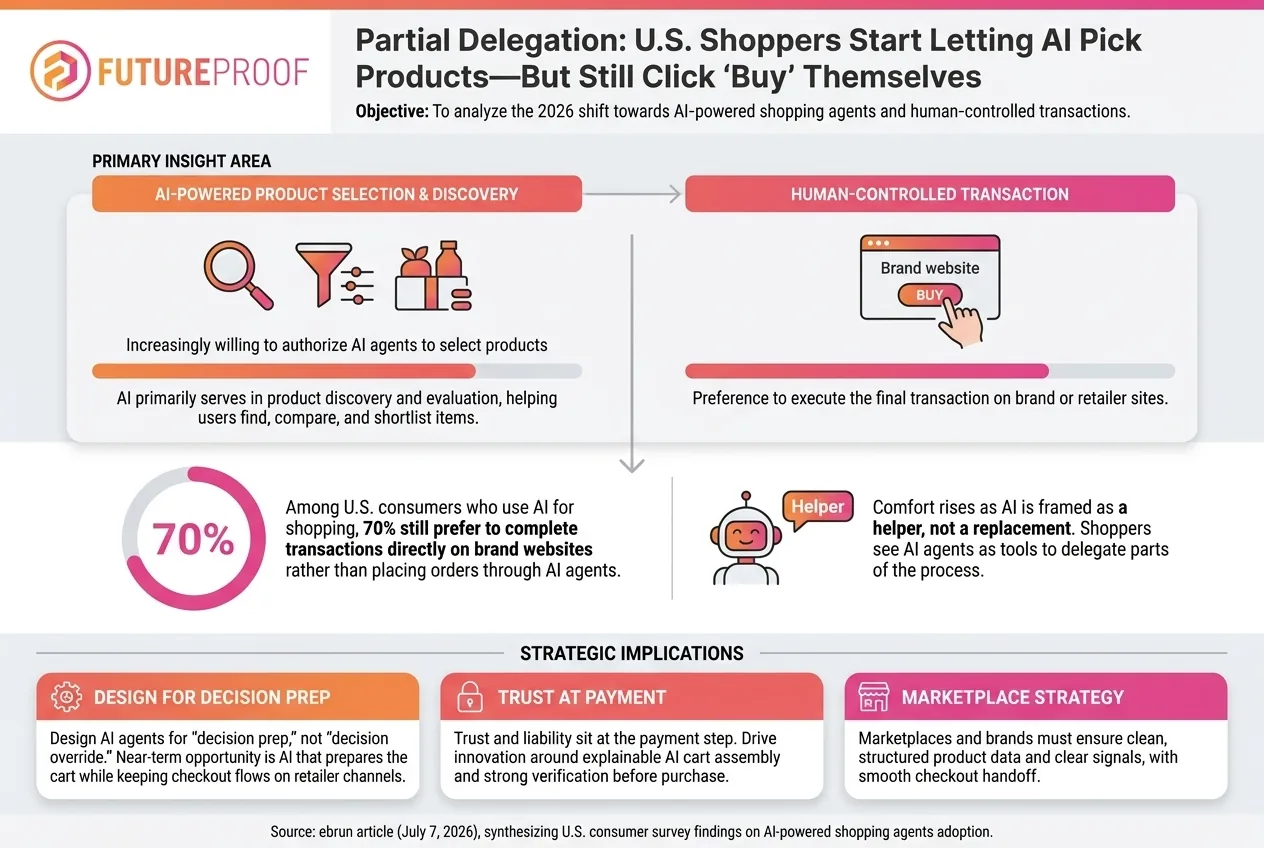
A groundbreaking report from ebrun on July 7, 2026, unequivocally highlights this fascinating dichotomy. The study reveals that while consumers are growing increasingly accustomed to AI agents assembling meticulously curated options for them, a substantial 70 percent of AI shopping users express a strong preference for completing their transactions directly on brand websites rather than through the AI itself. This statistic is more than just a data point; it's a powerful signal, a clear near-term directive for retailers and brands navigating the intricate pathways of modern digital commerce. It suggests that the future of retail AI isn't about replacing human decision-making entirely, but rather about preparing and enriching those decisions, ultimately empowering the shopper with efficiency and personalized insights, while preserving the critical human element of trust and control at the point of sale.
The appeal of AI in the early stages of the shopping journey is multifaceted and undeniable. Consumers are bombarded with choices daily, making the initial search for a specific product or even inspiration a time-consuming and often frustrating endeavor. AI agents excel here, leveraging sophisticated algorithms, natural language processing, and machine learning to understand nuanced preferences, interpret complex queries, and anticipate needs. They can analyze browsing history, past purchases, stated preferences, and even emotional cues to present highly relevant product selections. Imagine asking an AI for "sustainable running shoes for urban trails with good ankle support in a men's size 10" and instantly receiving a curated list of top recommendations, complete with detailed specifications, user reviews, and comparative analyses. This level of personalized efficiency is revolutionizing the pre-purchase phase, turning a daunting task into an intuitive, almost conversational experience. From intelligent chatbots guiding users through style choices to sophisticated recommendation engines surfacing bespoke product bundles, AI is proving to be an invaluable co-pilot in the discovery phase, significantly reducing cognitive load and enhancing the overall search experience.
Yet, as the journey progresses from exploration to commitment, the consumer's relationship with AI subtly shifts. The Ebrun report's finding – that 70% of AI shopping users prefer completing transactions on brand sites – underscores a fundamental human need for agency and assurance, particularly when money changes hands. This preference isn't a rejection of AI's utility but rather a delineation of its most effective role. Why do shoppers, who readily trust AI to find their ideal product, suddenly retract that trust at checkout? Several factors contribute to this phenomenon. Primarily, trust and security are paramount. Consumers have cultivated a deep-seated habit of transacting directly with brands they recognize and trust, especially when it involves sensitive payment information. Sharing credit card details or personal data with a third-party AI agent, even a highly sophisticated one, introduces a layer of perceived risk or unfamiliarity that many are unwilling to accept. The established security protocols, privacy policies, and customer service guarantees of a known brand website provide a sense of safety and accountability that an AI interface might not yet fully replicate.
Beyond security, the brand experience itself plays a crucial role. Completing a purchase on a brand's native site is often an integral part of the overall brand experience. It allows shoppers to engage with the brand's unique aesthetics, reinforce their loyalty through specific account benefits, apply exclusive discounts, manage shipping preferences with greater flexibility, and easily access customer support should any issues arise. This direct interaction fosters a sense of connection and ownership over the purchase process. For many, the act of completing a transaction is a definitive moment, a tangible commitment that they wish to enact directly with the vendor, rather than through an intermediary. It’s about more than just clicking "buy"; it's about confirming details, reviewing terms, and having full visibility into the order from start to finish, all within a familiar and controlled environment. This human desire for ultimate control and direct engagement with the brand's ecosystem at the final, most critical stage of the buyer's journey is a powerful psychological anchor that retailers must acknowledge and respect.
The Ebrun report’s insight into the 70% preference for brand site checkout is not a signal to curb AI investment, but rather to refine its application. It unequivocally states that the clear near-term path for retailers and brands is to "Build AI that prepares decisions, not replaces them." This distinction is vital. It frames AI as an intelligent assistant, a highly capable concierge guiding shoppers toward optimal choices, but not as the ultimate arbiter of the purchase itself. This model leverages AI's strengths in data processing, personalization, and efficiency, while respecting the consumer's inherent desire for control, security, and direct brand interaction at the critical conversion point. For retailers, this means focusing on three strategic pillars: structured product data, transparent recommendations, and seamless handoff to native checkout.
The first pillar, structured product data, forms the bedrock of any successful AI-driven commerce strategy. AI agents are only as good as the data they consume. If a brand's product information is fragmented, inconsistent, incomplete, or poorly organized, the AI's ability to accurately understand, recommend, and differentiate those products will be severely hampered. Imagine a sophisticated chef trying to create a gourmet meal with mismatched ingredients and incomplete recipes – the outcome will be disappointing. For AI, comprehensive, clean, and granular product data is its nutritional input. This includes detailed specifications, high-quality images and videos, exhaustive attribute lists (e.g., color, size, material, usage, sustainability metrics), accurate inventory levels, competitive pricing, and authentic customer reviews. Metadata, tags, and semantic enrichment are crucial for allowing AI agents to "read between the lines" and connect products with user intent in highly sophisticated ways. Brands must invest in robust Product Information Management (PIM) systems and master data management (MDM) strategies to ensure that their entire product catalog is AI-ready. This not only fuels intelligent recommendations but also enhances product discoverability across various AI ecosystems, making it easier for agents to identify and present a brand's offerings as ideal solutions for shopper needs. A brand with meticulously structured data is inherently more "selectable" by AI.
The second pillar revolves around transparent recommendations. As AI's influence grows, so does the consumer's need to understand why certain recommendations are being made. The "black box" phenomenon, where AI algorithms operate opaquely, can erode trust. To counter this, brands must implement AI recommendation engines that offer a degree of explainability. This means clearly communicating the rationale behind a suggestion: "Based on your recent browsing of outdoor gear," "Similar to items liked by customers with your profile," or "Frequently bought together with products in your cart." Such transparency demystifies the AI process, builds trust, and allows consumers to feel more in control. It empowers them to accept or reject recommendations with a clearer understanding, reinforcing the idea that AI is a helpful guide, not an authoritarian director. Furthermore, offering users the ability to provide feedback on recommendations ("Not interested in this type of product") or adjust their preference settings directly contributes to this transparency and cultivates a more personalized and trustworthy AI shopping experience. Ethical AI considerations, including bias detection and mitigation, are also integral to maintaining consumer trust in the long term.
Finally, the third and arguably most critical pillar for conversion is a seamless handoff to native checkout. This is where the AI-assisted journey gracefully transitions back to the brand's direct domain, ensuring that the efficiency gained in discovery isn't lost at the point of purchase. A seamless handoff means eliminating friction and maintaining context. When an AI agent has helped a shopper curate a selection, that information must transfer effortlessly to the brand's website. This could involve pre-populating a shopping cart on the brand's site with the AI-recommended items, deep-linking directly to specific product pages with selected variants, or even initiating the checkout process with relevant details already filled in. The goal is to make the transition so smooth that the user perceives it as a continuous journey, not a jarring jump. Any requirement for the user to re-enter information or re-select items that the AI already processed creates frustration and significantly increases cart abandonment rates. Maintaining consistent branding and user experience across the AI interface and the brand's website further reinforces trust and continuity. The technical integration required for such a handoff is complex but essential, bridging the gap between external AI platforms and internal e-commerce systems to deliver a cohesive, user-centric purchase path.
Ultimately, the brands that will dominate this evolving landscape are those "whose products are consistently selected by AI agents long before a human clicks buy." This is the pinnacle of AI-driven retail success. It signifies that a brand has optimized its entire digital presence and product offering to be highly desirable and discoverable by intelligent algorithms. How does a brand achieve this coveted status? It's a combination of all the strategic elements discussed: impeccable, highly structured product data that AI can easily parse and understand; a strong brand reputation and positive customer reviews that signal quality and reliability to AI's sentiment analysis capabilities; competitive pricing and value propositions that make products attractive to comparison-shopping AI agents; and robust inventory management that ensures recommended products are actually available. Being "AI-optimized" means designing products, content, and digital infrastructure with the understanding that an AI agent might be the first "customer" to evaluate them, filtering them for human consideration. This strategic foresight allows brands to gain a significant competitive edge, achieving unparalleled visibility and preferential selection within the vast and growing ecosystem of AI-powered product discovery.
The challenges for retailers are numerous, ranging from the initial investment in AI technologies and data infrastructure to integrating complex systems and managing ever-evolving consumer expectations. Legacy systems can hinder rapid adoption, and the ethical implications of AI, such as data privacy and algorithmic bias, require careful consideration. However, the opportunities far outweigh these challenges. Brands that successfully implement AI that prepares decisions, rather than replaces them, stand to gain tremendously. They will unlock enhanced personalization at scale, leading to increased conversion rates and higher average order values. Customer loyalty will deepen as shoppers experience unprecedented levels of convenience and relevance. Moreover, AI provides invaluable insights into consumer behavior, allowing brands to continuously refine their strategies, optimize product offerings, and improve the overall customer journey. This leads to a powerful competitive differentiation, positioning forward-thinking brands as leaders in a digitally transformed retail world.
Looking ahead, the partnership between humans and AI in shopping will only deepen and evolve. We can anticipate even more sophisticated predictive AI that anticipates needs before they are articulated, proactive recommendations that suggest purchases based on lifestyle patterns, and hyper-personalization that makes every shopping interaction feel uniquely crafted for the individual. The critical balance, however, will always lie in leveraging AI's incredible power to enhance efficiency and insight, while rigorously safeguarding human agency and the fundamental desire for control and trust, especially at the moment of commitment. The ebrun report of July 7, 2026, serves as a pivotal compass, guiding retailers not to fear the rise of AI, but to strategically embrace it as a powerful enabler – an intelligent assistant that empowers, educates, and facilitates, ultimately ensuring that the brand remains at the heart of the transaction. For brands, the imperative is clear: optimize for AI selection, build trust through transparency, and create a frictionless path to direct checkout. The future of shopping isn't merely AI-powered; it's intelligently human-centric.