AI Search Supremacy Is Rewriting the Future of Digital Discovery
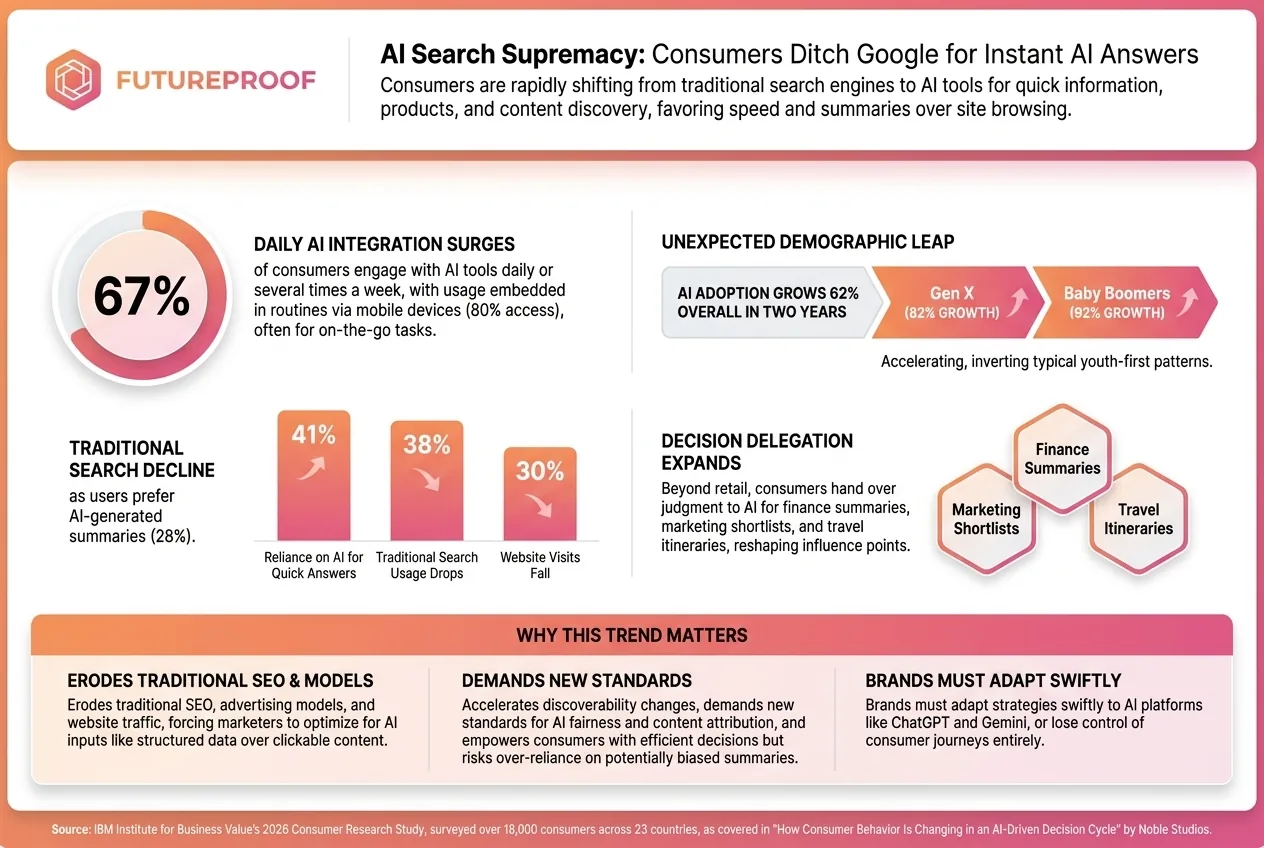
The digital information landscape is experiencing a tectonic shift, a fundamental reordering that demands immediate attention from every brand, marketer, and content creator. We are no longer merely witnessing the rise of artificial intelligence; we are living through the dawn of AI Search Supremacy. Consumers are abandoning the familiar pathways of traditional search engines, gravitating instead towards the immediacy and synthesized clarity offered by AI tools. This isn't just a minor optimization tweak; it's a wholesale revolution in how information, products, and content are discovered, with speed and summaries decisively outranking the more laborious process of traditional browsing. The implications for digital strategy are profound, reshaping everything from SEO and advertising models to fundamental website traffic metrics.
At the heart of this seismic change is a clear consumer imperative: the desire for instant answers. In an increasingly fast-paced world, the cognitive load of sifting through pages of search results, clicking through multiple websites, and synthesizing disparate pieces of information is becoming an unnecessary burden. AI tools, powered by advanced algorithms and vast data sets, can now perform this aggregation and summarization instantaneously, delivering concise, actionable intelligence directly to the user. This shift is not merely about convenience; it speaks to a deeper evolution in user expectation, where the value proposition has moved from providing access to information to delivering intelligence about that information. AI isn't just fetching links; it's providing context, comparisons, and conclusions, often before a user even contemplates visiting a brand's website.
This evolution is underscored by a remarkable and accelerating trend: rising daily AI use across demographics. What began as a niche interest for tech enthusiasts has rapidly permeated mainstream daily routines. From crafting emails and generating creative content to solving complex problems and managing personal schedules, AI applications are becoming indispensable digital companions. This omnipresence naturally extends to information seeking, where the same AI tools that assist with productivity are now being leveraged for discovery. Consumers are seamlessly integrating AI into their information-gathering processes because it offers a direct, efficient conduit to knowledge. The more they use AI for other tasks, the more natural it becomes to turn to it for answers, reinforcing a feedback loop that solidifies its supremacy in the search paradigm.
Perhaps one of the most surprising, and strategically significant, aspects of this transition is the broad and enthusiastic adoption surging among older generations. While younger demographics are often seen as early adopters of new technologies, AI's utility is proving universally appealing. New research from the IBM Institute for Business Value 2026 Consumer Research Study, highlighted by Noble Studios, reveals staggering growth figures: AI application use has grown a remarkable 62 percent in just two years. More strikingly, this growth includes an 82 percent surge among Gen X and an even more impressive 92 percent increase among Baby Boomers. This data point alone rewrites the playbook for digital marketers. The assumption that AI tools would primarily cater to or be adopted by Gen Z and millennials is fundamentally flawed. Instead, it indicates that the benefits of instant answers, streamlined information, and decision support resonate deeply across all age groups, challenging brands to rethink their target audience engagement strategies for AI-powered discovery. The ease of use, the directness of interaction through natural language processing, and the tangible time-saving benefits offered by AI are proving irresistible to segments previously thought to be more resistant to rapid technological shifts. This widespread embrace means that optimizing for AI search is not a niche strategy but a universal imperative for reaching virtually any consumer segment.
Beyond simple information retrieval, consumers are increasingly delegating critical decisions to AI. This represents a profound shift in trust and influence. Where once individuals would painstakingly research and compare options, they are now entrusting AI with the initial heavy lifting, often relying on its synthesized recommendations. Consider financial planning: instead of spending hours analyzing market trends and company reports, an AI tool can summarize key insights, compare investment options based on personal risk profiles, and even project future outcomes. Similarly, travel planning is being transformed. AI can sift through millions of flight and hotel options, cross-reference reviews, suggest itineraries based on preferences, and even flag potential disruptions, presenting a curated, optimized plan. Product discovery is another prime example; AI can analyze detailed specifications, user reviews, and even personal preferences to recommend the most suitable product, bypassing the traditional browsing experience entirely. This delegation signifies that AI is moving from being a mere tool to an indispensable advisor, shaping preferences and guiding choices before traditional marketing touchpoints even enter the picture. For brands, this means the battle for influence is now fought upstream, at the point of AI ingestion and interpretation, long before a consumer might visit a brand's official website.
This profound transformation in consumer behavior is already having a disruptive effect across the entire digital ecosystem, particularly on established models of SEO, advertising, and website traffic. Traditional SEO, which has long focused on ranking high in organic search results to drive clicks, faces an existential challenge. If AI tools can extract and summarize the answer directly, obviating the need for a click, then the fundamental goal of SEO – generating website traffic – is undermined. The "first click" might no longer be to a website but rather the initial interaction with an AI summary or direct answer. This necessitates a radical re-evaluation of keyword strategy, content structure, and technical SEO elements. Ranking for traditional keywords remains important for AI to find your content, but optimizing for AI summarization becomes paramount for visibility.
Advertising models are also on the precipice of disruption. The current ecosystem heavily relies on display ads, search ads, and programmatic advertising delivered alongside or within search results and website content. If AI provides direct answers, where do ads fit in? The future of advertising might lie in native integrations within AI-generated responses, subtle endorsements, or sponsored data points that influence AI’s summarization or recommendations. Brand awareness might increasingly be built through presence within AI knowledge bases and through the quality of information provided, rather than traditional ad placements. Website traffic, the lifeblood of many online businesses, is also under threat. If users receive satisfactory answers from AI without ever needing to navigate to a specific domain, direct traffic, referral traffic, and organic search traffic could see significant declines. This forces brands to reconsider the very purpose of their websites and what value proposition they offer beyond just information delivery. Perhaps websites will evolve into hubs for deep engagement, transactional services, or community building, while AI handles the initial discovery phase.
To survive and thrive in this new discovery landscape, brands must embark on a proactive strategy of optimization for AI inputs. This is no longer optional; it is the bedrock of future digital visibility. The most critical element here is structured data. Structured data, implemented through schema markup (like Schema.org), provides context to content in a machine-readable format. It's how you tell AI, "This is a product, this is its price, these are its reviews," or "This is a recipe, these are the ingredients, this is the cooking time." Without structured data, your content is essentially invisible or, at best, a guessing game for AI. Brands need to audit their entire digital presence, ensuring that every piece of relevant information – from contact details and service offerings to product specifications and event schedules – is accurately marked up. This helps AI understand, categorize, and extract information precisely, making it far more likely to feature your data in its summaries or recommendations. It’s about speaking AI’s language fluently.
Beyond technical structured data, optimizing content for AI summarization is equally vital. This means crafting content not just for human readers but with an explicit awareness of how AI will parse, interpret, and condense it. Content needs to be:
- Clear and Concise: Avoid jargon and overly complex sentence structures. Get to the point quickly.
- Fact-Driven: AI values accuracy. Back up claims with verifiable data and sources.
- Well-Organized: Use clear headings, subheadings, bullet points, and numbered lists. These act as signposts for AI, helping it identify key information and relationships.
- Answer-Oriented: Directly address common questions and provide definitive answers within the content. Consider incorporating "TL;DR" (Too Long; Didn't Read) summaries at the top of longer articles.
- Contextually Rich: While concise, ensure enough context is provided for AI to fully understand the nuance and implications of the information.
- Optimized for Natural Language Queries: Think about how a person would ask a question conversationally to an AI, and structure your content to answer those specific queries directly.
The aim is to make your content the most accessible, digestible, and authoritative source for an AI, increasing the probability that your brand's insights will be featured prominently in an AI-generated answer. It's about earning the "AI snippet" or the "AI recommendation," which could become the new equivalent of the coveted position zero in traditional search. This also means cultivating AI-friendly authority. While backlinks still play a role, AI's understanding of authority will likely expand to encompass factors like factual consistency across the web, brand mentions in highly trusted sources, and the clarity and conciseness of your content.
The future landscape of information discovery is unequivocally AI-driven. This shift is not a distant threat but a present reality, with consumers of all generations already embracing AI as their primary conduit to answers and decisions. Brands that fail to acknowledge this AI Search Supremacy and adapt their digital strategies risk becoming invisible in a world where browsing is increasingly replaced by instant summarization. The imperative is clear: optimize for AI inputs, structure your data meticulously, and craft content engineered for seamless summarization. Embrace AI not as a competitor to traditional marketing, but as a new partner in the journey of influence and discovery. Those who innovate now will not just survive, but truly thrive, positioning themselves at the forefront of the AI-powered digital age.