AI Is Now the New Pre Visit Habit Transforming How Consumers Prepare and Decide
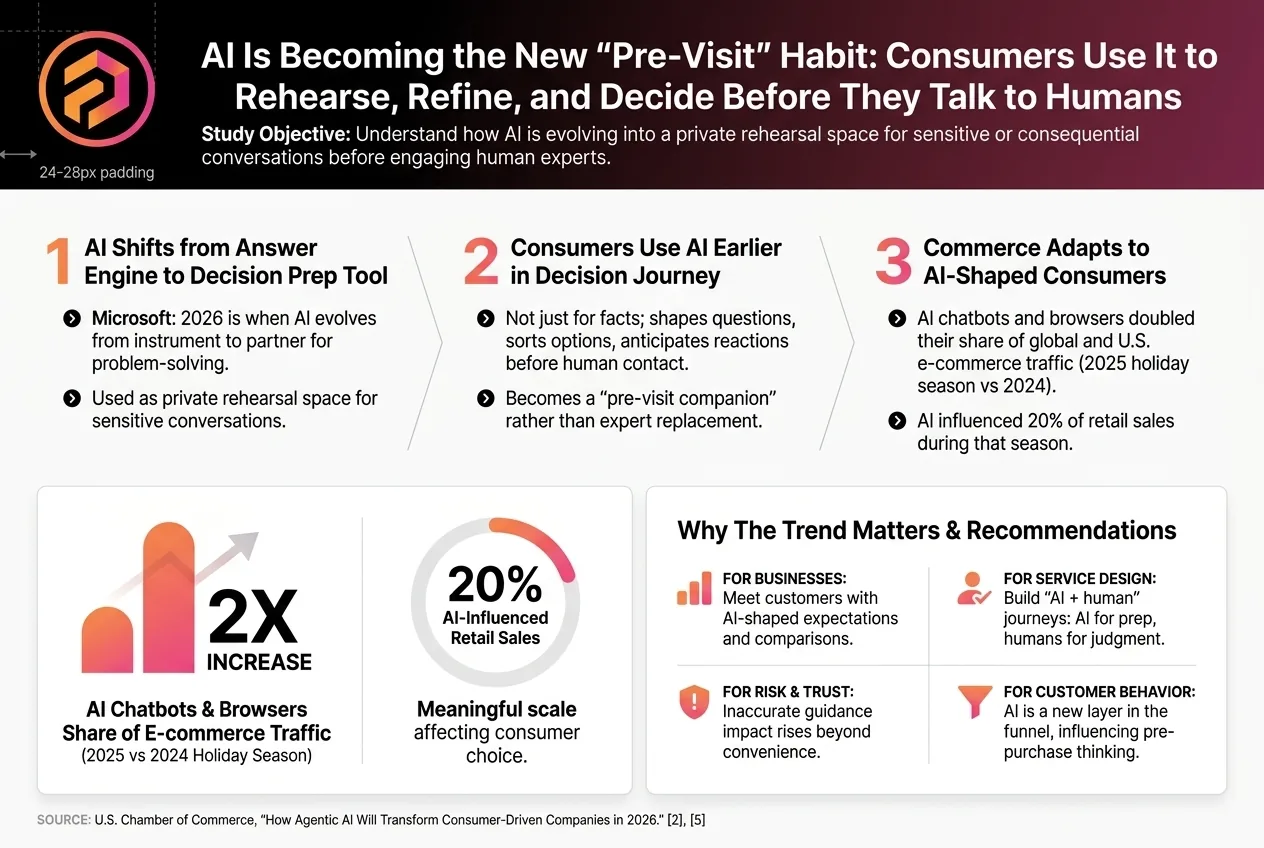
The landscape of consumer behavior is undergoing a seismic shift, powered by the ubiquitous integration of artificial intelligence into daily life. What was once a futuristic concept is now a present-day reality, as AI transitions from a mere instrument to an indispensable partner in the human decision-making process. No longer confined to sophisticated data analysis or background automation, AI is now actively shaping intentions, refining choices, and clarifying desires long before individuals engage with human professionals across a myriad of industries. This profound transformation establishes AI as the new pre-visit habit, fundamentally altering the initial stages of the customer journey and setting a precedent for how businesses must adapt to meet a more informed and AI-influenced clientele.
Microsoft’s insightful prediction for 2026 posits that this is the year AI truly shifts from an instrument to a partner. This isn't just a semantic change; it signifies a fundamental alteration in the user-AI dynamic. Users are increasingly collaborating with AI, leveraging its capabilities to problem-solve complex dilemmas, pressure-test choices under various simulated conditions, and navigate sensitive situations with a newfound sense of preparedness. This collaborative partnership explains the burgeoning trend of consumers treating AI as a private rehearsal space—a confidential arena where they can explore thoughts, rehearse conversations, and refine their understanding without the immediate pressure or judgment associated with human interaction. The implications are vast, touching every sector from healthcare to finance, retail to human resources, as individuals harness AI to gain clarity and confidence before stepping into critical real-world engagements.
The Emergence of AI as a Private Rehearsal Space
The concept of a "private rehearsal space" is perhaps one of the most compelling and rapidly evolving aspects of AI's integration into consumer habits. Imagine preparing for a difficult conversation with a manager, practicing your pitch for an investment, or articulating complex symptoms to a doctor. Traditionally, these preparations might involve internal monologue, discussions with trusted friends or family, or extensive personal research. Today, AI offers a new, uniquely powerful alternative. Consumers are actively turning to AI models to simulate these interactions, not just to gather information, but to refine their approach, anticipate counter-arguments, and articulate their needs with precision.
This phenomenon stems from several factors. Firstly, AI provides a judgment-free zone. Unlike human confidantes, AI does not offer personal opinions, emotional reactions, or preconceived biases. This allows users to explore sensitive topics, voice insecurities, or propose unconventional ideas without fear of embarrassment or negative social repercussions. This psychological safety fosters a level of candor and experimentation that might not be possible in human interactions, particularly when the stakes are high.
Secondly, AI offers unparalleled access and convenience. It is available 24/7, responds instantaneously, and can process vast amounts of information to generate tailored feedback. A user can rehearse a negotiation strategy at 3 AM, refine a personal statement during a lunch break, or clarify a medical query from the comfort of their home. This constant availability democratizes access to sophisticated preparatory tools, empowering individuals regardless of their social network or professional access.
Thirdly, AI's analytical capabilities allow users to "pressure test" choices. By presenting different scenarios or potential outcomes, AI can help users foresee challenges, identify weaknesses in their arguments, or explore alternative pathways. For instance, before making a significant financial investment, an individual might use AI to analyze various market conditions, project potential returns under different economic scenarios, and even simulate conversations with a financial advisor to understand likely questions and responses. This deep-dive simulation enhances decision quality and builds confidence, ensuring that when the individual finally engages with a human expert, they are not only well-informed but also resilient in their convictions. The Microsoft prediction of AI as a "partner" underscores this shift, highlighting a collaboration where AI actively assists in navigating complex problems and validating choices, moving beyond mere data provision to true collaborative thought.
AI's Early Influence in the Decision Journey: Beyond Factual Queries
The impact of AI is emerging much earlier in the decision journey than many businesses currently recognize. Traditionally, consumers might turn to search engines for factual queries or comparisons, then move on to human experts for deeper insights or personalized advice. However, AI is now inserting itself into the very nascent stages of thought and inquiry, fundamentally reshaping how individuals conceptualize and approach their needs.
People are no longer just asking AI for facts; they are actively using it to shape their questions, sort through a multitude of options, and even anticipate reactions before engaging a human expert. This represents a significant evolution from passive information consumption to active, iterative co-creation of understanding.
Consider the process of buying a new car. Instead of merely asking "What are the best SUVs of 2024?", a consumer might use AI to:
- Shape the question: "Given my family size, budget constraints, and preference for electric vehicles, what are three car models I should consider, and what are their pros and cons for long-distance travel and city commuting?"
- Sort options: "Now, compare Model X and Model Y specifically on their resale value, common maintenance issues, and how they perform in cold weather. Are there any known recalls for either?"
- Anticipate reactions: "If I tell a salesperson I'm looking for maximum fuel efficiency but also advanced safety features, how might they try to steer me towards a more expensive model, and what counter-arguments could I prepare?"
This sophisticated level of pre-engagement means that by the time a consumer walks into a dealership, clinic, or consulting office, their thinking has already been significantly shaped, refined, and even challenged by an AI loop. They arrive not as blank slates, but as individuals with AI-shaped expectations, often possessing a surprisingly deep understanding of their problem, potential solutions, and even the dynamics of the impending human interaction. AI, in this context, has become a pre-visit companion, acting as a cognitive sparring partner that hones the consumer's understanding and intent. Crucially, it serves as an augmentation, not a replacement for human expertise, enhancing the quality of the subsequent human interaction rather than obviating it.
The Commercial Imperative: AI's Footprint in E-commerce
The commercial world is already feeling the profound ripple effects of this shift. The provided data point from the US Chamber of Commerce is stark: AI chatbots and browsers doubled their share of global and US ecommerce traffic during the 2025 holiday season compared with 2024. Furthermore, AI influenced a staggering 20 percent of retail sales during that pivotal period. These figures are not mere statistics; they represent a fundamental restructuring of the digital sales funnel and consumer engagement pathways.
What does this surge in AI-influenced commerce signify? It means that a significant portion of consumers are now initiating and navigating their buying decisions through AI interfaces. These interfaces could range from sophisticated chatbots on e-commerce sites to AI-powered search engines that dynamically curate product recommendations based on conversational queries, or even virtual shopping assistants that guide users through selection processes. This shift transforms the traditional linear journey of browsing, comparing, and purchasing.
Consumers are increasingly showing up at the point of sale, whether digital or physical, with AI-shaped expectations. These expectations are multifaceted:
- Personalized Recommendations: Having interacted with AI that understands their preferences, budget, and past behavior, consumers expect human interactions or subsequent digital touchpoints to offer similarly tailored solutions, rather than generic product lists.
- Clarity and Detail: AI often provides granular information, detailed comparisons, and even simulations of product use. Consumers therefore expect human salespeople or product descriptions to match this level of detail and address nuanced questions that AI may have helped them formulate.
- Efficiency and Speed: AI interfaces are often designed for rapid information retrieval and immediate responses. This cultivates an expectation of efficiency in all subsequent interactions, with little tolerance for slow service or redundant questions.
- Validation of Choices: After using AI to "pressure test" options, consumers often seek validation for their AI-informed choices, expecting human experts to confirm their research rather than start from scratch.
For businesses, this trend is not just about integrating a chatbot; it's about re-evaluating the entire customer acquisition and retention strategy. Marketing efforts must acknowledge that AI is an intermediary. Content needs to be optimized not just for human readers and traditional search engines, but for AI models that will ingest, synthesize, and present information to consumers. Product descriptions, FAQs, and customer support resources must be meticulously crafted for accuracy and comprehensive coverage, as AI will be drawing from these sources to inform customer decisions. Failure to adapt means missing a significant portion of the evolving customer journey, allowing competitors who embrace AI as a critical pre-engagement touchpoint to capture market share.
Adapting to the AI-Shaped Customer: Strategies for Businesses
This trend undeniably matters for every business, regardless of industry. Businesses will inevitably meet customers whose thinking has already been meticulously shaped by an AI loop, entering interactions with predefined parameters, clarified needs, and even rehearsed questions. The imperative for businesses is not to resist this change, but to strategically adapt and leverage it to create richer, more effective customer journeys.
One of the most critical adaptations involves designing AI-plus-human journeys. Instead of viewing AI as a replacement for human interaction, businesses should see it as a powerful enhancement. AI can skillfully handle the initial prep and triage stages, serving as that invaluable pre-visit companion. It can answer frequently asked questions, gather preliminary information, clarify basic queries, and even help customers articulate their complex needs before they ever speak to a person. This allows human professionals—be they doctors, managers, advisors, or salespeople—to focus their invaluable time and expertise on what they do best: providing judgment, offering empathy, building rapport, and delivering reassurance.
For instance, in healthcare, an AI assistant could guide a patient through a symptom checker, suggest potential questions for their doctor, and help them organize their medical history. This prepares the patient for a more productive consultation, allowing the doctor to dive directly into diagnosis and treatment rather than spending precious time on initial information gathering. In sales, an AI bot could qualify leads, present initial product options, and even simulate usage scenarios, allowing the human salesperson to step in with highly personalized solutions and close the deal.
Furthermore, businesses must critically evaluate their data and content strategy. Since AI models will be drawing heavily from available information to inform customers, ensuring the accuracy, comprehensiveness, and contextual relevance of all public-facing content is paramount. Businesses need to consider:
- AI-optimized content: How is information structured for easy ingestion and synthesis by AI? Are key product benefits, service details, and policy specifics clearly articulated?
- Proactive information dissemination: Are businesses actively feeding their AI models (and external public models) with the most current and accurate information about their offerings?
- Consistency across channels: Does the information provided by AI align seamlessly with what human representatives would say? Discrepancies will erode trust.
Finally, training human teams to engage with AI-informed customers is crucial. Salespeople, customer service representatives, and even professionals in sensitive fields like therapy or legal advice need to understand that their clients are arriving with an augmented level of preparation. This requires a shift in approach:
- Active listening and validation: Acknowledge the customer's preparatory work ("It sounds like you've done some thorough research with AI, that's great!").
- Building on existing knowledge: Instead of starting from scratch, begin by addressing their AI-shaped questions and then expand with human judgment and nuanced insights.
- Emphasizing unique human value: Clearly articulate how human expertise adds value beyond what AI can provide – through empathy, ethical considerations, real-world experience, and complex problem-solving.
- Leveraging AI for internal support: Humans can also use AI to quickly access information, personalize responses, and understand customer sentiment, thereby streamlining their own interactions.
The Stakes: Accuracy, Context, and Trust in the AI Partnership
As AI moves earlier into personal and sensitive decisions, the stakes for accuracy, context, and trust rise exponentially. When consumers rely on AI to rehearse difficult conversations, clarify medical symptoms, or plan significant financial moves, the quality and reliability of that AI advice become paramount. Errors or misinterpretations can have serious, real-world consequences, ranging from suboptimal purchasing decisions to potentially detrimental health choices or misguided financial strategies.
Accuracy is the foundational pillar. If an AI provides inaccurate information or misinterprets a user's intent during a rehearsal for a sensitive conversation, it can lead to confusion, frustration, and ultimately, a breakdown of trust. For businesses, this means investing heavily in robust AI models, rigorous data validation, and continuous learning mechanisms to ensure the information provided is consistently correct and up-to-date. This also includes defining clear boundaries for AI capabilities, indicating when human expertise is indispensable.
Context is equally vital. AI, for all its power, still struggles with the nuances of human experience, individual circumstances, and unspoken emotional cues. A generic AI response might be factually correct but entirely inappropriate for a specific cultural context, personal history, or emotional state. As AI becomes a partner in deeply personal decisions, its ability to understand and account for subtle contextual factors becomes critical. Businesses must explore ways to infuse AI with greater contextual awareness, perhaps through more sophisticated user profiling, integration with broader data sets, and a design philosophy that prioritizes human oversight in areas requiring significant contextual judgment.
Trust is the ultimate currency in this evolving human-AI partnership. If consumers lose trust in AI as a reliable pre-visit companion, the entire edifice of this new habit will crumble. Building and maintaining this trust requires transparency, accountability, and ethical design. Users need to understand how AI is processing their information, what its limitations are, and how their privacy is protected. Businesses must be prepared to articulate their AI ethics policies, provide clear channels for feedback, and demonstrate a commitment to continuous improvement based on user experience. When human judgment is required, it must be clearly indicated, reinforcing that AI is a tool to augment, not fully replace, human wisdom.
The "Agentic AI" mentioned in the US Chamber of Commerce source hints at an even more proactive and autonomous role for AI. As AI agents become capable of taking actions on behalf of users, the ethical implications, and the need for robust mechanisms to ensure accuracy, context, and trust will only intensify. The responsibility falls on businesses and AI developers to ensure these intelligent partners are not just powerful, but also reliable, ethical, and aligned with human values and well-being.
Conclusion: Embracing the AI-Driven Future
The transformation of AI from a mere instrument to a trusted partner and a ubiquitous pre-visit habit is not a distant future scenario but a present-day reality rapidly gaining momentum. As Microsoft aptly predicts for 2026, the shift is already well underway, reshaping consumer expectations, influencing decision-making processes, and fundamentally altering the dynamics of commerce and human interaction. The doubling of AI-influenced e-commerce traffic and the significant impact on retail sales during the 2025 holiday season are powerful indicators that this is not a niche trend but a mainstream evolution.
For businesses across all sectors, the message is clear: the customer journey has changed irrevocably. Consumers are now leveraging AI as a private rehearsal space, an early decision-shaper, and a sophisticated pre-visit companion. They arrive at human interactions with AI-informed perspectives, refined questions, and solidified expectations. Ignoring this paradigm shift is no longer an option; adapting to it is an imperative for relevance and growth.
The path forward involves a strategic embrace of AI as an integral component of the customer experience. This means designing seamless AI-plus-human journeys where AI efficiently handles preparation and triage, freeing human experts to provide the irreplaceable elements of judgment, empathy, and reassurance. It demands a rigorous focus on ensuring the accuracy, contextual relevance, and trustworthiness of all information presented by AI, acknowledging the rising stakes as AI delves into more personal and sensitive decisions.
Ultimately, this evolution is not about replacing human expertise but about augmenting it, elevating the quality of interactions, and empowering consumers with unprecedented clarity and confidence. Businesses that recognize this profound shift, invest in intelligent AI integration, and proactively train their human teams to collaborate effectively with AI-informed customers will not only survive but thrive in this exciting, AI-driven future, forging stronger connections and delivering unparalleled value in a world where AI is truly the new pre-visit habit.