The Rise of AI Powered Discovery Reshaping How Consumers Find and Choose Products
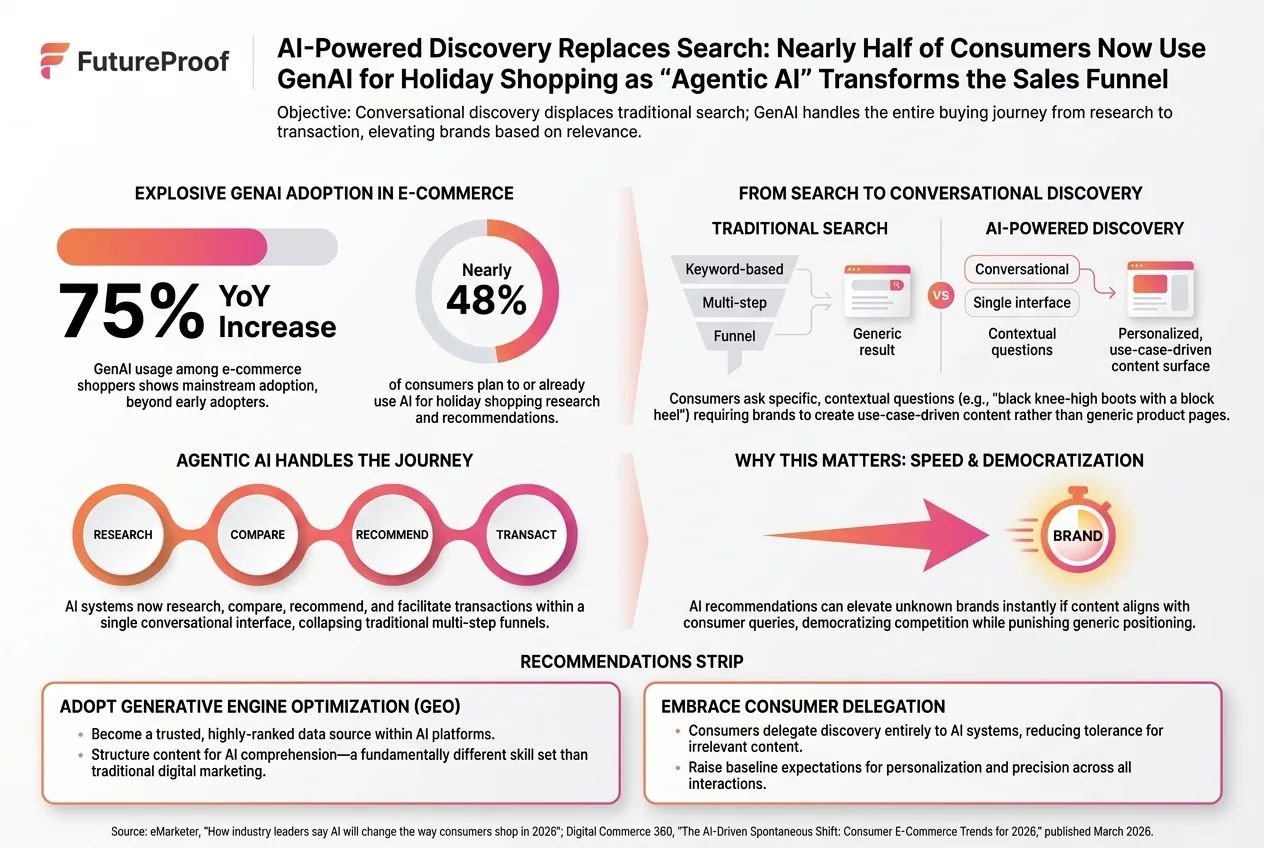
The landscape of consumer discovery is undergoing a profound transformation, moving at an unprecedented pace beyond the confines of traditional keyword-based search. A new era, defined by AI-powered discovery, is not just on the horizon; it is here, reshaping how shoppers find, evaluate, and purchase products. This seismic shift is evidenced by compelling new data revealing a staggering 75 percent year-over-year surge in Generative AI (GenAI) use among e-commerce shoppers, alongside nearly half of all consumers – a significant 48 percent – who are now planning to or already leveraging AI to guide their holiday shopping decisions. These figures, reported by eMarketer and Digital Commerce 360 in March 2026, underscore a pivotal moment for brands and marketers: the dawn of agentic AI, where intelligent assistants handle the heavy lifting of research, comparison, and recommendations within a single, seamless conversational flow.
For decades, the battle for online visibility was fought on the battlefield of keyword rankings. Brands meticulously crafted content around specific search terms, optimized meta descriptions, and pursued backlinks, all in the quest for the coveted top spot on search engine results pages (SERPs). Consumers, in turn, became adept at formulating their queries into concise keyword strings, sifting through pages of results, opening multiple tabs, and performing their own comparative analysis. This manual, often fragmented, process was the accepted norm. However, the sheer volume of products, the complexity of purchase decisions, and the ever-increasing demands on consumer time have rendered this traditional model increasingly inefficient and outdated. Shoppers no longer want to search; they want to find. They don't want a list of links; they want a definitive, personalized answer.
Enter AI-powered discovery, a paradigm shift driven by the sophisticated capabilities of Generative AI. This technology moves beyond simple keyword matching to understand context, intent, and nuance. Instead of merely presenting a catalogue of products that contain a specific word, AI-powered systems can grasp the underlying need, synthesize information from vast datasets, and offer curated, highly relevant recommendations. The 75 percent year-over-year surge in GenAI use among e-commerce shoppers is not merely a statistical anomaly; it represents a fundamental change in consumer behavior. Shoppers are actively embracing these AI assistants because they deliver a superior experience: faster, more accurate, and profoundly more personalized than traditional methods. They are moving from asking "where can I find a running shoe?" to "find me a highly cushioned running shoe for overpronators, suitable for long-distance training on asphalt, under $150, and available in a size 9 wide." This level of specificity and expectation is something traditional search engines struggle to deliver efficiently.
The rise of agentic AI further cements this transformation. These intelligent assistants are not just answering questions; they are acting on behalf of the consumer. They can conduct extensive research across various brands and retailers, compare features and prices, read reviews, identify pros and cons, and ultimately present a concise, well-reasoned recommendation – all within a single, ongoing conversational flow. Imagine a consumer asking an AI assistant to "plan a romantic weekend getaway for my anniversary, including a boutique hotel with a spa, fine dining, and cultural activities, all within a 2-hour drive and under $1000." The agentic AI can process this complex request, cross-reference multiple parameters, and return a comprehensive, actionable itinerary, complete with booking options. This is the ultimate expression of convenience and efficiency, fundamentally altering the customer journey.
Nowhere is this shift more pronounced and critical than in the realm of holiday shopping. The statistic that 48 percent of consumers are either planning to or already using AI to guide their holiday shopping is a stark warning and an immense opportunity for brands. Holiday shopping is notoriously complex, characterized by high stakes, gift-giving pressures, tight deadlines, and an overwhelming array of choices. Consumers are often searching for gifts for others, requiring them to consider someone else's preferences, sizes, or interests – information they may not perfectly possess. This is where AI truly shines. An AI assistant can help a shopper find "a thoughtful, personalized gift for my sister who loves gardening, has a small urban balcony, and is passionate about sustainable living." The AI can then suggest unique, eco-friendly gardening kits, compact vertical planters, or artisanal gardening tools, filtering by retailer reputation, sustainability credentials, and price points. For brands, ignoring this trend during the most crucial retail period of the year is akin to willfully sacrificing sales. Their ability to surface during these AI-guided holiday shopping expeditions will directly determine their seasonal success.
For brands navigating this new digital frontier, the implications are profound. Visibility is no longer solely about achieving high keyword rankings; it is now intrinsically linked to contextual relevance and the precise articulation of product attributes. AI algorithms don't just scan for keywords; they understand the meaning behind a query. They infer intent, identify unspoken needs, and cross-reference these against a rich, detailed understanding of what a product does, who it's for, and how it performs. This means that a brand's product information must be meticulously detailed, accurate, and semantically rich. If a consumer asks an AI for "a hypoallergenic, cruelty-free face moisturizer for sensitive, acne-prone skin that is also vegan and comes in recyclable packaging," the AI will prioritize products that explicitly declare these attributes, not just those that mention "face moisturizer." Brands must move beyond generic product descriptions and provide a comprehensive, structured data profile for every item in their inventory, anticipating the highly specific and multi-faceted questions consumers will pose to their AI assistants.
To compete effectively in this new environment, marketers must radically rethink their content strategy, moving towards "use case driven content." This approach focuses on creating content that addresses specific problems, scenarios, or aspirational goals that consumers might articulate to an AI. Instead of merely describing a product's features, use case driven content illustrates how the product solves a particular problem or enhances a specific experience. For example, instead of just listing the specifications of a backpack, a use case driven approach would create content around "the best ultralight backpacks for multi-day thru-hikes," "ergonomic backpacks for students carrying heavy textbooks," or "waterproof backpacks for photographers in humid climates." Each piece of content directly answers a highly specific consumer need, framing the product as the ideal solution within that particular context. This proactive approach ensures that when an AI assistant processes a nuanced query, the brand's product content is perfectly aligned with the user's intent, making it a prime candidate for recommendation.
This shift necessitates the adoption of a new optimization discipline: Generative Engine Optimization, or GEO. GEO is the evolution of traditional SEO, tailored to the unique demands of AI-powered discovery. It's about optimizing not just for search engines, but for the generative AI models that power conversational assistants. Key components of a robust GEO strategy include:
- Structured Data and Schema Markup: This is foundational. Brands must meticulously implement schema markup (like Schema.org) to tag every conceivable product attribute – size, color, material, sustainability certifications, use cases, compatibility, allergens, ingredients, and more. This structured data makes it incredibly easy for AI to understand, categorize, and cross-reference product information with consumer queries. Without this rich, machine-readable data, products become invisible to advanced AI agents.
- Natural Language Optimization: Content must be written not just for keywords, but for natural language understanding. This means creating comprehensive FAQs, detailed guides, and educational content that answers potential questions directly and exhaustively. Brands should anticipate the "who, what, when, where, why, and how" related to their products and proactively provide those answers in clear, concise language that AI can easily parse and synthesize.
- Contextual Richness and Depth: AI thrives on context. Beyond basic product descriptions, brands need to provide a wealth of contextual information: customer reviews, comparison charts, "how-to" guides, troubleshooting tips, lifestyle imagery, and videos demonstrating use cases. The more comprehensive and contextually rich the information, the better an AI can understand the product's value proposition and recommend it appropriately.
- Attribute Optimization: Every single attribute of a product must be optimized. This goes beyond the obvious. Think about less common but highly specific attributes that an agentic AI might consider, such as "ethically sourced," "biodegradable packaging," "compatible with smart home ecosystem X," or "suitable for pets with allergies." The more precise and complete the attribute data, the higher the likelihood of appearing in highly specific, AI-driven recommendations.
- Focus on Solutions, Not Just Features: Reiterating the use case driven approach, GEO demands that brands position their products as solutions to consumer problems. Content should highlight benefits and outcomes, not just technical specifications. An AI isn't just looking for "a drill"; it's looking for "a cordless drill powerful enough for DIY home renovations, with long battery life and a comfortable grip."
The future of product discovery is undeniably agentic. It is a future where intelligent AI assistants become trusted advisors, meticulously sifting through mountains of data to present consumers with the perfect solution to their needs. Brands that cling to outdated SEO practices, focusing solely on keywords and generic product listings, risk becoming entirely invisible in this new landscape. The competitive advantage will belong to those who proactively adopt Generative Engine Optimization, investing in highly detailed, use case driven content and structured data that speaks directly to the sophisticated algorithms of AI-powered discovery. The seismic shift is already underway, driven by the preferences of nearly half of all holiday shoppers and an incredible 75 percent year-over-year surge in GenAI use in e-commerce. Brands must adapt now, not just to survive, but to thrive in this exciting, AI-powered future of commerce.