The Rise of AI Powered Try Before You Buy and the New Era of Conversational Commerce
The landscape of consumer commerce is undergoing a profound transformation, driven by the rapid evolution and mainstream adoption of artificial intelligence. What was once a speculative future where AI assisted in niche shopping tasks is now a tangible reality, fundamentally reshaping how individuals discover, evaluate, and ultimately purchase products and services. At the heart of this revolution is the rise of AI-powered "try before you buy" experiences, where generative AI (GenAI) isn't just suggesting products, but actively simulating the nuances of ownership, integrating items into a consumer's unique life context, and even facilitating direct transactions. This shift marks a pivotal moment for brands, retailers, and marketers alike, demanding a re-evaluation of traditional strategies and a proactive embrace of AI-first approaches to product presentation and customer engagement.
The traditional "try before you buy" concept, long limited by physical constraints or rudimentary digital tools, has been redefined by the capabilities of generative AI. Consumers are no longer content with static product images or generic reviews; they demand a personalized projection of how a product will integrate into their specific world. This manifests in GenAI tools that can project the total cost of ownership (TCO) for a major appliance, factoring in individual usage patterns, local energy prices, and maintenance schedules. Imagine asking an AI, "What will be the actual monthly cost of owning this new electric vehicle, considering my average daily commute, local charging station availability, and typical electricity rates?" Or, "Will this smart home thermostat truly save me money on my energy bill in my 100-year-old house with drafty windows, and how much setup effort will it require given my limited tech skills?"
Beyond mere financials, GenAI excels at simulating the "everyday fit." Consumers are leveraging these tools to visualize how a new piece of furniture will look in their living room, not just with generic stock photos, but by integrating it into a virtual replica of their actual space, considering lighting, existing decor, and even anticipated foot traffic. Fashion queries go beyond static models, with AI generating images of garments on diverse body types, in various lighting conditions, and even suggesting how they might pair with items already in a consumer's digital wardrobe. The goal is to eliminate purchase anxiety by providing a rich, contextual understanding of what it's truly like to own and use a product before commitment. This extends to long-term trade-offs as well, with AI tools analyzing everything from expected depreciation and resale value for high-ticket items to the maintenance burden of complex gadgets or the ecological impact of certain purchases based on a user's stated values. This depth of pre-purchase simulation moves far beyond simple comparison charts; it's about holistic, personalized scenario planning.
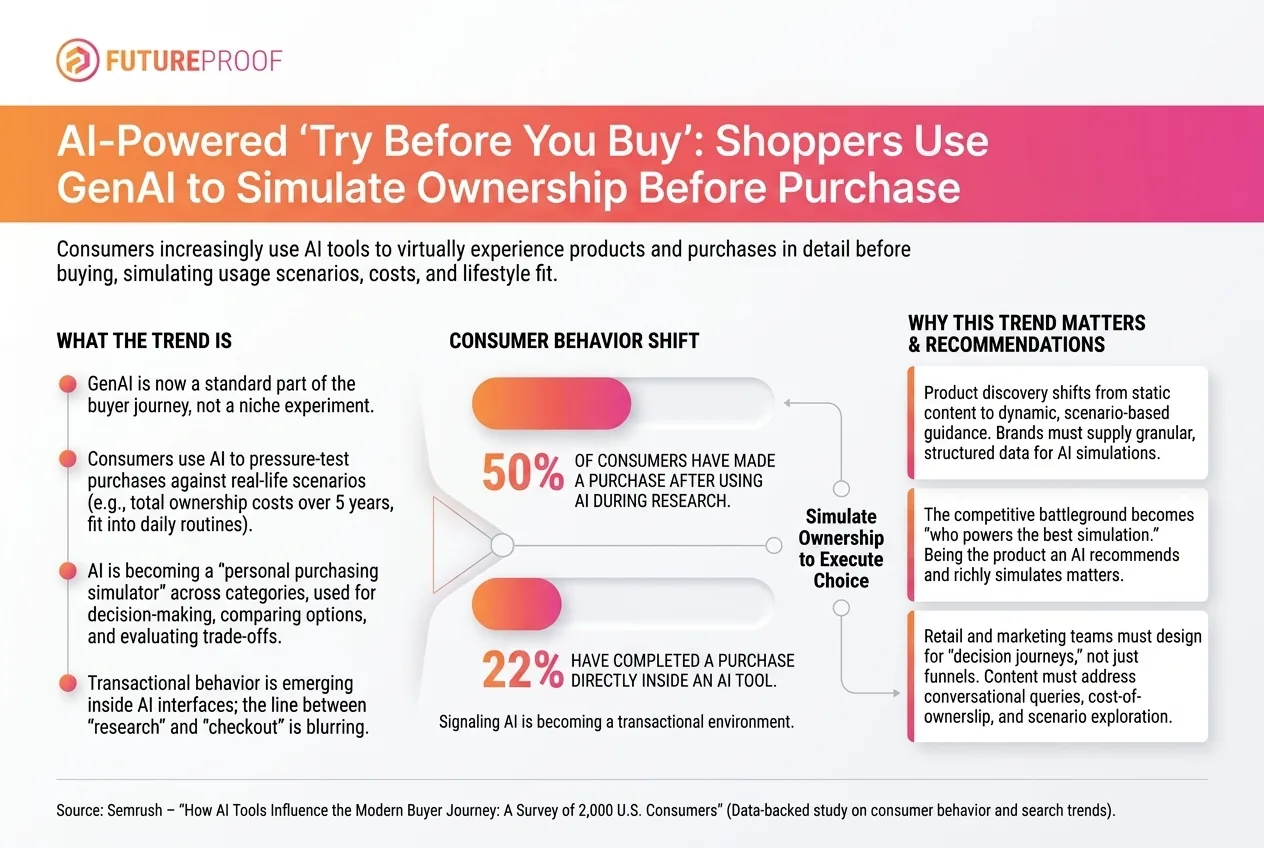
This profound shift from passive browsing to active, personalized simulation is not a niche trend but a rapidly mainstreaming phenomenon, as evidenced by compelling new data. A recent report from Semrush, titled "How AI Tools Influence the Modern Buyer Journey," reveals the undeniable impact of AI on consumer purchasing habits. The data paints a clear picture: a remarkable fifty percent of consumers have made a purchase after incorporating AI into their research process. This statistic underscores AI's growing power as a discovery engine, a validation tool, and a trusted advisor in the buyer journey. It signifies that AI isn't just a novelty; it's an integral component of how half of all modern shoppers inform their decisions, influencing everything from initial product awareness to the final choice between competing options.
But the influence extends even further. The Semrush report highlights an even more revolutionary finding: twenty-two percent of consumers have completed a purchase directly inside an AI tool. This statistic is a game-changer, indicating that AI is not merely influencing decisions but is also becoming a direct transactional conduit. This isn't just about AI recommending a product and then sending the user to a brand's website; it's about the entire purchase funnel, from discovery to checkout, occurring within the AI environment itself. Imagine interacting with a sophisticated chatbot that not only helps you choose the perfect vacation package based on your preferences and budget but also allows you to book flights, hotels, and excursions without ever leaving the conversation. Or, a voice assistant that, after a detailed discussion about your dietary needs and favorite flavors, orders your weekly groceries and arranges for delivery directly. This seamless integration of decision-making and transaction capability within AI tools represents an unprecedented level of convenience and personalization, significantly reducing friction in the buyer journey and fundamentally altering the landscape of e-commerce. The velocity and scale of this adoption demonstrate that AI is not just enhancing the buying process; it's actively reshaping it from the ground up.
This move toward scenario-based shopping and AI-driven transactions signifies the definitive end of product discovery as a passive activity involving static web pages. The era of merely presenting a list of features, a gallery of images, and generic customer reviews is rapidly fading. Today's empowered shopper enters the digital realm with complex, highly personalized questions, demanding answers that resonate with their unique circumstances. They are no longer asking "What does this product do?" but rather, "What will this product be like for me?" They expect AI to synthesize vast amounts of information and translate it into personalized, actionable insights that address their specific needs, lifestyle, and existing ecosystem.
AI accomplishes this by moving beyond simple keyword matching to genuinely understand the user's intent and context. It draws from a rich tapestry of data sources: the granular specifications of a product, the collective wisdom of thousands of customer reviews, the authoritative insights of expert content, and a myriad of real-world use cases. For instance, a shopper contemplating a new smartphone isn't just looking at processor speed; they're asking, "Will this phone's battery last me a full day of heavy gaming and video calls, given my current phone usage habits?" or "How well will this camera perform in low light for capturing my kids' indoor sports events?" An AI, armed with deep product knowledge, a database of user experiences, and the ability to interpret the nuances of individual queries, can synthesize this information to provide a tailored projection of ownership. It can highlight specific pros and cons relevant to the user's stated scenario, compare the product against alternatives based on personalized criteria, and even anticipate potential compatibility issues with other devices the user owns. This dynamic, conversational, and deeply personalized product discovery experience is a stark contrast to the static, one-size-fits-all approach of traditional product pages, which are increasingly seen as inadequate in addressing the complexity of modern consumer needs. The expectation is now for AI to act as a highly intelligent, infinitely patient personal shopping assistant, capable of understanding and responding to the most intricate "what if" scenarios.
For brands and retailers, this seismic shift in consumer behavior presents both an existential challenge and an unparalleled opportunity. The competitive edge in this new commerce paradigm no longer lies solely in having the best product or the most prominent ad placement on a search results page. Instead, it comes directly from the ability to power the best possible simulations and provide the most accurate, comprehensive, and personalized answers within AI environments. When purchase decisions are being made and transactions are occurring directly inside AI tools, the battleground for market share fundamentally changes. Being the product an AI recommends becomes as critically important, if not more so, than traditional SEO rankings or marketplace visibility.
Consider the implications: an AI might synthesize a user's requirements and, based on its vast dataset, recommend Brand A over Brand B, not because Brand A bought more ads, but because its structured data, customer reviews, and expert content are better optimized for AI interpretation, allowing the AI to construct a superior simulation of its value proposition. This means brands must move beyond simply listing features to providing rich, semantically structured data that AI can easily ingest, understand, and articulate in a conversational context. They need to ensure their product information is complete, accurate, and addresses every conceivable use case and scenario a consumer might pose to an AI. This includes transparency about materials, ethical sourcing, sustainability efforts, and even the nuances of product performance under specific conditions. Furthermore, brands must actively engage with and understand the algorithms of the various AI platforms that are now acting as gatekeepers to purchase decisions. They need to optimize their digital presence not just for human eyes and search engine crawlers, but specifically for AI's interpretative capabilities. This might involve adopting advanced schema markup, providing robust FAQs that anticipate nuanced questions, and ensuring that their entire digital footprint — from social media to customer service interactions — contributes to a coherent, AI-friendly narrative about their products. The future of brand visibility and consumer trust hinges on how effectively brands can empower AI to convincingly simulate the ownership experience and, consequently, earn the coveted AI recommendation.
The implications for marketers are abundantly clear and demand an urgent reorientation of strategy. The era of simply crafting compelling narratives for human consumption, while still valuable, must evolve. The primary mandate for modern marketers is now to design content and structure data specifically for conversational decision journeys. This necessitates a fundamental shift in thinking: from creating static promotional materials to building dynamic, AI-interpretable knowledge bases. The goal is to make it effortlessly easy for AI to surface the precise information consumers need to make informed, scenario-based decisions and purchases.
To achieve this, marketers must meticulously structure their product and brand information in ways that directly address the kinds of questions AI tools are designed to answer. This includes, but is not limited to:
- Lifecycle Costs (Total Cost of Ownership - TCO): Beyond the initial purchase price, provide structured data on energy consumption, typical maintenance costs, consumable expenses (e.g., ink cartridges, filters), expected lifespan, and even potential resale value. This empowers AI to project the true long-term financial commitment.
- Compatibility: Detail how products integrate with existing ecosystems (e.g., "Works with Alexa/Google Home"), other devices, physical spaces (dimensions, weight), and specific lifestyles. Provide clear parameters and potential limitations.
- Maintenance Requirements: Offer clear, concise information on cleaning routines, repairability scores, warranty details, and the availability of service networks. AI can then inform users about the time and effort investment required to keep a product functioning optimally.
- Specific Use Case Scenarios: Instead of generic benefits, articulate how the product performs in various real-world situations. For example, for a camera: "Excellent for low-light indoor sports photography," or for a car: "Ideal for long-distance family road trips with ample luggage space." This provides AI with rich context to match products to individual needs.
- Comparative Data: Structure information that allows AI to easily compare key performance indicators against competitors for specific scenarios, not just broad categories. "How does Product X's battery life compare to Product Y when streaming video for 8 hours?"
This involves leveraging advanced semantic markup (like Schema.org), developing comprehensive FAQ sections that anticipate highly specific and nuanced questions, creating structured comparison matrices, and even publishing transparent data feeds that AI tools can directly access and synthesize. Every piece of content, from product descriptions to blog posts, should be atomized and tagged to ensure AI can extract relevant data points efficiently. The focus must be on creating a data architecture that allows AI to construct coherent, personalized narratives and projections, transforming raw information into insightful simulations. This is no longer merely about driving traffic; it's about optimizing for understanding, synthesis, and ultimately, transaction within the AI environments where consumers are increasingly making their choices and purchases. The competitive future belongs to those who design for the AI-powered conversational decision journey.
In conclusion, the advent of AI-powered "try before you buy" experiences marks a fundamental and irreversible shift in the consumer landscape. Generative AI is not just assisting purchases; it's simulating entire ownership scenarios, projecting costs, assessing everyday fit, and weighing long-term trade-offs, all tailored to the individual consumer. The compelling data from Semrush underscores the mainstream adoption of this trend, with AI now influencing the majority of purchase decisions and directly facilitating a significant portion of transactions. This transition from static product pages to dynamic, scenario-based shopping demands that brands and retailers rethink their entire digital strategy. The new competitive frontier is the ability to power the most accurate, personalized, and seamless AI simulations, making being the AI-recommended product as vital as traditional search rankings. For marketers, the path forward is clear: a radical redesign of content and data architecture for conversational decision journeys. By meticulously structuring information around lifecycle costs, compatibility, maintenance, and specific use case scenarios, brands can empower AI to deliver the personalized insights that drive modern purchasing decisions. Embracing this AI-first approach is not an option but an imperative for any brand looking to remain relevant, competitive, and connected with the increasingly sophisticated and AI-informed consumer of today and tomorrow. The future of commerce is conversational, deeply personalized, and inextricably linked to the intelligence of AI.