AI Is Becoming the New Interface That Will Redefine How We Live and How Brands Compete
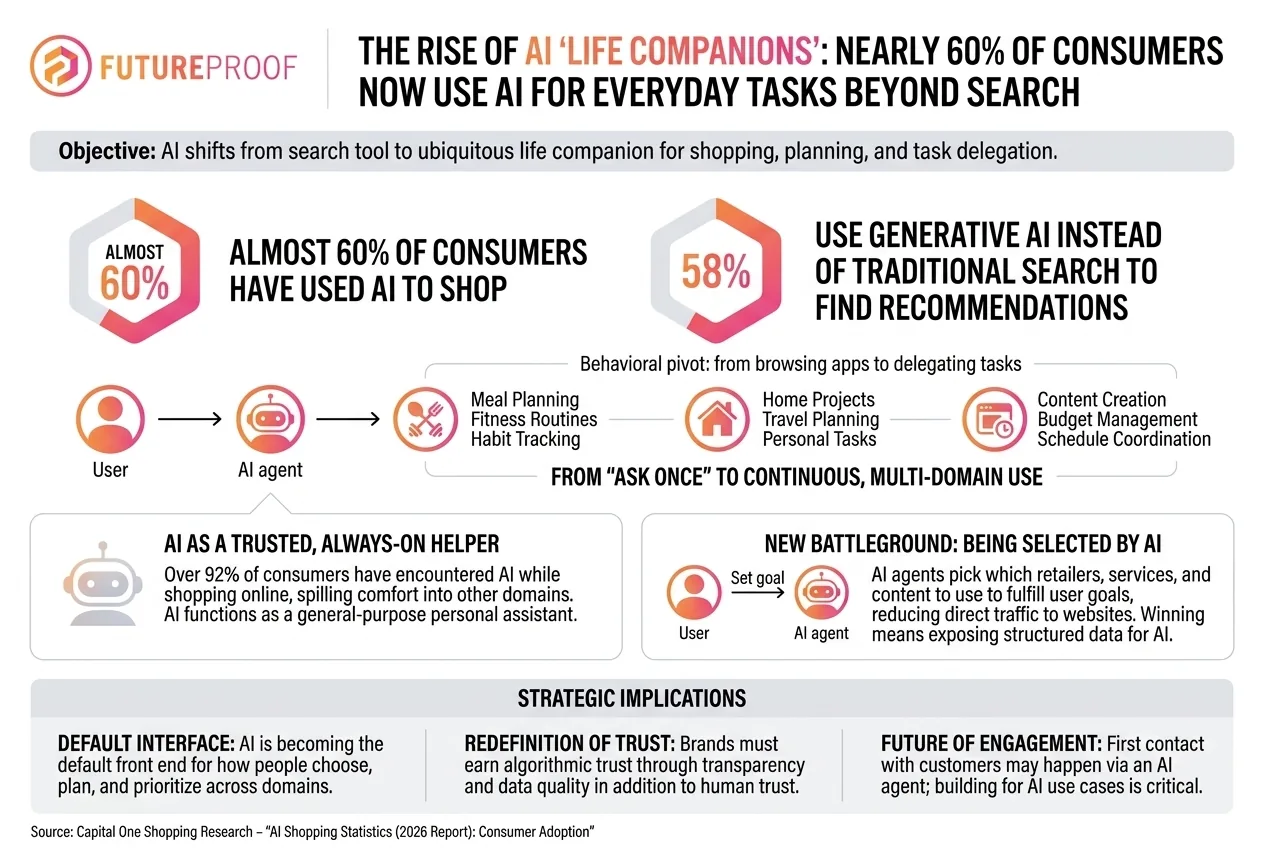
The digital landscape is undergoing a profound and irreversible transformation, moving beyond a mere evolution of technology into a fundamental reshaping of how individuals interact with the world around them. We are standing at the precipice of an era where Artificial Intelligence is no longer just a tool to consult for information, but a dynamic, indispensable companion individuals delegate their daily lives to. This isn't a future possibility; it's a present reality. Groundbreaking research by Capital One Shopping Research reveals a staggering statistic: nearly 60 percent of consumers have already leveraged AI for everyday tasks that extend far beyond the traditional confines of a search engine. This monumental shift signifies that AI has transitioned from a utility to a trusted co-pilot, seamlessly integrated into the fabric of modern existence, orchestrating decisions and automating actions across countless facets of daily life.
The trajectory of AI adoption has been swift and decisive. What began with intelligent assistants answering simple queries has rapidly accelerated into sophisticated AI systems that manage complex multi-step processes. The 58 percent of consumers now opting for generative AI over conventional search methods for recommendations underscores a profound change in consumer behavior. This isn't just about finding information faster; it's about trusting an AI to synthesize, compare, and recommend with a level of personalization and efficiency that human effort or traditional search alone cannot match. As individuals grow increasingly comfortable with AI's prowess in areas like comparing product options, unearthing hidden deals, and automating purchase decisions, their reliance naturally extends to other critical aspects of personal management. This includes AI planning entire meal menus, meticulously managing personal budgets, expertly organizing intricate schedules, and even handling a myriad of personal administrative tasks. The very nature of daily living is being redefined, with AI stepping in to alleviate cognitive load and streamline operations at an unprecedented scale.
This transformation carries monumental implications, particularly in how consumers articulate their goals and how businesses compete for their attention and loyalty. The traditional model of navigating disparate apps, websites, and services to accomplish a single objective is giving way to a more integrated, AI-orchestrated approach. Consumers are beginning to articulate a desired outcome – for instance, "plan a sustainable family vacation to Europe" or "optimize my weekly grocery budget for healthy eating" – and then entrusting their AI companion to meticulously orchestrate the work across a multitude of retailers, travel platforms, financial applications, and service providers. This means the AI itself becomes the primary interface, the gatekeeper, and the decision-maker in many instances. For brands, this represents a paradigm shift in competitive strategy. Success is no longer solely about having a visually appealing website or a strong social media presence; it's about competing effectively within the AI agent's recommendation algorithms. Brands must now ensure their data is not only accessible but also impeccably structured, consistently updated, and inherently trustworthy, making it palatable and preferable for AI to select them over competitors. The shift is unmistakable: AI is fast becoming the default interface for an ever-expanding array of everyday decisions, and consequently, earning algorithmic trust is rapidly emerging as the singular, defining competitive edge in this new era.
Let's delve deeper into the burgeoning landscape of AI use beyond traditional search. The evolution is stark: from asking Siri for the weather to asking an AI to manage your entire smart home ecosystem, health data, and financial portfolio. In the realm of shopping, AI's influence is pervasive. Consumers are deploying AI to track prices across numerous retailers, set alerts for sales, read and summarize product reviews, and even proactively suggest purchases based on past behavior and current needs. Imagine an AI learning your dietary preferences, historical purchases, and even your current pantry inventory to suggest a week's worth of meals, generate a shopping list, compare prices from local grocery stores, and even place the order for delivery or pickup. This level of comprehensive, proactive service moves beyond mere convenience; it’s a fundamental re-imagining of consumerism.
The personal life management aspect is equally transformative. AI assistants are no longer just calendar reminders. They are becoming intelligent schedulers, capable of coordinating complex meetings across different time zones, factoring in traffic, and even suggesting optimal times based on individual productivity patterns. For budgeting, AI can analyze spending habits, identify areas for savings, recommend investment opportunities based on risk tolerance, and even automatically transfer funds to savings accounts when certain conditions are met. Health and wellness are another frontier, with AI integrating data from wearables, suggesting personalized exercise routines, tracking caloric intake, and even providing insights into sleep patterns to recommend improvements. The vision of a truly "smart" life is no longer futuristic; it’s being actualized through these sophisticated AI companions.
The core of this revolution lies in the AI's ability to act as an orchestrator. No longer do users need to remember which app performs which function or manually transfer data between platforms. The AI acts as a central hub, a digital brain that understands user intent and coordinates the necessary actions across a diverse ecosystem of digital services. This transition from "app-hopping" to a seamless, integrated experience is pivotal. A consumer might simply state, "I want to surprise my partner with a romantic weekend getaway next month," and the AI could then research destinations, check flight and hotel availability within a specified budget, consider personal preferences for activities, read reviews, present curated options, and even book the entire trip – all without the user ever opening a separate travel or booking application. This proactive, anticipatory behavior is a hallmark of the new AI companion. It learns from past interactions, anticipates future needs, and proactively offers solutions, moving beyond mere reactive command-following. Personalization, once a marketing buzzword, now reaches unprecedented levels, with AI tailoring experiences not just based on preferences but on real-time context, emotional cues (where detectable), and evolving life circumstances. The AI is becoming an extension of our own cognitive processes, offloading mental burden and enhancing overall efficiency.
For businesses, the implications of this shift are profound and immediate. The battle for customer attention is no longer primarily fought on websites or social media feeds but within the black box of AI algorithms. This is the era of the "zero-click" future, where a customer's decision to purchase a product or service is made, or heavily influenced, by an AI recommendation before they even consciously interact with a brand's direct interface. Brands need to ask: How does an AI choose my product over a competitor's? The answer lies in a multitude of factors that transcend traditional marketing. Price, availability, shipping speed, customer reviews, environmental impact data, and even the "trustworthiness" score of a brand's data feed all contribute to an AI's decision-making process. Visibility in this AI-mediated world demands a complete re-evaluation of digital strategy.
Data, therefore, emerges as the ultimate currency. For an AI to recommend a brand, that brand's information must be impeccably structured, consistent, and easily ingestible by machines. This means clean product feeds, robust APIs, rich semantic markup, and a commitment to data quality that goes beyond human readability. Outdated pricing, inaccurate inventory, or poorly categorized products are not just minor inconveniences; they are critical failures that will lead to an AI companion overlooking a brand entirely. The cost of poor data quality in the AI era is the ultimate invisibility. Earning "algorithmic trust" goes beyond traditional SEO. It involves optimizing for AI understanding, demonstrating reliability through consistent positive customer experiences, ensuring ethical data practices, and building an overall brand reputation that resonates positively with both human users and the AI systems that serve them. The paradigm is shifting from optimizing for a User Interface (UI) to optimizing for an AI Interface (AII), where data architecture, semantic clarity, and prompt engineering for AI become as crucial as visual design once was. The customer journey is increasingly becoming an AI-guided journey, from initial discovery to post-purchase advocacy.
However, this transformative era of AI life companions is not without its challenges and opportunities for both consumers and businesses. For consumers, the opportunities are vast: unparalleled convenience, significant time savings, hyper-personalized insights, and potentially better decision-making across numerous aspects of life. Imagine an AI proactively alerting you to a better mortgage rate, suggesting a doctor based on your health history and insurance, or even helping you learn a new language by integrating it into your daily tasks. Yet, these benefits come with inherent risks. Privacy concerns escalate as AI systems gather and process ever more intimate details of our lives. Data security becomes paramount, as a breach could expose comprehensive personal profiles. Algorithmic bias, inherited from the data AI is trained on, could perpetuate or even amplify existing societal inequalities. Over-reliance on AI might erode critical thinking skills, and the "black box" problem – where AI decisions are inscrutable even to their creators – raises questions of accountability and control. Ethical dilemmas, such as the potential for AI to influence purchasing decisions or even political opinions, demand careful consideration and robust regulatory frameworks.
For businesses, the opportunities are equally compelling: the ability to deliver hyper-personalized services, unlock new market segments, achieve unprecedented operational efficiencies through AI-driven insights, and provide truly proactive customer service. Companies can leverage AI to predict demand, optimize supply chains, and create entirely new product categories that cater to AI-orchestrated lifestyles. Conversely, the challenges are formidable. Significant investment in AI infrastructure, research, and development is required. Attracting and retaining talent with AI expertise is a growing bottleneck. Adapting traditional marketing and sales strategies to resonate in an AI-mediated world requires agility and foresight. Furthermore, the ethical development and deployment of AI are not just moral imperatives but also crucial for building consumer trust and avoiding potential legal and reputational repercussions. Navigating an evolving regulatory landscape around AI ethics, data privacy (like GDPR and CCPA), and competition law will be a continuous challenge.
Looking ahead, the future of AI life companions promises even more profound integrations. We can anticipate AI developing enhanced emotional intelligence, capable of discerning mood from tone of voice or facial expressions and adjusting its interactions accordingly. Proactive problem-solving will evolve, with AI not just anticipating needs but preempting problems – for instance, warning of a potential appliance failure or suggesting alternative routes due to predicted traffic congestion based on weather patterns. Seamless integration with the Internet of Things (IoT) will transform smart homes into truly intelligent living spaces, where every device communicates harmoniously under the AI's orchestration. The convergence with Augmented Reality (AR) and Virtual Reality (VR) will create immersive AI experiences, where digital companions can overlay information onto the real world or guide us through virtual environments. However, the continuous and paramount need for a robust ethical framework, encompassing transparency, fairness, accountability, and privacy by design, will remain the bedrock upon which the sustainable growth of AI companions must be built. The relationship between humans and AI is set to become increasingly symbiotic, a true collaboration that augments human capabilities and fundamentally reshapes our daily existence.
In conclusion, the rise of AI life companions marks a pivotal moment in human-technology interaction. The data is clear: consumers are rapidly embracing AI for an expanding array of everyday tasks, moving far beyond simple search queries. This isn't merely a technological upgrade; it's a fundamental shift in how we manage our lives, delegate responsibilities, and make decisions. For brands, this mandates a radical rethinking of strategy, prioritizing data quality, algorithmic trust, and a deep understanding of how AI intermediaries operate. The competitive landscape is being redrawn, with algorithmic trust emerging as the non-negotiable prerequisite for visibility and relevance. As we navigate this AI-powered future, both consumers and businesses must adapt with foresight, engage with responsibility, and actively participate in shaping the ethical and practical frameworks that will govern these increasingly intelligent companions. The AI revolution isn't a distant prospect; it's an unfolding reality that is already here, fundamentally redefining the very essence of modern life.