AI Is Now the First Stop in the Consumer Journey and Brands Must Adapt
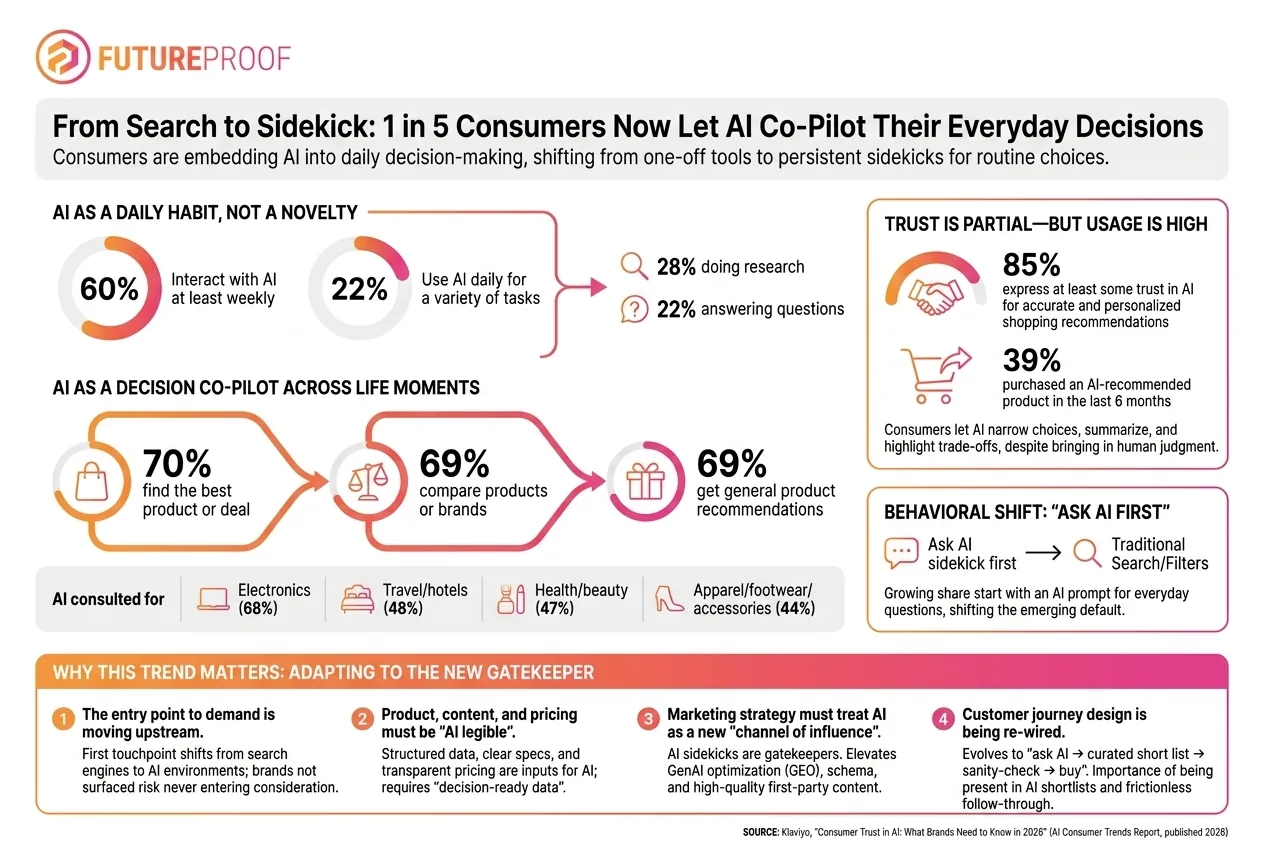
The digital landscape is undergoing a profound transformation, fundamentally reshaping how consumers discover, evaluate, and ultimately purchase products and services. What began as a nascent curiosity with artificial intelligence is rapidly evolving into a mainstream reliance, with AI now serving as an indispensable co-pilot for everyday decision-making. Recent groundbreaking data from Klaviyo’s 2026 AI Consumer Trends report paints a vivid picture of this seismic shift, revealing that a staggering 60 percent of global consumers now engage with AI on a weekly basis, while a significant 22 percent integrate it into their daily routines. This isn't merely passive interaction; it represents a deeper, more intentional integration of AI into the very fabric of consumer behavior, particularly when it comes to forming opinions and making purchasing choices.
The traditional consumer journey, once a relatively linear path through search engines, brand websites, and online marketplaces, is being rerouted. AI is emerging as the new preliminary touchpoint, acting as an always-on adviser that sits strategically upstream from these long-established channels. The data unequivocally supports this: the primary uses of AI currently center around information gathering, with 28 percent of consumers leveraging it for detailed research and 22 percent relying on it to answer specific questions. This early-stage engagement signifies AI's burgeoning role as an initial arbiter of information, shaping consumer perspectives long before they even consider navigating to a brand’s digital storefront. The implication for brands is immense, demanding a re-evaluation of current marketing strategies and content optimization practices to align with this AI-first approach.
What truly underscores the depth of this paradigm shift is how profoundly AI is infiltrating the consideration process itself. Consumers are not just asking AI for simple facts; they are entrusting it with complex comparative tasks that directly influence their purchasing decisions. A remarkable 70 percent of consumers have utilized AI to unearth the best products or deals available, highlighting AI’s power as a sophisticated comparison tool. Equally compelling, 69 percent have employed AI to compare products or brands against each other, seeking nuanced insights and competitive advantages. Furthermore, 69 percent have turned to AI for general product recommendations, relying on its algorithmic prowess to curate personalized suggestions tailored to their perceived needs and preferences. This intricate level of engagement spans across a vast array of product categories, demonstrating AI's broad applicability and growing influence. From high-value electronics, where 68 percent of consumers seek AI guidance, to travel planning at 48 percent, health and beauty products at 47 percent, and even apparel at 44 percent, AI is becoming the default first stop for advice across nearly every segment of the market. This pervasive adoption signals a new era where AI doesn't just assist; it actively steers consumer interest and helps forge initial product shortlists.
While the rapid embrace of AI is evident, the evolution of consumer trust in this technology is equally crucial. The Klaviyo report indicates a promising trend: 85 percent of consumers express at least some level of trust in AI to deliver accurate and personalized shopping advice. This foundational level of trust is critical for AI to maintain its position as a reliable co-pilot. More importantly, this trust is translating directly into purchasing behavior, with a significant 39 percent of consumers having purchased an AI-recommended product within the last six months. This figure is not merely a testament to AI's persuasive capabilities but also to its ability to genuinely connect consumers with products that meet their expectations, thereby validating the trust placed in its recommendations. For an increasing number of individuals, the initial step in any purchasing journey has now fundamentally shifted: instead of instinctively heading to a search bar or a familiar retailer’s website, the new default is to "ask AI first." This behavioral change has monumental implications for how brands must strategize their visibility and appeal.
The critical takeaway for brands and marketers is unequivocal: the very entry point to demand generation is migrating into AI assistants. If AI is becoming the primary conduit through which consumers form their initial option sets, then brands face an urgent imperative to ensure their product data and content are not merely accessible but are exquisitely clear, thoroughly structured, and effortlessly interpretable by sophisticated AI models. This shift elevates the concept of "AI-legible" product information from a niche concern to a central pillar of modern digital strategy. AI sidekicks are no longer futuristic concepts; they are alongside traditional channels, such as organic search, paid ads, and social media, as a powerful new source of influence that demands equal, if not greater, attention. The consumer journey is becoming streamlined and highly efficient: "ask AI, get a short list, sanity check, buy." Brands that fail to optimize for this AI-driven reality risk becoming invisible in the burgeoning age of the intelligent co-pilot.
To truly grasp the magnitude of this change, consider the traditional marketing funnel. AI is now intercepting consumers at the very top, during the awareness and consideration phases, long before they enter the conversion stage. This means that brands cannot simply rely on traditional SEO tactics focused on keywords for search engines. They must now optimize for semantic understanding, context, and the ability of AI models to derive meaningful insights from their product information. Being "AI-legible" isn't just about having data; it's about having intelligible data. This requires a meticulous approach to content creation and data management. Product descriptions need to be precise, unambiguous, and replete with structured attributes. Technical specifications should be clearly delineated, and benefits should be articulated in a way that AI can easily parse and synthesize into concise, compelling recommendations for users.
Moreover, the quality and consistency of product data become paramount. Inaccurate, incomplete, or conflicting information will not only confuse AI models but also lead to incorrect or suboptimal recommendations, ultimately eroding consumer trust and potentially costing brands sales. Brands must invest in robust Product Information Management (PIM) systems and master data management (MDM) practices to ensure a single source of truth for all product-related content. This includes not just textual descriptions but also high-resolution images, detailed videos, customer reviews, ratings, and comprehensive FAQs. Each piece of information acts as a data point that an AI co-pilot can leverage to construct a holistic understanding of a product, enabling it to provide more accurate and relevant guidance to consumers. The goal is to make the product information as "consumable" for an AI as it is for a human, ensuring that its nuances and advantages are fully appreciated by the digital adviser.
The strategic deployment of structured data, often through schema markup, emerges as a non-negotiable requirement for brands aiming for AI visibility. Schema.org vocabulary allows brands to semantically tag their content, explicitly telling AI what specific pieces of information represent – whether it's a product’s price, its availability, customer reviews, shipping details, or return policies. This machine-readable formatting empowers AI models to crawl, interpret, and present information with unparalleled accuracy and context. Without proper structured data, brands are essentially leaving it to chance, hoping AI can infer the meaning of their content. In an increasingly competitive AI-driven landscape, leaving anything to chance is a recipe for digital obscurity. Brands need to actively guide AI to their most critical selling points and ensure that every facet of their product offering is communicated in a format that AI can readily digest and relay.
Beyond technical optimization, optimizing content for AI also demands a shift in content strategy. Consider the rise of conversational AI. Consumers are increasingly interacting with AI using natural language queries, asking questions in the same way they would converse with a human assistant. Brands must anticipate these natural language queries and create content that directly answers them. This means developing comprehensive FAQ sections, creating detailed knowledge bases, and crafting blog posts and guides that address common customer pain points and product-related inquiries. Each piece of content becomes a potential input for an AI assistant, enriching its understanding and improving its ability to serve as an effective co-pilot. The days of simply stuffing keywords are long gone; the future belongs to content that is genuinely helpful, informative, and contextually rich, designed to satisfy both human curiosity and AI’s need for structured understanding.
The consumer journey, as described by Klaviyo’s insights, is undeniably becoming more dynamic and AI-centric. The sequence "ask AI, get a short list, sanity check, buy" signifies a powerful new pathway. The "sanity check" phase is particularly interesting, suggesting that while consumers trust AI for initial recommendations, they still perform due diligence, likely through traditional search engines, social proof, or direct brand site visits. This means that brands still need to maintain strong presences across all channels, but their foundational strategy must now originate with AI optimization. If a brand isn't on the AI's shortlist, it might not even make it to the "sanity check" phase, effectively being cut out of the consideration process before it even begins. This elevates AI-legibility to a gatekeeper status, determining which brands get a seat at the table in the first place.
The long-term implications of this shift are profound for e-commerce, digital marketing, and brand-consumer relationships. Brands that proactively embrace AI as a critical channel will gain a significant competitive advantage. They will be able to foster deeper relationships with consumers by being present at the earliest stages of their decision-making process, influencing choices through accurate and personalized AI recommendations. Furthermore, by understanding how AI interprets and presents their products, brands can gain invaluable insights into consumer preferences and market trends, allowing them to refine their product offerings and messaging strategies more effectively. The data from the Klaviyo report – 60 percent of global consumers using AI weekly, 22 percent daily, and 70 percent having used AI to find the best product or deal – is not just a statistic; it's a clarion call for brands to adapt or risk being left behind in the rapidly evolving digital ecosystem. The future of consumer interaction is co-piloted by AI, and successful brands will be those that learn to navigate this new frontier with precision, clarity, and an unwavering commitment to AI-legible excellence.