The Rise of AI Assembled Lives and What It Means for the Future of Consumer Behavior
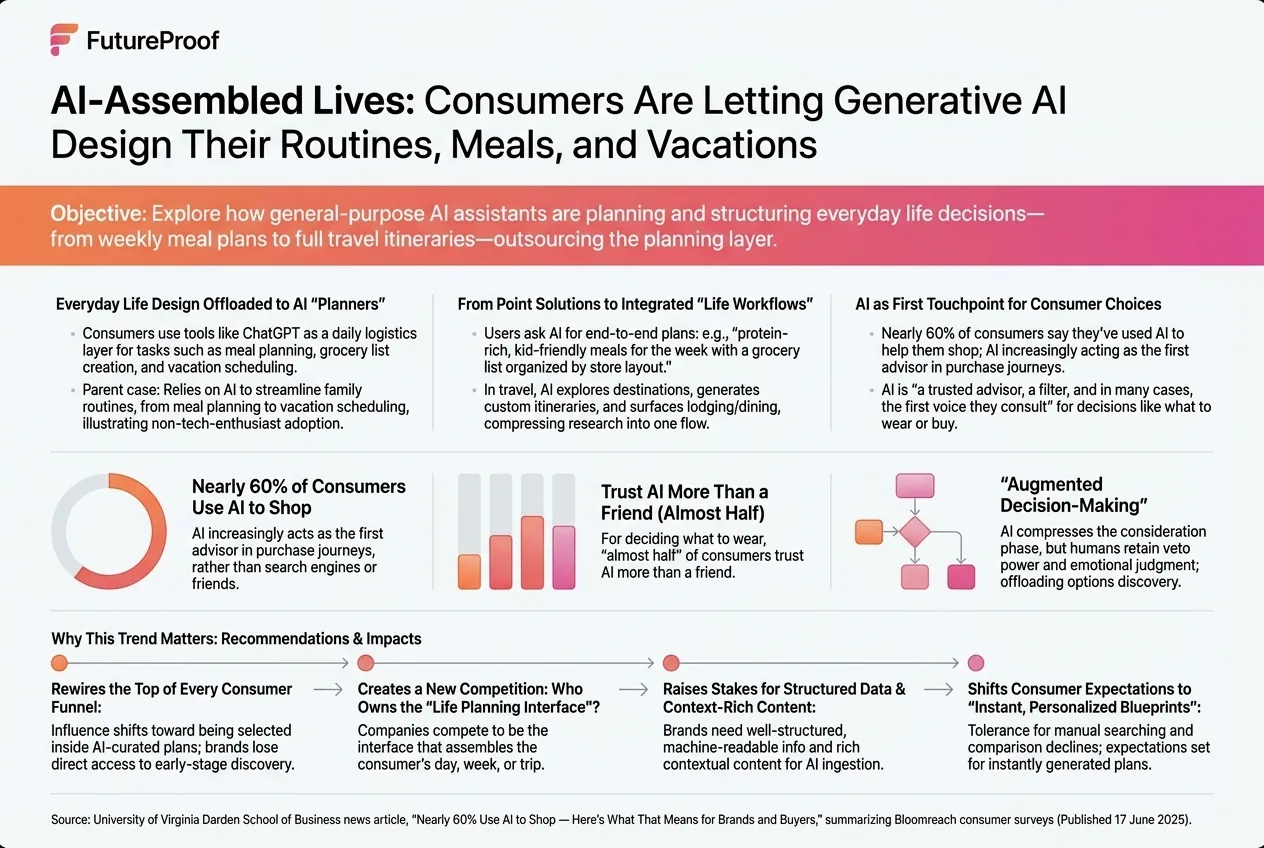
The digital landscape is undergoing a silent yet seismic transformation, redefining the very fabric of our daily existence. Far beyond the early adopter phase or mere novelty, generative artificial intelligence is no longer just a tool for complex calculations or creative content generation; it is becoming the invisible architect of our everyday lives. From the mundane yet critical decisions of what to eat for dinner to the intricate logistics of a dream vacation, consumers are increasingly entrusting their routine planning to AI. This isn't just about using a search engine; it's about offloading the cognitive burden of decision-making, research, and synthesis to sophisticated algorithms that can design, plan, and optimize our routines with unprecedented efficiency and personalization. Welcome to the era of AI-assembled lives, a profound shift in consumer behavior that is fundamentally reshaping how individuals navigate their world and, consequently, how brands must engage with them.
This emerging paradigm represents a monumental leap from simply interacting with technology to actively co-creating our realities with it. The implications are vast, touching every facet of consumer engagement, brand visibility, and market competition. As AI seamlessly integrates into the roles of personal assistant, logistics coordinator, and even trusted advisor, businesses are confronted with a new frontier where the traditional top of the consumer funnel is being rerouted, requiring innovative strategies to remain relevant and discoverable. Understanding the drivers behind this shift, its profound impact, and the necessary adaptations for brands is no longer optional; it is imperative for survival and success in the burgeoning AI-first world.
The Rise of AI-Assembled Lives: A New Consumer Paradigm
For decades, technology has promised to simplify our lives, but often, it added layers of complexity – more apps to manage, more information to sift through, more decisions to make. Generative AI, however, is delivering on that promise by moving beyond mere data provision to proactive life orchestration. Consumers are no longer just searching for recipes; they are asking AI to generate a full week's meal plan, tailored to dietary preferences, available ingredients, and even budget, complete with an organized grocery list. They aren't just looking up travel destinations; they are requesting bespoke itineraries for a family of four, including flight suggestions, accommodation options, daily activities, and restaurant recommendations, all optimized for specific interests and desired pace. This represents a fundamental shift from information retrieval to intelligent, end-to-end plan generation.
The core of this new consumer behavior lies in the power of generative AI to create, synthesize, and predict, rather than just retrieve. Unlike traditional search engines that provide a list of links, or specialized apps that offer specific functionalities, generative AI acts as a holistic planner. It processes vast amounts of information, understands context, and then generates a coherent, actionable plan. This capability transforms it into a "logistics layer" for daily routines, moving beyond the realm of tech enthusiasts into mainstream households. The appeal is universal: reducing mental load, saving time, and gaining access to highly personalized, optimized solutions without the exhaustive effort traditionally required. It’s an evolution from simply being informed to being autonomously managed, offering a profound sense of efficiency and liberation from the endless minor decisions that clutter modern life. Consumers are discovering that their AI assistant isn't just helpful; it's becoming an indispensable partner in navigating the complexities of modern living.
Unpacking the Drivers: Why Consumers Are Embracing AI for Daily Life
Several converging factors are propelling this rapid adoption of AI for personal logistics and decision-making. These drivers speak to deep-seated consumer needs for efficiency, personalization, and cognitive relief in an increasingly complex world.
1. AI as a Logistics Layer for Routines: Beyond Tech Enthusiasts
The initial wave of AI adoption might have been driven by early adopters and tech-savvy individuals, but the current shift signifies a much broader, mainstream embrace. Households are increasingly leveraging generative AI as a foundational logistics layer for managing a multitude of daily routines. This extends far beyond simple voice commands for smart home devices; it’s about intelligent orchestration. As noted by CMSWire, this reflects an adoption that transcends the traditional tech demographic. Imagine an AI scheduling car maintenance based on mileage and calendar availability, or drafting a comprehensive school holiday activity plan that balances educational outings with fun, all while considering family budget and geographical constraints. The sheer volume of small, repetitive, yet crucial decisions that underpin daily life creates a significant cognitive burden. AI offers a powerful solution by automating and optimizing these logistical challenges, freeing up mental bandwidth for more engaging or meaningful pursuits. It’s about building a predictable, efficient flow into life, powered by intelligent automation.
2. End-to-End Planning: The End of Fragmented Searches
One of the most compelling drivers for AI adoption is its ability to offer end-to-end solutions, eliminating the fragmentation and exhaustive effort associated with traditional planning. Previously, designing a weekly meal plan involved jumping between numerous recipe sites, cross-referencing ingredient lists, checking dietary restrictions, and then manually compiling a grocery list, often while trying to optimize for cost or minimize food waste. Similarly, planning a vacation could involve dozens of tabs open for flights, hotels, tour operators, review sites, and local blogs. This multi-platform, multi-step process is a significant pain point for consumers.
Generative AI addresses this directly by acting as a singular, comprehensive planning interface. Users can simply ask AI for a "full week of vegetarian meals suitable for a family with young children, focusing on seasonal produce and a maximum prep time of 30 minutes per meal, with a sorted grocery list organized by supermarket aisle." Or, "plan a two-week cultural immersion trip to Japan for two adults, including traditional accommodation, high-speed rail passes, and recommendations for authentic local experiences in Tokyo, Kyoto, and Osaka, with a budget cap." The AI synthesizes all this information, cross-references it with vast databases, and generates a cohesive, actionable blueprint. This seamless, integrated experience saves immense time and reduces decision fatigue, transforming a previously arduous task into a simple conversational exchange.
3. Augmented Decision Making and Trust: AI as a Trusted Advisor
Perhaps one of the most striking aspects of this trend is the growing consumer trust in AI, extending even to deeply personal choices. A key data point from the University of Virginia Darden School of Business, summarizing Bloomreach consumer surveys, illuminates this dramatically: "Nearly 60 percent of consumers say they have used AI to help them shop, and almost half trust AI more than a friend for deciding what to wear." This statistic is a powerful indicator of AI's burgeoning influence and perceived reliability. The idea that consumers would trust an algorithm more than a human friend for fashion advice speaks volumes about AI's capacity for objective analysis, vast data processing, and rapid personalized recommendations, free from subjective biases or limited human experience.
This isn't about complete delegation of autonomy, but rather "augmented decision making." Consumers are leveraging AI to handle the arduous tasks of research, options discovery, and preliminary synthesis. The AI acts as an incredibly efficient, unbiased, and knowledgeable assistant that presents a curated set of choices, often optimized for specific criteria. The human remains in the loop, making the final decision, but their cognitive load is significantly reduced. This partnership allows consumers to make better-informed decisions faster, with less effort, fostering a growing reliance on AI not just as a tool, but as a trusted partner in navigating life's myriad choices. The perceived objectivity and data-driven nature of AI recommendations often instills a confidence that subjective human advice might lack, especially in areas with a multitude of options.
The Profound Implications: Why This Shift Matters for Businesses and Brands
The emergence of AI-assembled lives is not merely a technological novelty; it represents a fundamental reordering of the consumer journey with far-reaching implications for businesses across all sectors. Brands that fail to recognize and adapt to this paradigm shift risk becoming invisible in an increasingly AI-mediated world.
1. The Shifting Top of the Consumer Funnel: Reduced Direct Brand Access
Historically, the top of the consumer funnel – the initial discovery and awareness phase – was largely controlled by brands through advertising, organic search, social media, and direct marketing. Consumers would search for "best hotels in Paris," browse travel blogs, or stumble upon advertisements. Now, this crucial early discovery phase is increasingly shifting to AI. When a consumer asks AI to "plan a romantic weekend getaway to Paris," the AI becomes the gatekeeper, curating options and presenting them as part of a holistic plan.
This means that instead of directly encountering a brand's website or ad, consumers are encountering AI-generated recommendations that may or may not include specific brands. Brands are losing direct access to that initial moment of interest and consideration. The challenge is no longer just about optimizing for search engines to appear high in search results; it's about optimizing for AI selection to be included in an AI-generated plan. This requires a deeper understanding of how AI sources, evaluates, and integrates brand information, fundamentally altering the competitive landscape for visibility and market share. Brands must find ways to influence the AI's "choices" without direct engagement with the end-user at the earliest stages.
2. The Race for the Dominant Life Planning Interface
The shift towards AI-assembled lives inevitably leads to an intense competition among tech giants and innovative startups to become the dominant life planning interface. Imagine a single AI platform that organizes your meals, trips, daily routines, financial planning, and even health management. The company that owns this primary interface will wield immense power, becoming the central hub through which consumers manage their lives.
This competition is not just about features; it’s about ecosystem integration, user data, and trust. Will it be Google with its comprehensive information and AI capabilities? Amazon with its retail and logistical prowess? Apple with its seamless device integration and user loyalty? Or perhaps a new entrant specializing solely in life orchestration? The winning platform will gain unparalleled insights into consumer preferences, behaviors, and needs, creating a significant competitive advantage. Brands need to carefully consider which platforms they align with and how to ensure their presence within these emerging central hubs of daily decision-making. The stakes are incredibly high, as the dominant interface will effectively control the digital front door to a consumer's entire life.
3. The Imperative for Structured Data and Context-Rich Content
In an AI-first world, how brands present their information becomes paramount. AI doesn't "read" websites in the same way humans do; it ingests and processes data. Therefore, brands need clearer structured data and context-rich content to ensure they can be accurately interpreted, understood, and selected by AI inside its generated plans. This goes beyond traditional SEO keywords; it's about semantic understanding.
This means a renewed focus on schema markup, robust product feeds, comprehensive FAQs, and highly detailed, factual content that leaves no ambiguity. For a restaurant, it's not enough to list a menu; it needs to explicitly state dietary accommodations (gluten-free, vegan, nut-free options), allergy information, sourcing practices, and even ambiance descriptors in a structured, machine-readable format. For a hotel, it's about detailed room amenities, accessibility features, family-friendly services, and proximity to specific attractions, all clearly tagged. AI needs to understand the context and value proposition of a brand to incorporate it into a relevant, personalized plan. Brands must invest heavily in making their data intelligible and appealing to algorithms, ensuring that their unique selling points are clearly articulated in a format AI can readily process and recommend. Without this, even the best products or services might simply be overlooked by the AI.
4. New Consumer Expectations: Instant, Personalized Blueprints
As consumers become accustomed to the ease and hyper-personalization of AI-generated plans, their expectations for every interaction will fundamentally change. The days of spending hours manually researching and comparing options will feel increasingly archaic. Consumers will expect instant, personalized blueprints for their needs, whether it's finding a new product, booking a service, or planning a major life event.
This creates a new benchmark for brand experience. Brands must adapt to provide an experience that either integrates seamlessly with AI planning tools or mimics their efficiency and personalization. Generic recommendations, one-size-fits-all solutions, or cumbersome navigation will be met with frustration. Consumers will expect immediate relevance, tailored options based on their expressed and inferred preferences, and a clear path to action. Brands that can deliver this level of instant, personalized service will thrive, while those clinging to traditional, slower, and less personalized engagement models will struggle to meet these elevated consumer demands. The bar for convenience and bespoke service has been permanently raised by generative AI.
Navigating the AI-Assembled Future: Strategies for Brands
To thrive in this new landscape, brands must adopt a forward-thinking, AI-first strategy that redefines their approach to content, data, partnerships, and customer engagement.
1. Embrace AI-First Content Strategies:
The goal is no longer just to rank high on traditional search engine results pages, but to be the definitive source of information that AI models draw upon for their generative tasks. This means creating comprehensive, factual, and context-rich content that clearly articulates your brand's value proposition, product features, and service offerings in an unambiguous, machine-readable format. Focus on answering common questions thoroughly, providing detailed specifications, and offering educational content that establishes your authority in your niche. Think beyond keywords to semantic relevance and comprehensive topical coverage. Optimize for voice search queries and conversational AI interfaces, anticipating how a user might interact with an AI to discover your brand.
2. Invest Heavily in Structured Data and Semantic SEO:
This is perhaps the most critical technical adaptation. Implement robust schema markup (e.g., product schema, organization schema, recipe schema, event schema) across all your digital properties. Ensure your product feeds are meticulously maintained and detailed, offering every possible attribute and variant. Develop a strong internal linking structure and knowledge graph to help AI understand the relationships between different pieces of your content and product ecosystem. Becoming an authoritative source for AI means providing data that is easily digestible, verifiable, and comprehensive, allowing AI to confidently recommend your offerings as part of a curated plan. This semantic optimization helps AI understand not just what your brand offers, but why it's the best fit for a user's specific needs.
3. Forge AI Partnerships and Integrations:
Proactively seek opportunities to integrate your brand's data and services with dominant AI platforms and emerging life planning interfaces. This could involve API integrations that allow AI to directly book your services or purchase your products, or participation in specific AI recommendation programs. Being a part of the AI's "solution stack" rather than just a passive option is crucial. Identify which AI platforms are gaining traction in your industry and explore direct collaborations to ensure your brand is seamlessly embedded within their generative capabilities. This strategic alignment can provide a direct conduit to consumers who are increasingly relying on AI for their planning needs.
4. Cultivate Brand Trust and Authority Independently:
While AI may mediate discovery, ultimate consumer trust still resides with the brand itself. In a world where AI curates choices, a strong, authentic brand identity, unique value proposition, and exceptional customer experience become even more vital. Brands need to build a reputation that transcends AI recommendations, fostering a loyal customer base that actively seeks out their offerings, even if AI suggests alternatives. Emphasize your brand's unique story, commitment to quality, sustainability, customer service, and community engagement. This independent brand strength acts as a powerful differentiator and a safeguard against over-reliance on AI algorithms that might prioritize other factors. Trust, transparency, and a compelling brand narrative will differentiate successful brands in an AI-curated market.
5. Personalize Experiences Beyond AI:
While AI offers generalized personalization, brands have the opportunity to delve deeper. Use first-party data (with user consent) to offer even more granular and empathetic personalized experiences that complement AI's broader strokes. This could involve loyalty programs, exclusive offers, or tailored content that resonates with individual customers on a deeper level. The goal is to create a symbiotic relationship where AI provides the initial blueprint, and the brand enhances it with a uniquely human touch and understanding.
Challenges and Ethical Considerations
While the promise of AI-assembled lives is immense, it's crucial to acknowledge the challenges and ethical considerations. Questions surrounding data privacy, algorithmic bias, and the potential for over-reliance on AI to diminish human critical thinking skills are paramount. Will AI recommendations create echo chambers, limiting exposure to diverse options? How will brands ensure ethical data usage within AI systems? Maintaining user agency, transparency in AI decision-making, and promoting digital literacy will be critical in shaping a responsible and beneficial AI-first future. These considerations underscore the need for a balanced approach, where AI augments human life rather than dictating it entirely.
Conclusion
The emergence of AI-assembled lives signifies a monumental shift in consumer behavior, moving beyond simple information retrieval to comprehensive, AI-driven life planning. Consumers are increasingly offloading the cognitive burden of daily decisions, from meals to vacations, to generative AI, driven by a profound desire for efficiency, personalization, and cognitive relief. This trend is not a fleeting one; it is reshaping the very foundation of how individuals interact with the world and make choices.
For businesses and brands, the implications are clear and immediate. The top of the consumer funnel is irrevocably shifting, with AI acting as the new gatekeeper of discovery. Competition for the dominant life planning interface will intensify, and brands must adapt by investing in impeccable structured data, context-rich content, and strategic AI partnerships to ensure discoverability and relevance. New consumer expectations demand instant, personalized blueprints, challenging brands to deliver experiences that match or integrate with AI’s capabilities. The brands that proactively embrace this AI-first paradigm, focusing on semantic optimization, ethical integration, and authentic brand building, will not only survive but thrive in this evolving landscape. The future of daily life planning is undeniably intertwined with generative AI, shaping a new era of convenience, personalization, and strategic imperative that demands immediate attention and thoughtful adaptation. The revolution is not coming; it is already here, assembling our lives one intelligent plan at a time.