How AI Agents Are Transforming Retail Discovery and Redefining Customer Acquisition
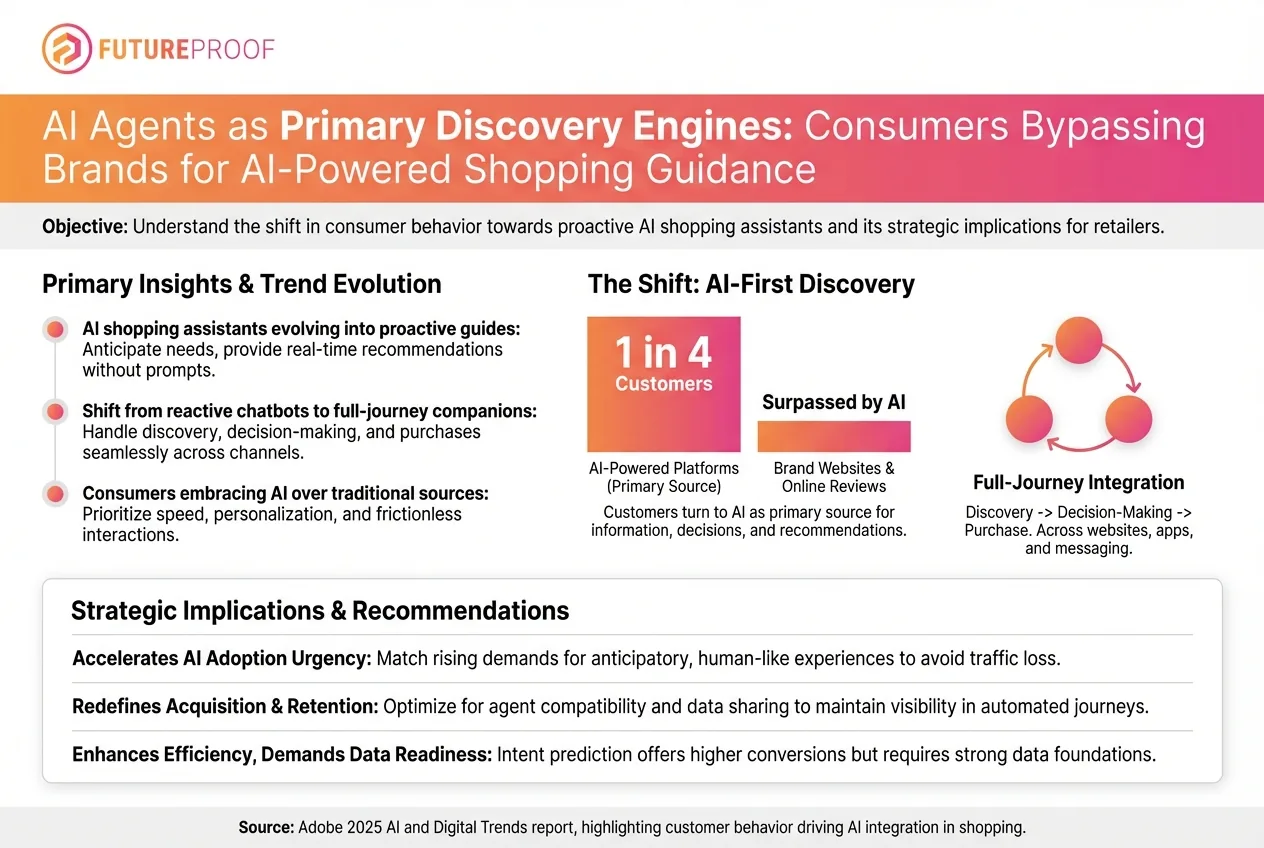
The landscape of consumer discovery and purchasing is undergoing a seismic transformation, fundamentally reshaping how retailers acquire and retain customers. For decades, the journey from awareness to acquisition relied heavily on brand websites, traditional search engines, and the democratic, albeit often chaotic, landscape of online reviews. Today, a new dominant force is emerging: AI agents. These sophisticated digital assistants are rapidly becoming the primary discovery engines in shopping, a profound shift that necessitates an urgent recalibration of retail strategies. Consumers are increasingly bypassing conventional channels, opting instead for the seamless, personalized, and proactive guidance offered by advanced AI.
This isn't merely an incremental evolution; it's a revolutionary redefinition of the retail funnel. Modern AI agents are far more than simple chatbots or recommendation engines. They possess an advanced capacity to anticipate consumer needs, often before the consumer explicitly articulates them, by analyzing vast troves of data including past behaviors, preferences, contextual cues, and even emotional states inferred from interactions. They excel at real-time product comparisons, sifting through millions of options to present the most relevant choices tailored to individual criteria. Crucially, these AI-powered systems don't just facilitate a single transaction; they actively support and guide the entire buying journey across myriad channels, from initial research and comparison to purchase, post-purchase support, and even future engagement. This comprehensive, always-on assistance liberates consumers from the often overwhelming task of navigating countless websites and conflicting reviews, offering instead a curated, efficient, and highly personalized path to purchase.
For retailers, this paradigm shift changes the fundamental rules of engagement. Visibility, once secured through SEO on traditional search engines, compelling website design, and aggressive digital advertising, now increasingly depends on an entirely new metric: how effectively products and services are structured, presented, and understood by AI agents. The ability to be discovered, recommended, and ultimately chosen hinges on the underlying data architecture a retailer possesses. In an environment where AI is the gatekeeper of discovery, robust data foundations and unified customer insights are no longer aspirational goals but urgent, critical priorities. Automated shopping journeys are no longer a distant futuristic concept; they are taking hold right now, demanding immediate strategic adaptation.
The data unequivocally supports this accelerated shift. According to the Adobe 2025 AI and Digital Trends Report, a compelling one in four customers already rely on AI platforms as their primary source for information and purchase decisions. This staggering statistic underscores the velocity and magnitude of the change, signaling that AI-driven guidance is now surpassing the influence of established brand websites and traditional online reviews. This isn't a niche trend but a significant mainstream adoption, indicating a widespread consumer trust and preference for AI-powered shopping assistance. Retailers who fail to recognize and adapt to this new reality risk becoming invisible to a rapidly growing segment of the market.
The implications for customer acquisition are profound. Historically, acquisition revolved around drawing customers to a brand's owned digital properties. Now, AI agents often serve as the first point of contact, acting as intelligent intermediaries. If a retailer's products are not optimally structured for AI consumption, they simply won't appear in the curated recommendations presented to consumers. This demands a shift from optimizing for human-readable content on web pages to optimizing for machine readability and semantic understanding by AI algorithms. Product descriptions must be rich in structured data, precise in attribute definitions, and contextually relevant to the myriad queries an AI agent might process. The AI is not just searching for keywords; it is interpreting intent, comparing detailed specifications, and matching complex user preferences with appropriate products.
Customer retention also undergoes a significant transformation. Traditional retention strategies often focused on loyalty programs, email marketing, and personalized website experiences. In the age of AI agents, retention is increasingly driven by the seamless, consistent, and highly personalized experiences facilitated by these intelligent systems. When an AI agent consistently provides relevant recommendations, anticipates future needs, and simplifies repeat purchases, it fosters a deeper level of loyalty, not necessarily to a specific website, but to the integrated, friction-free shopping experience itself. Retailers must ensure their customer data is unified and accessible to these AI systems, allowing for continuity in personalized interactions even when the consumer engages with a different AI platform.
The imperative for robust data foundations cannot be overstated. At the core of every effective AI agent is vast, high-quality data. For retailers, this translates into an urgent need to meticulously organize, enrich, and maintain their product information. Product Information Management (PIM) systems become indispensable, serving as the single source of truth for all product data, from basic specifications like dimensions and materials to richer content like high-resolution images, video demonstrations, sustainability certifications, and user-generated reviews. This data must be structured in a way that AI agents can easily parse, categorize, and cross-reference, often requiring extensive use of schema markup (e.g., Schema.org) and other structured data formats. Without this foundational layer, products remain opaque to AI, rendering them invisible in the discovery phase.
Beyond basic product attributes, AI agents thrive on contextual richness. They need to understand not just what a product is, but how it's used, who it's for, what problems it solves, and how it compares to alternatives across a multitude of factors. This means retailers must invest in comprehensive content strategies that cater specifically to AI understanding. This includes detailed use-case scenarios, compatibility information, cross-sell and up-sell associations, and even sentiment analysis derived from customer feedback. The goal is to provide AI agents with all the necessary ingredients to construct an intelligent, comprehensive, and persuasive recommendation for the consumer. This isn't about keyword stuffing; it's about semantic completeness and logical data relationships.
Equally critical is the establishment of unified customer insights. AI agents excel at personalization, but their effectiveness is directly proportional to the depth and breadth of customer data they can access and analyze. Retailers must break down data silos and integrate information from every touchpoint – online purchases, in-store interactions, browsing behavior, customer service inquiries, social media engagement, and app usage – into a cohesive Customer Data Platform (CDP). This unified view allows AI agents to build holistic customer profiles, understanding individual preferences, purchase histories, stated needs, and implicit desires. Without this 360-degree view, personalization efforts remain superficial, and AI recommendations fall short of their potential. The ability to connect disparate data points allows AI to anticipate needs, suggest complementary products, and offer truly bespoke guidance, fostering deeper engagement and loyalty.
The shift towards AI-powered discovery also compels retailers to re-evaluate their content creation strategies. Product descriptions must move beyond marketing copy designed for human consumption and embrace a data-first approach optimized for AI interpretation. This involves leveraging natural language processing (NLP) to understand common queries and intent, ensuring product content addresses these directly and comprehensively. Metadata becomes paramount, with every product attribute, feature, and benefit meticulously tagged and categorized. This ensures that when an AI agent processes a complex query like "sustainable running shoes for flat feet with maximum cushioning under $150," it can accurately filter and present relevant options, complete with detailed explanations for its recommendations.
Retailers must also prepare for a future where AI agents not only recommend but actively participate in the buying process, potentially even making purchases on behalf of consumers based on pre-set parameters and preferences. This necessitates robust integration with payment systems, inventory management, and fulfillment logistics, all orchestrated through seamless API connections. The entire operational backend must be as AI-ready as the customer-facing content. This also brings forth the importance of ethical AI deployment and data privacy, ensuring that AI-driven personalization is transparent, respectful of user consent, and secure. Building trust with consumers through responsible data practices will be paramount for widespread adoption and sustained engagement with AI-powered shopping.
The implications for brand building are also significant. Traditionally, brand identity was cultivated through consistent messaging, visual aesthetics, and direct customer interactions. In an AI-mediated world, a brand's essence must be effectively communicated through data points and semantic understanding. How does an AI agent convey a brand's commitment to quality, sustainability, or luxury? It does so by processing structured data points about materials, manufacturing processes, certifications, and customer reviews that explicitly mention these attributes. Brands need to actively curate this data-driven narrative, ensuring their values and unique selling propositions are machine-readable and accurately interpreted by AI.
In conclusion, the rise of AI agents as primary discovery engines represents a transformative moment for retail. The era of passive discovery through broad search queries and independent website exploration is rapidly giving way to active, anticipatory, and personalized guidance provided by intelligent systems. The Adobe 2025 AI and Digital Trends Report provides undeniable evidence of this shift, with one in four customers already preferring AI platforms for their purchase decisions. For retailers, the challenge and opportunity lie in adapting with urgency and foresight. Success in this new paradigm hinges on two critical pillars: creating robust, meticulously structured data foundations that enable AI agents to fully comprehend and recommend products, and unifying customer insights to fuel truly personalized and seamless buying journeys. Those who embrace an AI-first strategy, prioritizing data quality, semantic content, and omnichannel integration, will not only survive but thrive, securing unparalleled visibility and cultivating deep, lasting customer relationships in the rapidly evolving landscape of automated commerce. The future of retail discovery is here, and it speaks the language of AI.