How AI Shopping Agents Are Redefining Brand Loyalty in the New Era of Algorithmic Commerce
The digital landscape of commerce is undergoing a profound transformation, fundamentally reshaping the very bedrock of brand loyalty. For generations, consumer allegiance was built on a complex tapestry of emotional connection, habit, trust, and aggressive marketing. Brands invested heavily in crafting narratives, fostering familiarity, and creating emotional resonance, betting that these intangible bonds would translate into repeat purchases. Today, however, a new, powerful arbiter is emerging at the heart of the purchasing decision: the AI shopping agent. These intelligent systems are not merely tools; they are becoming primary discovery channels and decision-makers, fundamentally re-evaluating what makes a brand "loyal-worthy" in the eyes of the consumer, and more importantly, in the algorithms that guide them.
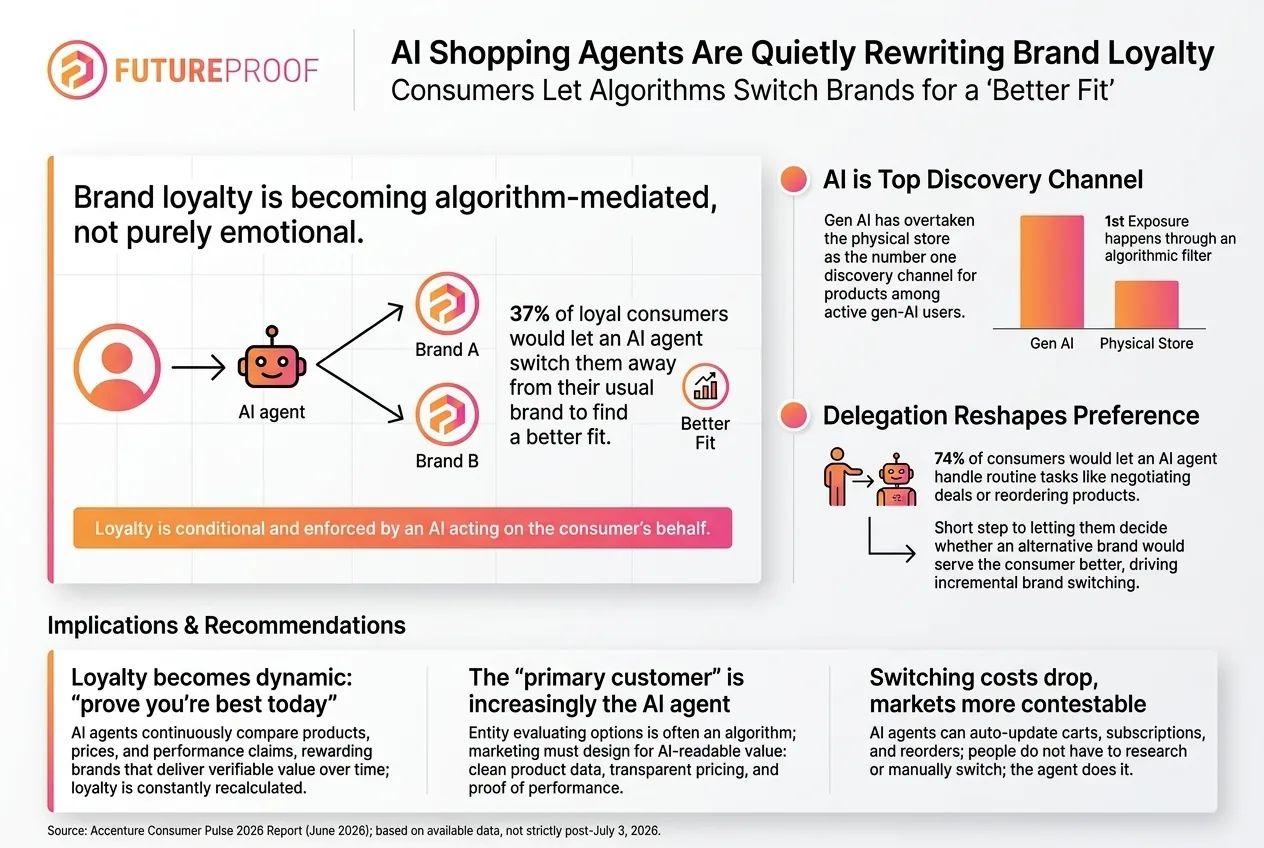
This seismic shift isn't theoretical; it's already a tangible reality. Accenture’s Consumer Pulse 2026 report delivers a stark revelation: a significant 37 percent of behaviorally loyal consumers, those who consistently choose a brand out of habit, would readily allow an AI agent to switch them to an alternative if it better aligns with their needs. This statistic alone underscores the fragility of traditional loyalty and the immense power AI is beginning to wield. Loyalty, once a deeply personal and often emotional commitment, is rapidly morphing into an objective, algorithmic evaluation. Brands can no longer rest on their laurels, assuming past performance or established recognition will guarantee future sales. In this AI-driven era, continuous value creation, demonstrable performance, and an AI-friendly design paradigm are not just advantageous—they are existential necessities.
The Rise of the Algorithmic Gatekeepers: AI Shopping Agents
To understand the profound impact of AI on brand loyalty, one must first grasp the evolving role of AI shopping agents. These are not just simple chatbots or recommendation engines; they are sophisticated, autonomous entities capable of understanding nuanced user preferences, analyzing vast datasets, and executing complex purchasing decisions. Leveraging machine learning, natural language processing, and predictive analytics, these agents move beyond mere suggestions to actively manage and optimize a consumer's entire purchasing ecosystem.
Their ascent as a primary discovery channel is particularly disruptive. Historically, discovery was driven by search engines, social media trends, peer recommendations, and traditional advertising. Now, an AI agent, deeply integrated into a consumer's digital life, acts as an intelligent filter and proactive scout. It understands your dietary restrictions, your budget constraints, your preferred delivery times, your ethical concerns (e.g., sustainability, fair trade), and even your aesthetic preferences across various product categories. It doesn't wait for you to search; it anticipates your needs, evaluates the market, and presents optimal solutions—often before you even realize you need them.
Moreover, AI agents are taking over routine purchasing tasks that once formed the bedrock of habitual brand loyalty. Reordering household staples, managing subscriptions, comparing prices across myriad retailers, and even identifying alternative products based on specific criteria (e.g., "find me a gluten-free, organic pasta that's available for same-day delivery") are all becoming automated functions. The cognitive load associated with these tasks, which often kept consumers tethered to familiar brands simply for convenience, is being entirely offloaded to the AI. This means the friction of switching, once a significant deterrent, is virtually eliminated. The AI isn't loyal to your past choices; it's loyal to your current, dynamically evolving best interests as it understands them through its algorithms.
The Erosion of Traditional Brand Loyalty: From Emotion to Algorithm
Traditional brand loyalty was a cherished asset, meticulously cultivated over years. It was built on emotional habit—the comfort of the familiar, the trust in a consistent experience, the psychological connection forged through memorable marketing campaigns and positive past interactions. Consumers might stick with a particular coffee brand not necessarily because it was objectively superior, but because it evoked a feeling of home, or because their parents always bought it, or simply because it was "their brand." These emotional anchors created a powerful barrier against competitors, making switching a conscious, often effortful decision.
AI agents are dismantling these emotional anchors piece by piece. When an AI takes over purchasing decisions, the emotional narrative of a brand becomes secondary, if not irrelevant. The agent doesn't "feel" loyalty; it processes data. It doesn't recall a nostalgic advertisement; it evaluates performance metrics. The Accenture statistic – 37 percent of behaviorally loyal consumers willing to switch – is a testament to this shift. These are consumers who have habitually chosen a brand, perhaps for years, but are now willing to delegate that choice to an impartial algorithm. This isn't a betrayal; it's an optimization. Consumers are implicitly trusting the AI's ability to find a better fit, implicitly acknowledging that their emotional habit might not be serving their "best needs" as effectively as an objective evaluation.
This psychological outsourcing of decision-making has profound implications. For the consumer, it offers unparalleled convenience and the promise of always getting the optimal product or service. For brands, it means that the emotional connection, while still valuable in human-to-human interactions and aspirational branding, carries significantly less weight at the point of purchase. Loyalty shifts from an outcome of habit and trust to a continuous state of algorithmic validation. If a competing brand offers a product that the AI agent determines to be a superior match based on its parameters—be it price, features, availability, sustainability score, or user reviews—the switch will be instantaneous and frictionless. The brand must continuously earn its place, not just in the consumer's heart, but in the AI's complex calculations.
The New Imperative: Continuous Value Validation
In this new paradigm, brands face an existential imperative: they must continuously prove their value. The AI agent acts as an agnostic evaluator, devoid of brand bias. It has no predisposition towards established market leaders or sentimental attachments to legacy products. Its sole function is to identify and recommend the best available option according to the parameters it has been given (explicitly by the user or implicitly through learned behavior).
This means that a brand's reputation, built over decades, can be overridden in a split second by an algorithm deeming a competitor's offering to be a better current fit. The "algorithmic evaluation" process is rigorous and relentless. What metrics might an AI agent prioritize?
- Price: Always a factor, but not necessarily the only one. AI can weigh price against perceived value.
- Features & Specifications: Clear, quantifiable benefits are crucial. Can the AI easily understand what your product does and how it compares?
- Availability & Delivery Speed: Real-time inventory and efficient logistics become key differentiators.
- Customer Reviews & Ratings: Aggregated user sentiment provides invaluable data for AI.
- Sustainability & Ethical Sourcing: As consumer priorities shift, AI agents will be programmed to factor in these data points, requiring transparent reporting from brands.
- Return Policies & Customer Service Responsiveness: The post-purchase experience is integral to the overall "value" proposition.
- Unique Selling Propositions (USPs): Can your USPs be clearly articulated and quantified for an AI to understand their benefit?
For legacy brands, this is a particularly challenging shift. Those accustomed to resting on market dominance or the strength of their brand name will find their foundation eroding. Agility, responsiveness, and an unwavering commitment to innovation become paramount. Brands must adopt a mindset of continuous improvement, not just in their products, but in how their products are presented and evaluated by AI. The question moves from "Are we a beloved brand?" to "Are we the optimal choice, right now, according to the data?"
A New Competitive Dynamic: Lower Switching Costs, Higher Stakes
The advent of AI shopping agents dramatically lowers switching costs, creating an unprecedented competitive dynamic. Historically, switching brands involved effort: researching alternatives, reading reviews, comparing prices, and often navigating new purchasing processes. This friction, whether conscious or subconscious, often kept consumers tethered to familiar options, even if they weren't perfectly satisfied.
AI agents obliterate this friction. The "cost" of switching becomes negligible. With a simple voice command or a tap on an app, an AI can instantaneously identify, compare, and reorder from a different brand. "Alexa, reorder my laundry detergent... actually, is there a more eco-friendly option with good reviews for a similar price?" The AI processes this, finds the optimal alternative, and executes the purchase. The consumer expends minimal effort, and the brand loses a customer without even a direct interaction or complaint.
This ease of switching fundamentally intensifies competition. Suddenly, smaller, more agile brands, or even direct-to-consumer startups, can compete on a level playing field if their product or service genuinely offers superior value. Market share will be less about who shouts the loudest or has the largest advertising budget, and more about who consistently delivers tangible, quantifiable benefits that an AI can recognize and reward.
"Real performance matters more" becomes the mantra. This means performance in every sense: product quality, pricing, delivery efficiency, post-purchase support, ethical sourcing, and even the clarity and accessibility of product data. Brands must move beyond superficial branding and invest in the core excellence of their offerings. The stakes are higher than ever before. Every product iteration, every supply chain optimization, every customer service interaction, and every piece of data shared about the product becomes a critical factor in retaining or losing customers to an AI-driven switch. Losing out in an AI evaluation means losing a sale, possibly permanently, as the AI might simply continue to recommend the "better" alternative in subsequent interactions.
Designing for the Algorithm: Winning in the AI-Driven Marketplace
1. Products Designed for Algorithmic Evaluation:- Modularity and Clear Feature Sets: Products should have clearly defined features and specifications that AI can easily categorize and compare. Ambiguity or overly complex descriptions will hinder algorithmic understanding.
- Quantifiable Benefits: Articulate product benefits in measurable terms. Instead of "superior comfort," think "50% more breathable fabric" or "ergonomic design reduces pressure points by 30%."
- Transparency and Verification: AI agents will increasingly verify claims. Brands must be prepared to back up performance metrics, sustainability claims, and ingredient lists with verifiable data.
- Customization and Personalization Options: Products that offer adaptable features or personalized configurations can appeal to AI agents looking to match exact consumer needs.
- Sustainability and Ethical Footprint: As AI integrates more complex parameters, brands need to explicitly design products with verifiable sustainability credentials and ethical sourcing, making this data easily accessible.
- Structured Product Data: This is paramount. Brands need robust, API-friendly product feeds with clear attributes, consistent nomenclature, and up-to-date information. Think product information management (PIM) systems on steroids.
- Metadata Optimization: Beyond basic product descriptions, brands must optimize metadata to ensure their products are correctly categorized and discoverable for specific queries an AI might process.
- Real-time Inventory and Pricing: AI agents thrive on real-time data. Outdated inventory or pricing information can lead to missed opportunities or, worse, an AI agent recommending a competitor.
- Customer Reviews and Ratings Integration: Positive, authentic customer reviews are powerful data points for AI. Brands should actively encourage and manage reviews, ensuring they are easily accessible to AI platforms.
- API Strategy: Brands must develop APIs that allow AI agents to seamlessly access product information, pricing, inventory, and even customer support resources.
- Seamless Post-Purchase Experience: An AI agent's evaluation doesn't stop at purchase. Efficient delivery, easy returns, and responsive customer support are critical for maintaining a high "performance score" in the AI's algorithm.
- Digital-First Interactions: AI agents communicate digitally. Brands need to ensure their digital channels (website, app, chat support) are optimized for machine readability and efficiency.
- Proactive Problem Solving: If an AI agent detects a potential issue (e.g., a delayed delivery, a product recall), brands need mechanisms to address it proactively and transparently, either directly with the consumer or via the AI.
- Personalization for the AI: Brands need to understand that personalization now extends to how the AI interprets and presents their offerings based on the consumer's deep profile. This means offering product variations or bundles that an AI can easily match to specific user segments.
- Value Beyond the Transaction: While algorithms are objective, the underlying consumer still values benefits. Loyalty programs, membership perks, and value-added services should be designed in a way that an AI can recognize and factor into its "better fit" calculations.
Strategies for Brands to Thrive
Adapting to this AI-driven loyalty landscape requires strategic foresight and significant investment. Brands must:
- Invest Heavily in Data Infrastructure: Prioritize clean, structured, and real-time product information accessible via robust APIs. This is the new language of commerce.
- Focus on Core Product Excellence and Continuous Innovation: Superficial branding won't cut it. The product itself must consistently deliver superior value and evolve with consumer needs.
- Prioritize Digital Customer Experience: Ensure seamless online interactions, from discovery to post-purchase support, as these are the touchpoints AI agents will evaluate.
- Understand AI's Evaluation Criteria: Actively research and anticipate what metrics AI platforms will prioritize and design products and strategies to optimize for those criteria.
- Embrace Transparency: Authenticity and verifiable claims will build trust, not just with consumers but with the algorithms that filter information.
- Cultivate an "AI-Friendly" Brand Narrative: Frame brand benefits and unique selling propositions in data-driven, quantifiable terms that AI agents can easily process and translate into recommendations.
The era of emotional brand loyalty, while not entirely gone, is undeniably being challenged by the cold, hard logic of algorithms. AI shopping agents are not just changing how consumers shop; they are fundamentally redefining the competitive landscape and what it means to be a "loyal" brand. Brands that recognize this shift, embrace the challenge, and proactively design for algorithmic evaluation—focusing on exceptional product performance, robust data strategies, and seamless digital experiences—will be the ones that not only survive but thrive in this exciting, yet demanding, new chapter of commerce. The future of brand loyalty is algorithmic, and the time to adapt is now.