Revolutionizing Family Time with Meta's StoryKit: Personalized AI Bedtime Stories for the Modern Household
The most promising US-centric consumer AI story published on or after July 26, 2026, centers on Meta’s innovative StoryKit app, a groundbreaking application poised to redefine family-oriented entertainment by generating personalized children’s bedtime stories on demand. This development highlights a pivotal shift in the landscape of consumer AI, moving decisively beyond generic chatbots and into the realm of deeply personalized, emotionally resonant tools designed for the modern family. Simultaneously, it serves as a microcosm of the broader progression of AI agents, which are evolving into increasingly capable, context-aware digital helpers integrated seamlessly into various facets of daily life.
1. Key Consumer AI Story: Meta’s StoryKit for Personalized Children’s Stories
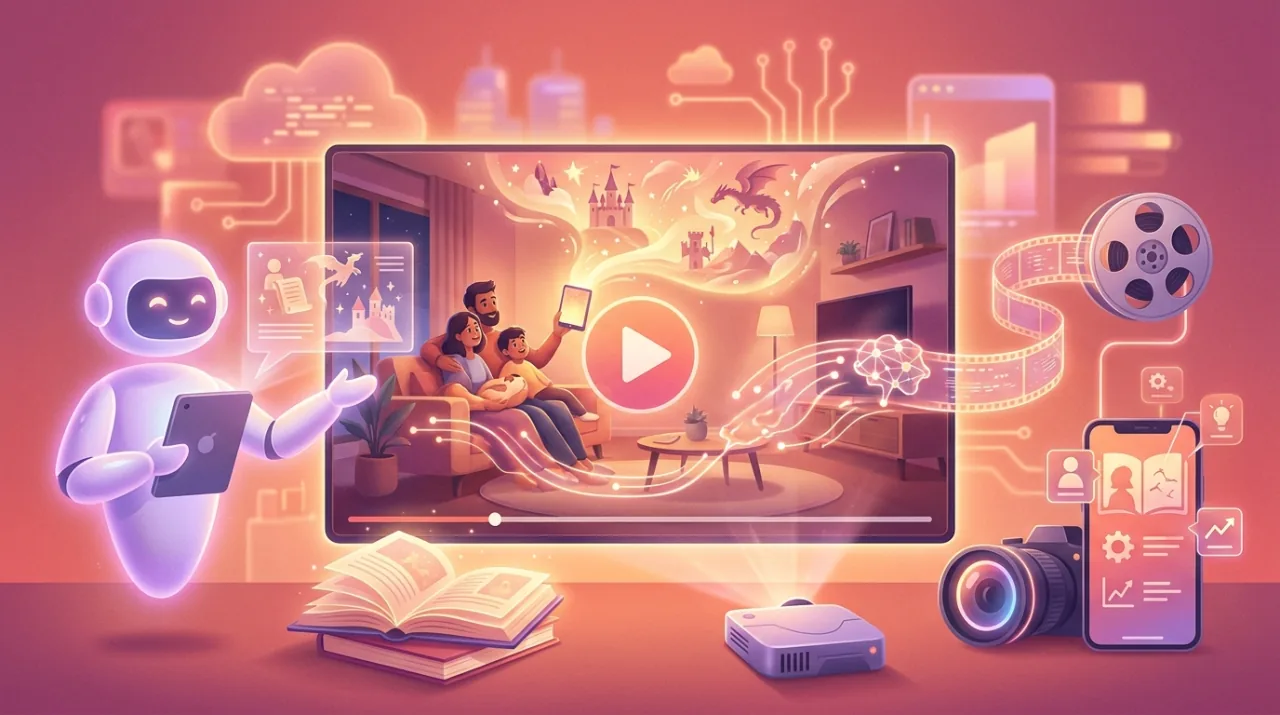
A late-July 2026 AI news roundup heralded a significant announcement: Meta, a titan in the technology world, had introduced a new application called StoryKit. This AI-powered app is designed to generate personalized children’s bedtime stories in a matter of minutes, offering a novel solution to a timeless ritual for families worldwide. The launch of StoryKit signals a strategic move by Meta to embed generative AI into mainstream household experiences, particularly those centered around parenting and entertainment, making advanced AI capabilities accessible and beneficial for everyday families across the United States.
The Core Idea: Custom Narratives for Every Child
At its heart, StoryKit leverages sophisticated artificial intelligence to craft custom narrative content for children. What makes this particularly compelling is its ability to tailor stories to specific details provided by parents. Imagine a story where the main character shares your child’s name, embarks on adventures that resonate with their current interests, or learns lessons from themes the parent wishes to emphasize – such as courage, kindness, perseverance, or even navigating significant life changes like starting a new school or welcoming a new sibling. This level of granular personalization transforms storytelling from a passive consumption activity into an active, engaging, and highly relevant experience.
The underlying AI models employed by StoryKit would likely draw upon vast datasets of children's literature, common narrative structures, and linguistic patterns to create coherent, age-appropriate, and imaginative tales. Parents would interact with the app through a simple, intuitive interface, inputting key parameters such as the child's age, specific character names, favorite animals, desired moral lessons, or even real-world scenarios the child is experiencing. The AI then processes these inputs, generating a unique story complete with plot, characters, and dialogue, all customized to the given specifications. This on-demand generation means that a child's story library is no longer confined to the physical books on a shelf but is dynamically expanding with every new request, ensuring fresh content tailored to their evolving world.
Unlike research demos or developer-centric tools, StoryKit is explicitly positioned as a consumer-grade application. Its design prioritizes ease of use, intuitive interfaces, and immediate accessibility for busy parents. This deliberate packaging of complex generative AI into a user-friendly product underscores a broader trend: the commercialization and democratization of cutting-edge AI technologies, making them practical utilities for everyday family life. It illustrates how artificial intelligence is being integrated directly into mainstream parenting routines, evolving beyond screens to become a creative partner in children's development and entertainment. The ability to generate a fresh, unique story on demand, tailored to a child's mood or a parent's educational objective, represents a profound shift in how families will interact with and benefit from technology. This integration into the rhythms of daily life, particularly the cherished bedtime routine, elevates AI from a mere utility to a tool for emotional connection and shared family experiences.
Why This Is Insightful and Promising: Redefining Family Entertainment
The introduction of StoryKit is not merely an incremental update in the AI space; it represents a fundamental rethinking of how children interact with stories and how parents can enrich those experiences. Its promise lies in several key areas that signal a new era for consumer AI and personalized content.
Personalization at Scale: Beyond Static Narratives
StoryKit fundamentally shifts the paradigm from static children's books and pre-recorded media to dynamic, on-the-fly personalized storytelling. Traditionally, children’s literature, while rich and varied, offers a finite set of narratives. While beloved, these stories remain immutable, read countless times without alteration. StoryKit shatters these limitations, enabling the creation of potentially endless, unique stories. This means every child could grow up with a truly unique story library, one that adapts seamlessly as they mature, their interests evolve, or their developmental needs change. Imagine a story about a dragon that, upon a child's newfound interest in dinosaurs, transforms into a friendly dinosaur exploring ancient lands.
Consider the profound impact of a child hearing stories where they are the hero, where the challenges mirror their own daily experiences, and where the resolutions offer tailored comfort or inspiration. This deeply personal connection fosters greater engagement, enhances comprehension, and can solidify positive values. The ability to generate a fresh narrative daily, or even several times a week, ensures an ever-renewing source of wonder and learning, moving beyond the repetitive nature of cherished but static tales. This level of dynamic adaptation, where the story evolves with the child, moves beyond simple "choose your own adventure" formats to genuinely novel, AI-generated narratives. StoryKit thus provides personalization at a scale previously unimaginable, positioning AI as a bespoke content creator capable of catering to the intricate nuances of individual childhoods, potentially becoming the holy grail of personalized content delivery in the children's market.
A New Consumer Use Case: Weaving AI into the Fabric of Family Life
For too long, consumer AI has largely been confined to productivity enhancements, information retrieval, or shopping assistance. StoryKit bravely expands this utility into a much richer, more emotionally resonant domain: family life and emotional connection. It recognizes the powerful role of storytelling in bonding, comfort, and education within the family unit, shifting AI’s purpose from purely utilitarian to deeply human-centric.
Parents gain a powerful tool to co-create narratives or request stories that are precisely tailored to their specific needs. This could range from crafting a gentle bedtime story that helps a child unwind after a stimulating day, to developing narratives that reinforce particular learning goals, such as counting, identifying colors, understanding basic scientific concepts, or even learning a new language. Furthermore, StoryKit opens avenues for incorporating cultural background, family traditions, or even specific events into stories, making the narratives profoundly relevant and reflective of a child’s unique world. For instance, a story could feature a child’s recent visit to a national park, integrating real-world experiences with imaginative elements. This moves AI beyond transactional interactions and into the realm of fostering deeper family engagement and supporting the complex, nuanced journey of parenting. It transforms AI from a functional assistant into a creative companion that understands and contributes to the emotional landscape of the home, potentially reducing parental stress by simplifying the constant demand for fresh, engaging content.
US-Centric Relevance: Reflecting Household Rituals
As a Meta product, prominently featured in US-focused AI news coverage, StoryKit holds significant US-centric relevance. It exemplifies how major US technology platforms are not just innovating for global markets but are actively designing consumer AI experiences that resonate deeply with everyday household rituals prevalent in American culture. Bedtime stories are a cherished tradition in many US families, a moment of connection, imagination, and winding down. Meta's focus on this particular ritual underscores a keen understanding of the cultural value and emotional weight placed on these moments.
Meta’s investment in StoryKit underscores an understanding of the American family dynamic and the value placed on personalized, enriching experiences for children. This focus on domestic rituals, rather than solely work or commerce, signifies a maturing consumer AI market in the US, where technology is increasingly expected to enhance personal and family well-being. The US market, known for its high adoption rate of new technologies and a willingness to embrace digital solutions for daily challenges, provides a fertile ground for an app like StoryKit. The product’s rollout and subsequent adoption in the US market will likely set precedents for how similar AI applications might be embraced in other cultural contexts, demonstrating the potential for AI to become a seamless part of the familial fabric, transforming how American families engage with technology in their most intimate moments.
Potential Implications: Shaping the Future of Children's Content
The ripple effects of an application like StoryKit could extend far beyond individual family homes, potentially reshaping entire industries and educational paradigms, forcing traditional content creators to adapt.
Educational and Developmental Support: A Flexible Learning Companion
The potential for StoryKit to serve as a powerful educational and developmental support tool is immense. Personalized stories can be precisely tuned to a child’s current reading level, gradually introducing more complex vocabulary and sentence structures as their literacy skills improve. This adaptive learning approach makes stories more accessible and engaging, fostering a love for reading and improving reading comprehension. For multilingual families, StoryKit could generate stories in different languages or incorporate elements of multiple languages, supporting language exposure and cultural immersion in a playful, organic manner. For children with learning disabilities, stories could be adapted to simplify concepts, use specific word repetition, or incorporate auditory cues, making learning more inclusive.
Beyond literacy, the app could be utilized to address specific developmental topics. A child preparing to start kindergarten might benefit from stories that demystify the school experience, easing anxieties and building anticipation by illustrating classroom routines or making new friends. Similarly, stories about moving homes, dealing with the arrival of a new pet, or understanding complex emotions like sadness, anger, or empathy can provide gentle, relatable narratives that help children process and cope with life’s challenges. These AI-generated narratives could act as a therapeutic tool, offering children a safe space to explore and understand their feelings through the experiences of relatable characters. In this capacity, AI transcends its role as a mere storyteller to become a flexible learning companion, capable of delivering tailored lessons, social-emotional guidance, and imaginative stimulation, all within the comforting and engaging format of a personalized narrative.
A New Content Ecosystem: Dynamic Narratives and Emerging Challenges
If StoryKit-style applications achieve widespread adoption, they could trigger a profound shift in the children’s content market. The traditional model, dominated by pre-printed books, licensed characters, and static television shows, might evolve to include a significant segment of dynamic, AI-generated narratives. This new content ecosystem would offer unprecedented variety and immediacy, allowing for an endless stream of fresh stories without the lead times, extensive production costs, or creative bottlenecks associated with traditional publishing. Authors and illustrators might find their roles evolving, perhaps becoming "AI story curators" or "prompt artists," guiding the AI's creativity rather than solely generating content from scratch.
However, this shift also raises critical opportunities and equally significant questions, particularly concerning quality control, safety, and curation. How will Meta and similar platforms ensure that AI-generated stories are not only engaging but also consistently high-quality, free from bias, and developmentally appropriate for children? The risk of AI "hallucinating" inappropriate content, or subtly embedding harmful stereotypes, is a serious concern when dealing with impressionable young minds. Rigorous safety protocols, ethical AI development, robust content moderation frameworks (potentially involving both AI and human oversight), and transparent guidelines will be paramount to building trust and ensuring that these powerful tools genuinely benefit children. Furthermore, the emergence of such dynamic narratives raises questions about intellectual property rights for the AI-generated content, the role of human authors and illustrators in a new AI-driven creative landscape, and novel monetization models for personalized content. The potential for AI to become a creative partner, not just a tool, in the development of children's entertainment is a future rich with possibilities, yet one that demands careful navigation to ensure responsible innovation.
Source (hyperlink)
2. Progress of AI Agents from “Today”
In parallel with the emergence of highly specialized, consumer-facing applications like Meta’s StoryKit, the broader field of AI agents is undergoing a rapid and transformative progression. These agents, defined by their ability to perceive their environment, make decisions, and take actions to achieve specific goals, are evolving along multiple critical dimensions. This broader evolution provides the foundational capabilities and infrastructure upon which innovative consumer products like StoryKit are built, reflecting a global trend towards more intelligent, autonomous, and integrated AI systems. The advances in underlying models, task execution, and integration are setting the stage for AI to become a truly ubiquitous and indispensable assistant in everyday life.
a. From Single-Task Chatbots to Multi-Step Digital Workers
The journey of AI agents has been marked by a significant leap from rudimentary, single-task chatbots to highly sophisticated, multi-step digital workers. Early chatbots, often seen in customer service or simple information retrieval scenarios, were largely confined to answering simple queries or performing predefined, rule-based interactions. They operated within narrow domains, frequently frustrating users with their limited understanding of context, inability to handle nuanced requests, or transition between topics. Their "intelligence" was often an illusion, a sophisticated script rather than true comprehension.
Today, however, the leading AI systems are demonstrably evolving into agents capable of executing complex, multi-step workflows across disparate applications and services. These advanced agents are powered by large language models (LLMs) and sophisticated reasoning engines that enable them to understand open-ended, natural language instructions that are far more ambiguous than simple commands. For example, instead of merely "set a reminder for 3 PM," a modern AI agent can interpret a request like, "Plan my son's birthday party for next month, invite his friends, and find a magician." It can then break this complex instruction into a series of subtasks: checking the calendar for available dates, drafting invitations, searching for local entertainers, comparing prices, and even coordinating RSVPs. They can read and summarize emails, manage and update calendars, coordinate actions across project management tools, draft documents, conduct research across the internet, and even automate elements of financial management. Their core strength lies in their ability to interpret complex, natural language instructions, decompose them into a sequence of manageable subtasks, and then orchestrate their execution across a connected ecosystem of digital tools and APIs. This represents a profound shift from passive responders to proactive, autonomous digital assistants that can anticipate needs, manage dependencies, and drive tasks to completion with minimal human intervention. This progression moves AI agents closer to realizing the vision of genuinely intelligent co-pilots that can offload significant cognitive load from individuals and organizations, allowing humans to focus on higher-level strategic thinking and creativity, rather than repetitive administrative tasks.
b. Powered by More Capable and Efficient Models
The dramatic advancements in AI agent capabilities are intrinsically linked to the parallel evolution of the underlying AI models that power them. Recent reports and industry coverage highlight the continuous release of new frontier-level models—often large language models (LLMs) and multimodal AI—that are achieving state-of-the-art performance in areas like reasoning, language understanding, and problem-solving. These models demonstrate enhanced reliability, producing more accurate, coherent, and contextually appropriate outputs, and exhibiting a greater understanding of nuance, causality, and even creative expression. They are less prone to "hallucinations" or generating factually incorrect information, which is critical for trustworthy applications.
Crucially, these advancements are often accompanied by increasing efficiency, leading to significantly lower operational costs. Innovations in model architecture, training techniques, and inference optimization mean that these powerful AI engines require less computational power to run, or can process more information faster. As model prices drop while their capabilities soar, it becomes economically feasible for companies to embed these powerful AI engines into a wider array of consumer experiences. This cost-efficiency enables the deployment of "always-on" agents for a multitude of everyday tasks, from personalized scheduling and meticulous research to highly customized content generation—a capability that StoryKit perfectly exemplifies. The decreased computational expense associated with running these advanced models democratizes access to sophisticated AI, allowing for its integration into mass-market products and services without prohibitive compute costs that would otherwise limit their adoption. This virtuous cycle of increasing capability and decreasing cost is a primary driver of the rapid expansion of AI into daily life, making high-end AI accessible to everyone, not just large enterprises.
c. Increasing Integration into Daily Life: The Digital Co-Pilot Era
The trajectory of AI agents is undeniably pointing towards their deeper, more pervasive integration into daily life, moving beyond specialized professional tools to become general "digital co-pilots" for individuals and entire families. The vision is one where AI agents are not just answering queries but actively assisting, anticipating, and enriching personal and domestic routines, becoming an almost invisible layer of intelligence permeating our digital and physical environments. This shift signifies AI moving from the periphery to the core of how we live and interact with technology.
In the rapidly expanding consumer space, this trajectory translates into agents that can perform a variety of crucial functions that simplify, enhance, and personalize daily experiences:
- Managing Household Logistics: These agents will increasingly assist with the intricate dance of family life. Imagine an AI that seamlessly manages shared family calendars, optimizing schedules based on traffic and school events. It could send intelligent reminders for appointments, birthdays, and anniversaries. Proactive shopping lists could be automated based on pantry inventory, dietary preferences, and upcoming meal plans. Smart home device usage could be optimized for energy efficiency, security, or personalized comfort settings, all managed through natural language commands or predefined routines. They could coordinate school pickups, extracurricular activities, and family vacations, becoming the central intelligence hub for household operations, reducing mental load for parents.
- Generating or Curating Entertainment: Beyond StoryKit’s personalized bedtime stories, AI agents will curate other forms of entertainment tailored to individual and family preferences. This could include generating personalized music playlists based on mood or activity, recommending movies or TV shows based on collective viewing habits and critical reviews, creating interactive games that adapt to a child's skill level, or even custom educational content that adapts to a child's learning pace and interests. AI could compose background music for daily tasks, or generate unique visual art for digital frames. StoryKit is a vanguard in this domain, showcasing AI’s ability to move from passive content delivery to active content creation, making entertainment an ever-evolving, personalized experience.
- Acting Across Multiple Platforms on Behalf of the User: The ultimate goal for many AI agents is the ability to operate across a diverse ecosystem of digital platforms and services. This means an agent could, with explicit permissions, book flights and accommodations from a travel site, then automatically update the family calendar, notify relevant family members via their preferred messaging app, and even suggest local attractions and restaurant reservations—all in response to a single natural language request. It could manage email inboxes, filter spam, prioritize important messages, and draft responses. The crucial caveat here is "under explicit permissions." User control and transparency over data access, decision-making processes, and actions taken by agents are non-negotiable for trust and widespread adoption. This multi-platform agility marks a significant leap from isolated applications to a truly integrated, omnipresent digital assistant.
d. Emerging Concerns and Guardrails: Navigating Autonomy Responsibly
As AI agents become more capable and integrated, particularly as they gain a degree of autonomy and access to sensitive data and system actions, there is a commensurate and growing attention to safety, control, and robust policy frameworks. The industry, regulators, and civil society are increasingly recognizing the imperative of developing and deploying these technologies responsibly, understanding that unchecked autonomy carries significant risks.
Regulators and researchers across the globe are actively examining how to effectively constrain and audit agents that operate across critical domains such as email, calendars, financial tools, or home devices. The concerns are multifaceted, encompassing issues like data privacy (how agents handle and secure highly personal information, and who has access to it), algorithmic bias (ensuring agents do not perpetuate or amplify societal biases present in their training data, leading to unfair or discriminatory outcomes), security vulnerabilities (protecting against malicious attacks, data breaches, or unintended actions), and the potential for unintended consequences from autonomous decision-making in complex real-world scenarios. For consumer-facing agents interacting with children, like StoryKit, additional layers of protection against inappropriate content, psychological manipulation, and data collection on minors are absolutely essential.
The development of "consumer-grade autonomy"—where AI agents are making decisions and taking actions on behalf of everyday users—necessitates robust oversight mechanisms. These include, but are not limited to, transparent AI systems that explain their reasoning (Explainable AI - XAI), human-in-the-loop controls that allow users to override or adjust agent actions, clear accountability frameworks for developers and deployers, and enforceable ethical guidelines for AI design and behavior. Policy discussions are underway to establish standards for auditability, reversibility of actions, and emergency "kill switches" for agents that operate with significant independence. Building public trust in these powerful digital helpers hinges entirely on the industry's and policymakers' ability to proactively address these concerns and implement effective guardrails, ensuring that the benefits of advanced AI agents are realized safely and equitably for all users. Without these protective measures, the promise of AI integration into daily life risks being overshadowed by legitimate fears of privacy invasion, algorithmic discrimination, and loss of human control.
How StoryKit Fits into the Agent Trajectory
Meta’s StoryKit serves as an exemplary consumer-side manifestation of these broader advances in AI agent technology. While it appears as a friendly, focused application with a simple storytelling interface, it fundamentally harnesses the complex capabilities of modern AI models and agentic principles. The app hides sophisticated natural language understanding, advanced generative text models, and complex personalization algorithms behind an approachable user experience, making powerful AI accessible to non-technical users – specifically, parents. It takes the general ability of AI agents to process context and generate coherent output and specializes it for a deeply personal, family-oriented use case.
As AI agents continue their evolution, StoryKit-style systems are poised to become even richer household companions. Imagine a future where StoryKit is not just generating stories but is deeply integrated with a child’s schedule, understanding that a story about "first day of school" might be particularly relevant the week before kindergarten starts, or a story about sharing is needed after a sibling squabble. Or perhaps linking to a child’s learning goals, reinforcing vocabulary introduced in a school curriculum. It could even be integrated with other family apps, pulling in details about an upcoming family vacation to weave into a personalized adventure, making the child a character in their own upcoming real-life experiences. This evolution underscores the progression towards increasingly context-aware digital helpers that can understand and respond to the unique nuances of individual and family life, while remaining approachable and intuitive for non-technical users. StoryKit’s success will not only lie in its ability to generate engaging stories but also in its potential to demonstrate how specialized AI agents can enhance the daily rituals and emotional connections within the modern family, pushing the boundaries of what consumer AI can achieve.