
AI Has Become the New Shopping Channel and Brands Must Win the Shortlist
The landscape of consumer commerce is undergoing a profound metamorphosis, propelled by the accelerating integration of Artificial Intelligence into our daily lives. No longer merely a futuristic concept confined to sci-fi narratives or advanced tech labs, AI is rapidly transitioning from a sophisticated discovery tool to a powerful, mainstream shopping channel. This monumental shift mandates an immediate strategic re-evaluation for brands and retailers worldwide, as AI visibility becomes as critical as traditional search engine optimization. The very fabric of traffic generation, conversion optimization, and critically, customer ownership, will be reshaped by winning the coveted 'shortlist' generated by intelligent AI systems.
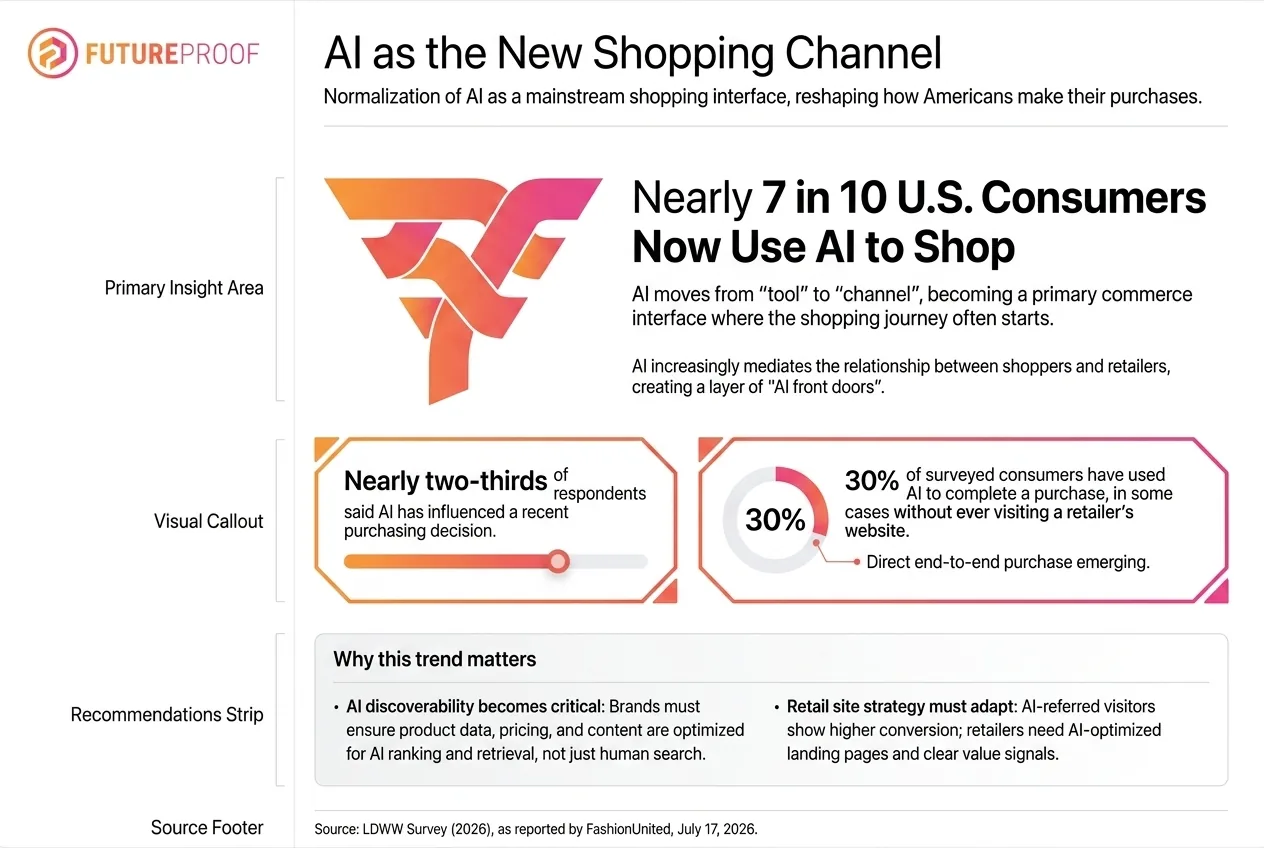
A groundbreaking report from FashionUnited, released on July 17, 2026, unequivocally underscores this seismic change, presenting compelling data gathered from a survey of 2,000 U.S. adults conducted by LDWW. The findings are stark, painting a clear picture of AI’s pervasive influence: nearly seven in ten Americans now routinely utilize AI to shop for a diverse array of products and services. This isn't just passive browsing; the report further reveals that almost two-thirds of respondents admit AI directly influenced a recent purchase. Perhaps most astonishingly, a full 30 percent have completed an entire purchase transaction through an AI interface without ever needing to navigate to a traditional retailer's website. These statistics are not merely indicative of a trend; they signify a fundamental rewiring of the consumer journey, placing AI at the epicenter of the purchasing process.
The Evolution of AI: From Discovery to Direct Commerce
For years, AI's role in retail has been primarily behind the scenes, powering recommendation engines, personalizing product suggestions, and optimizing supply chains. It was a sophisticated assistant, guiding consumers towards relevant items and enhancing the discovery phase. However, the latest data reveals a dramatic leap. Consumers are no longer just asking AI "what should I buy?"; they are increasingly commanding AI "buy this for me." This distinction is paramount. The journey from product exploration to direct transaction, mediated entirely by an AI, marks a new era of conversational commerce and intelligent shopping.
Consider the implications of nearly 70% of Americans engaging with AI for their shopping needs. This isn't a niche market; it's a mainstream phenomenon. Consumers are interacting with AI-powered chatbots, voice assistants, and personalized shopping agents not just to compare prices or read reviews, but to actively identify, select, and purchase items. This broad adoption signifies a growing trust and comfort with AI as a reliable and efficient shopping partner. It speaks to a consumer base that values convenience, speed, and hyper-personalization, all of which advanced AI systems excel at delivering. Brands must recognize that their customers are already talking to AI about their products, whether they've optimized for it or not.
The statistic that almost two-thirds of Americans report AI influencing a recent purchase highlights AI’s potent persuasive power. This influence can manifest in various ways: an AI assistant might filter through thousands of options to present the three most suitable choices based on complex criteria; it might offer a personalized bundle based on past purchases and stated preferences; or it might proactively suggest a product to solve an articulated problem. The decision-making process is increasingly being outsourced to AI, which acts as a trusted, unbiased (or seemingly unbiased) advisor, distilling vast amounts of information into actionable recommendations. For brands, this means their product narratives, unique selling propositions, and customer reviews must be readily digestible and compelling to AI algorithms, not just human eyes.
The truly disruptive figure is the 30% of consumers who have completed a purchase directly through AI without visiting a retailer's website. This represents the ultimate disintermediation of the traditional e-commerce funnel. Previously, even with AI recommendations, the final step almost invariably involved a visit to a brand's website or a marketplace. Now, AI platforms are becoming the checkout counter themselves. This phenomenon, often termed "headless commerce" in an AI context, allows consumers to remain within the AI ecosystem – be it a smart speaker, a messaging app, or a generative AI interface – from initial query to final payment. For brands, this statistic is a wake-up call; it underscores the urgency of establishing direct integration and presence within these AI-driven transaction channels, rather than assuming their website will always be the ultimate destination.
Why the Shift to AI-Powered Shopping is Irreversible
Several factors converge to make AI a natural and increasingly preferred shopping channel:
- Unparalleled Convenience and Efficiency: AI streamlines the shopping process like never before. Instead of navigating endless menus, filters, and product pages, consumers can articulate their needs in natural language and receive instant, tailored suggestions. The ability to complete a purchase with minimal clicks or even just a voice command is a powerful draw for time-pressed individuals.
- Hyper-Personalization at Scale: Traditional e-commerce struggles to provide truly individualized experiences for millions of users. AI, leveraging vast datasets of past behavior, preferences, and real-time context, can offer product recommendations, bundles, and even pricing that feel uniquely tailored to each individual, fostering a deeper sense of understanding and relevance.
- Intelligent Decision Support: Faced with an overwhelming paradox of choice, consumers often suffer from decision fatigue. AI acts as an intelligent curator, sifting through noise to present optimal choices, compare specifications, read reviews, and even anticipate needs. This reduces cognitive load and instills confidence in purchase decisions.
- Integration into Daily Life: With the proliferation of smart home devices, voice assistants, and AI-powered apps, AI shopping blends seamlessly into everyday routines. Asking an AI to reorder groceries, purchase a gift, or find a specific item becomes as natural as checking the weather.
- Trust and Authority: As AI systems become more sophisticated and accurate, consumers are developing a growing trust in their recommendations. When an AI provides a suggestion, it often comes with an implicit backing of vast data analysis, making it a credible "advisor" in the purchasing process.
The New Imperative: AI Visibility as the Cornerstone of Success
In this rapidly evolving environment, brands and retailers face a critical new challenge: achieving "AI visibility." Just as SEO dictated discoverability in the era of search engines, optimizing for AI algorithms will now determine which brands make it onto the AI-generated shortlist, influencing traffic, conversion, and ultimately, market share.
What Does "AI Visibility" Entail?
AI visibility is multi-faceted, extending beyond traditional keyword optimization. It requires a holistic strategy focused on making a brand and its products intelligible, trustworthy, and appealing to AI systems that act on behalf of consumers.
- Impeccable Data Quality and Structure: AI systems feed on data. For a brand to be visible and accurately represented, its product information must be meticulously organized, comprehensive, and consistent. This means:
- Rich Product Descriptions: Beyond basic features, descriptions must capture context, use cases, benefits, and emotional appeal, written in natural language that AI can understand and synthesize.
- Standardized Product Attributes: Consistent use of categories, SKUs, colors, sizes, materials, and other specifications allows AI to filter and compare effectively.
- High-Quality Media: AI increasingly processes images and videos. Clear, tagged, and diverse visual assets are crucial for AI-driven visual search and product understanding.
- Real-time Inventory and Pricing: Outdated information frustrates both AI and consumers. Robust APIs that provide real-time updates are non-negotiable.
- Semantic Relevance and Natural Language Understanding: AI doesn't just match keywords; it understands intent and context. Brands must optimize their content for natural language queries, anticipating how consumers might ask an AI for a product. This involves:
- Question-and-Answer Content: Building FAQs, detailed product guides, and conversational content that directly addresses potential consumer queries.
- Long-Tail Query Optimization: Moving beyond short keywords to optimize for complex, multi-faceted questions that reflect how people speak to AI assistants.
- Contextual Understanding: Ensuring that product information clearly articulates not just what a product is, but who it's for, what problem it solves, and why it's superior.
- Brand Authority, Trust, and Reputation: AI systems are designed to provide the best, most reliable recommendations. This means they will prioritize brands with a strong, trustworthy reputation.
- Authentic Reviews and Ratings: User-generated content, especially reviews, are a goldmine for AI. Brands must encourage authentic feedback and ensure its accessibility to AI platforms.
- Consistent Brand Messaging: A clear, consistent brand voice and value proposition across all touchpoints (website, social media, AI interactions) builds trust.
- Ethical Practices: Transparency in product information, fair pricing, and excellent customer service contribute to a positive brand perception that AI can factor into its recommendations.
- Omnichannel Integration and API Accessibility: For AI to seamlessly facilitate purchases, it needs access to a brand's entire ecosystem.
- Robust APIs: Brands must develop and maintain robust APIs that allow AI platforms to query product catalogs, check inventory, process orders, and track shipments in real-time.
- Unified Customer Data: A single view of the customer, integrating purchase history, preferences, and interactions across all channels, empowers AI to offer truly personalized experiences.
- Seamless Hand-off: While AI may complete a purchase, there must be clear pathways for consumers to interact with human customer service if needed, ensuring a continuous, positive experience.
Impact on Core Business Metrics: Traffic, Conversion, and Customer Ownership
The rise of AI as a shopping channel will fundamentally alter how brands achieve their key business objectives.
Traffic Generation
The traditional funnel of "search engine > brand website > purchase" is being disrupted. AI can act as a new, powerful gateway to products, potentially bypassing direct visits to a brand's site. Brands that win the AI shortlist will see their products recommended directly to consumers, leading to qualified traffic or, more likely, direct AI-facilitated purchases. Brands not optimized for AI risk becoming invisible, struggling to attract new customers who rely on AI for their shopping guidance. Diversifying traffic acquisition strategies to include AI channel optimization is paramount.
Conversion Optimization
AI's ability to hyper-personalize recommendations, compare options, and streamline the purchase path leads to inherently higher conversion rates. When an AI presents a product, it's often because it has assessed suitability against multiple criteria specified by the consumer. This pre-qualification means the consumer is closer to a purchase decision. The seamless, often one-click or one-voice-command checkout facilitated by AI further reduces friction, leading to significantly improved conversion rates for brands that successfully integrate.
Customer Ownership
This is perhaps the most significant challenge and opportunity. If 30% of purchases occur without a direct website visit, brands risk "disintermediation." The AI platform, rather than the brand, could become the primary interface and relationship holder with the customer. This raises critical questions:
- Who owns the customer data? If purchases happen within an AI ecosystem, brands need clear agreements on data sharing to understand customer behavior.
- How do brands build loyalty? Without direct interaction on their own platforms, how do brands foster brand affinity, communicate new offerings, or run loyalty programs?
- Maintaining Brand Identity: How does a brand ensure its unique story, values, and experience are conveyed when the purchase journey is mediated by AI?
To counter disintermediation and maintain customer ownership, brands must:
- Embed Value Propositions: Ensure their unique value, brand story, and post-purchase service are well-articulated and discoverable by AI, so the AI can communicate these to the consumer.
- Incentivize Direct Engagement: Offer unique benefits (e.g., exclusive content, loyalty points, direct customer support) that encourage consumers to engage with the brand directly, even if the initial purchase was AI-facilitated.
- Develop AI-Native Loyalty Programs: Explore how loyalty programs can be integrated into AI interactions, allowing consumers to accrue and redeem points directly through AI.
- Leverage AI for Post-Purchase Engagement: Use AI to proactively offer support, suggest complementary products, or gather feedback, thereby maintaining a continuous relationship.
Actionable Strategies for Brands and Retailers to Adapt
Embracing the AI shopping revolution requires a proactive, strategic overhaul. Here are concrete steps brands and retailers should consider:
- Invest in AI-Ready Data Infrastructure: Prioritize Product Information Management (PIM) systems, Digital Asset Management (DAM) systems, and master data management (MDM) tools that ensure clean, consistent, and structured data across all product attributes, descriptions, and media. This is the foundational layer for AI visibility.
- Develop an AI-Specific Content Strategy: Go beyond traditional SEO. Craft content that anticipates natural language queries, provides detailed answers to potential questions, and compares products semantically. Think about how an AI would 'read' and 'understand' your product, not just a human. Create comparison charts, user guides, and detailed FAQs that are easily parsable by AI.
- Optimize for Conversational Interfaces: Design website chatbots, customer service scripts, and product content to be conversational and interactive. If consumers are asking AI questions, brands need to provide answers in a format AI can easily retrieve and relay.
- Embrace Generative AI for Content Creation: Utilize generative AI tools to rapidly create variations of product descriptions, marketing copy, and FAQs, ensuring broader coverage of potential AI queries and greater semantic richness.
- Monitor AI Shopping Trends and Algorithms: Just as SEO algorithms evolve, so too will AI shopping algorithms. Brands must dedicate resources to monitoring these changes, understanding how AI platforms rank and recommend products, and adapting their strategies accordingly.
- Foster User-Generated Content: Encourage customer reviews, photos, and Q&A sessions. AI systems highly value social proof and authentic user experiences. Make it easy for AI to access and synthesize this UGC.
- Explore AI Platform Partnerships and Integrations: Proactively engage with major AI platforms (e.g., Google Assistant, Amazon Alexa, emerging generative AI shopping agents) to understand their integration requirements and explore advertising or partnership opportunities that ensure your products are front and center in AI recommendations.
- Pilot AI-Powered Personalization and Recommendations: Implement AI-driven tools on your own website and apps to gain experience with intelligent personalization, understand customer responses, and refine your AI strategies.
- Train Your Teams: Educate marketing, product, and customer service teams about the nuances of AI commerce, ensuring everyone understands the shift and their role in optimizing for AI visibility.
Navigating Challenges and Ethical Considerations
While the opportunities are immense, challenges exist. Data privacy and security become even more critical when AI handles purchasing directly. Algorithmic bias, where AI systems inadvertently favor certain demographics or product types, is a concern that brands and AI developers must address through transparent and ethical AI development. The cost of adapting existing infrastructure and developing new strategies can be substantial, requiring significant investment. However, the cost of inaction – risking irrelevance in an AI-dominated retail landscape – is arguably far greater.
The Future: AI Agents and Hyper-Personalized Retail
The current state is just the beginning. The future will likely see the proliferation of highly sophisticated AI agents acting as personal shoppers, capable of learning individual preferences, anticipating needs, negotiating prices, and managing entire portfolios of purchases across various brands. These AI agents will operate with a high degree of autonomy, making it even more imperative for brands to ensure their products are not just discoverable but also compelling to these intelligent intermediaries. The lines between online and offline shopping will further blur, with AI guiding consumers through hybrid experiences, from virtual try-ons to in-store navigation and personalized recommendations.
Conclusion
The FashionUnited report is a clarion call, signaling a decisive turning point in retail. AI is no longer a peripheral technology but a core shopping channel, fundamentally reshaping consumer behavior and expectations. The statistics – nearly seven in ten Americans using AI to shop, two-thirds influenced by AI in recent purchases, and 30% completing purchases directly through AI – underscore the urgency of adaptation. For brands and retailers, AI visibility is not an optional add-on; it is an existential necessity. Winning the AI shortlist will dictate who captures traffic, who drives conversions, and ultimately, who maintains customer ownership in this brave new world of intelligent commerce. Those who embrace this shift proactively, investing in robust data, semantic content, and strategic AI integration, will not merely survive but thrive, leading the charge into the AI-powered future of retail. The time to act is now.


