How AI Driven Economic Anxiety Is Reshaping Consumer Behavior and What Brands Must Do to Stay Relevant
The seismic shifts occurring in the global economy, primarily driven by the accelerating integration of artificial intelligence across industries, are fundamentally reshaping the landscape of consumer behavior. While the conversation around AI often centers on innovation and efficiency, a less heralded but equally profound consequence is the widespread job displacement and organizational restructuring it precipitates. This phenomenon, far from being a niche concern, is sowing seeds of economic anxiety across diverse demographics, forcing consumers to adopt a more cautious, value-driven approach to spending. Brands that fail to acknowledge and adapt to this new reality risk obsolescence, as traditional marketing strategies and value propositions increasingly fall flat against a backdrop of public apprehension.
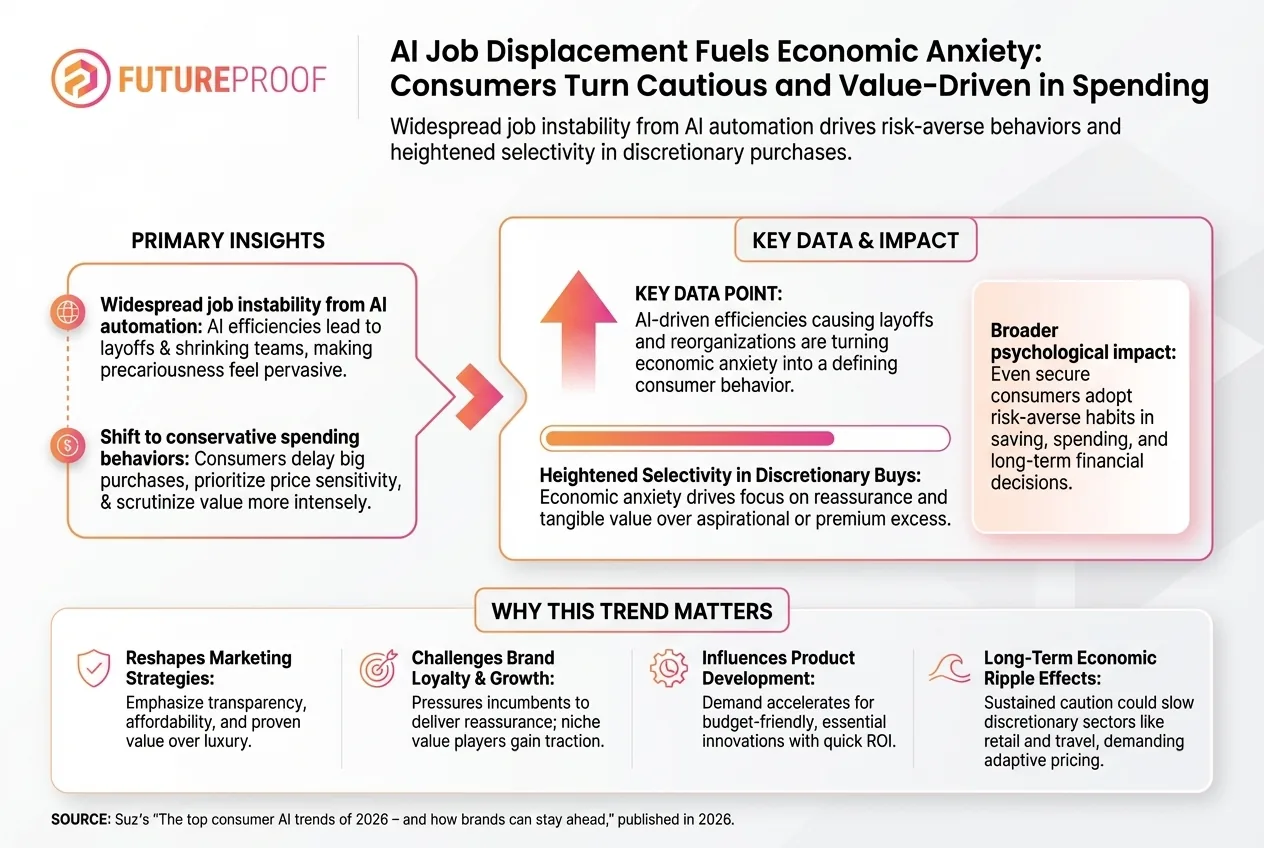
The current economic climate is defined by an underlying current of instability. As AI-driven efficiencies lead to layoffs and shrinking teams across nearly every sector, from manufacturing and logistics to customer service and creative industries, the perceived security of employment diminishes. This isn't just a fear for those directly affected; the ripple effects are pervasive. Friends, family, and colleagues witness these transformations firsthand, internalizing the potential for their own roles to be redefined or eliminated. This creates a widespread sense of precarity, a feeling that future income streams are less predictable and stable than before. A key data point underscores this reality: "AI related efficiencies are driving layoffs and reorganizations across industries, making economic instability a defining force behind more conservative, price sensitive consumer behavior." This insight, drawn from Suzy's "The top consumer AI trends of 2026 and how brands can stay ahead, 2026," confirms what many are experiencing on the ground: the economic landscape is shifting rapidly, and consumers are responding with a defensive crouch.
This pervasive economic anxiety is translating directly into observable changes in how consumers think about and execute purchases. The era of impulse buying and aspirational spending, fueled by a sense of general optimism and future security, is rapidly waning. In its place, a meticulous, often skeptical, approach to consumption is taking root. Consumers are no longer simply looking for products or services; they are seeking solutions that offer tangible, demonstrable value, provide long-term utility, and align with a heightened sense of financial prudence.
One of the most immediate and impactful shifts is the pronounced move towards more cautious spending. This isn't merely about spending less overall; it's about a fundamental re-evaluation of every potential purchase. Discretionary spending, once a common outlet for personal gratification, is now under intense scrutiny. Consumers are weighing wants against needs with greater rigor, often deferring purchases that don't directly address an immediate, practical requirement. This manifests in smaller basket sizes, fewer add-on purchases, and a general hesitation before committing to non-essential items. The "treat yourself" mentality is being replaced by a "save for a rainy day" ethos, reflecting a deep-seated concern for future financial resilience.
Coupled with this caution is an intensified focus on value-driven decisions. However, "value" in this context is undergoing a significant redefinition. It's no longer solely about the lowest price; rather, it encompasses durability, versatility, longevity, and genuine utility. A cheap item that breaks quickly is now perceived as a false economy, whereas a more expensive item that promises years of reliable service becomes the wiser investment. Consumers are actively seeking products and services that offer the best return on investment, not just in monetary terms, but in terms of time saved, problems solved, and anxieties alleviated. This means a shift towards products designed for repairability, multi-functional items, and services that demonstrably improve efficiency or reduce future costs.
The delay of major purchases has become a hallmark of this new consumer climate. Big-ticket items like cars, homes, major appliances, and luxury vacations, which represent significant financial commitments, are being postponed as consumers adopt a wait-and-see attitude. The uncertainty surrounding future employment and income makes large, fixed expenses a daunting prospect. This reluctance stems from a desire to maintain liquidity and avoid long-term debt, creating a substantial drag on industries reliant on these larger transactions. Even smaller, yet still significant, purchases such as new electronics, furniture, or home improvements are subject to extended research periods and careful deliberation, with consumers often opting to repair or extend the life of existing items rather than replace them.
Perhaps the most universally felt consequence is the intensified scrutiny of prices. Consumers are spending more time comparing prices across multiple retailers, utilizing comparison websites, searching for discount codes, and waiting for sales events. Brand loyalty, once built on convenience or emotional connection, is increasingly being tested by price differentials. If a competitor offers a similar product at a lower price point, or with a clearer value proposition, switching becomes a much more palatable option. This isn't about being "cheap"; it's about being pragmatic and maximizing every dollar in an environment where every dollar feels harder earned and more precious. Loyalty programs themselves are being re-evaluated; consumers are less interested in abstract points or exclusive content and more focused on tangible, immediate savings or benefits that directly impact their budget.
For brands, this profound shift in consumer mindset is not merely a challenge but a fundamental imperative to rethink every aspect of their operation, from product development and pricing to marketing and customer service. The traditional playbook, heavy on aspirational messaging and lifestyle branding, is increasingly out of step with a consumer base prioritizing security and substance. Consumers are looking beyond the gloss to the core utility and enduring worth of what they are buying.
The first critical pillar for brands in this new era is transparency. In a world rife with uncertainty, trust becomes an invaluable commodity, and transparency is its bedrock. This means being upfront and honest about pricing structures, supply chains, product ingredients, and even internal practices. Consumers are weary of hidden fees, ambiguous claims, and corporate opaqueness. They want to understand why a product costs what it does, where its components come from, and how it's made. For instance, brands can gain trust by clearly stating their commitment to ethical sourcing, explaining their cost-saving measures without sacrificing quality, or even being open about how AI is used internally—perhaps to enhance customer service or streamline operations, rather than as a tool for widespread job cuts that might fuel anxiety. This requires a delicate balance and an emphasis on how AI augments human capabilities and ultimately benefits the customer experience. Transparency fosters authenticity, a trait deeply valued by today's wary consumer.
Secondly, affordability, or rather, perceived affordability, is paramount. This doesn't necessarily mean simply slashing prices, which can often be unsustainable or devalue a brand. Instead, it involves intelligent pricing strategies and communicating the true long-term value. Brands should explore flexible payment options, subscription models that genuinely deliver ongoing savings or convenience, and tiered product offerings that cater to different budget points. Emphasizing durability and a longer product lifespan, thereby reducing the frequency of replacement purchases, is a powerful form of affordability messaging. For example, a slightly more expensive appliance that uses significantly less energy or comes with a robust warranty can be positioned as a more affordable option in the long run. Value bundles, offering complementary products or services at a reduced combined cost, can also appeal to the budget-conscious consumer. The goal is to demonstrate a clear return on investment, both immediate and future, for every dollar spent.
The third, and arguably most critical, pillar is proof of benefit. Aspirational marketing, which paints a picture of a desirable lifestyle achievable through product ownership, is largely ineffective when economic anxiety dominates. Consumers are no longer asking "What can this make me?" but "What can this do for me?" Brands must move beyond abstract promises and offer concrete, demonstrable evidence of how their products or services solve a problem, save money, increase efficiency, or improve quality of life. This means leveraging customer testimonials, case studies, expert endorsements, and quantifiable metrics. Before-and-after scenarios, clear demonstrations of utility, and guaranteed outcomes resonate deeply. If a product claims to save time, show how. If it promises durability, provide certification or a robust warranty. The message must shift from "buy this to be like X" to "buy this to solve Y problem and achieve Z benefit, as evidenced by [proof]." This is about showing, not just telling, and grounding claims in tangible, verifiable outcomes.
Beyond these three pillars, brands must also cultivate genuine empathy in their messaging. Acknowledge the current economic realities without being exploitative. Brands that demonstrate an understanding of consumer struggles and offer solutions that genuinely alleviate anxiety will build far stronger connections than those perceived as tone-deaf or overly luxurious. This requires deep consumer insights, moving beyond superficial demographics to understand the psychographics of anxiety, hope, and resilience.
Customer loyalty, once built on habit and convenience, is harder to secure but more valuable when earned. In this environment, loyalty is forged through consistent delivery of transparent value, reliability, and an unwavering commitment to customer satisfaction. Personalized experiences that genuinely anticipate and meet needs, rather than just push products, become essential. Brands should focus on fostering a sense of community, creating platforms where customers feel heard, valued, and part of a shared experience. This strengthens bonds beyond transactional interactions, making customers feel less like statistics and more like valued members of an ecosystem.
Value-focused competitors, often smaller and more agile, are well-positioned to capitalize on this shift. Their ability to pivot quickly, maintain leaner operations, and focus intensely on specific value propositions can allow them to gain significant ground against legacy brands burdened by established structures and outdated marketing strategies. This competition further underscores the urgency for all brands to re-evaluate their core offerings and communication.
Practically, adapting to this new landscape requires several strategic adjustments. Brands must invest more heavily in qualitative and quantitative research to deepen their understanding of evolving consumer anxieties and needs. This goes beyond traditional market segmentation to uncover the underlying emotional drivers behind purchasing decisions. Product portfolios should be rigorously re-evaluated, potentially streamlining offerings to focus on core value propositions, or introducing new lines that directly address the need for affordability and demonstrable utility. Supply chain resilience and efficiency also become critical, enabling brands to maintain competitive pricing without compromising quality, thereby reinforcing the value proposition.
Internally, brands must also consider how they integrate AI. While efficiencies are necessary, a transparent approach to internal AI adoption that emphasizes augmentation of human capabilities rather than pure replacement can build trust with employees, which in turn can ripple outwards to customer perception. Companies that treat their own workforce with respect and transparency regarding AI implementation are more likely to project an image of ethical operation externally.
Ultimately, the future belongs to brands that embrace this fundamental recalibration of the market. The era of unchecked aspiration is giving way to an age of pragmatic value. Brands that prioritize transparency, communicate genuine affordability, and provide irrefutable proof of benefit will not only survive but thrive. They will build trust in an uncertain world, forging deep, lasting relationships with consumers who are more discerning, more cautious, and more appreciative of authentic value than ever before. This is not merely a cyclical trend; it is a profound societal shift, demanding a strategic evolution that places genuine customer needs and anxieties at the very heart of brand strategy.