AI Is Now the Front Door to Commerce and Brands Must Adapt Fast
The landscape of consumer commerce is undergoing a monumental, irreversible transformation, fundamentally reshaping how shoppers discover, compare, and ultimately purchase products. The traditional buying journey, once characterized by extensive on-site exploration and brand discovery, is rapidly being supplanted by an AI-driven paradigm where consumers arrive at brand and retailer sites already pre-decided. This seismic shift, highlighted by compelling new 2026 data from L.E.K. Consulting, demands immediate and profound strategic reorientation from every brand and retailer aiming to remain relevant and competitive in the digital marketplace.
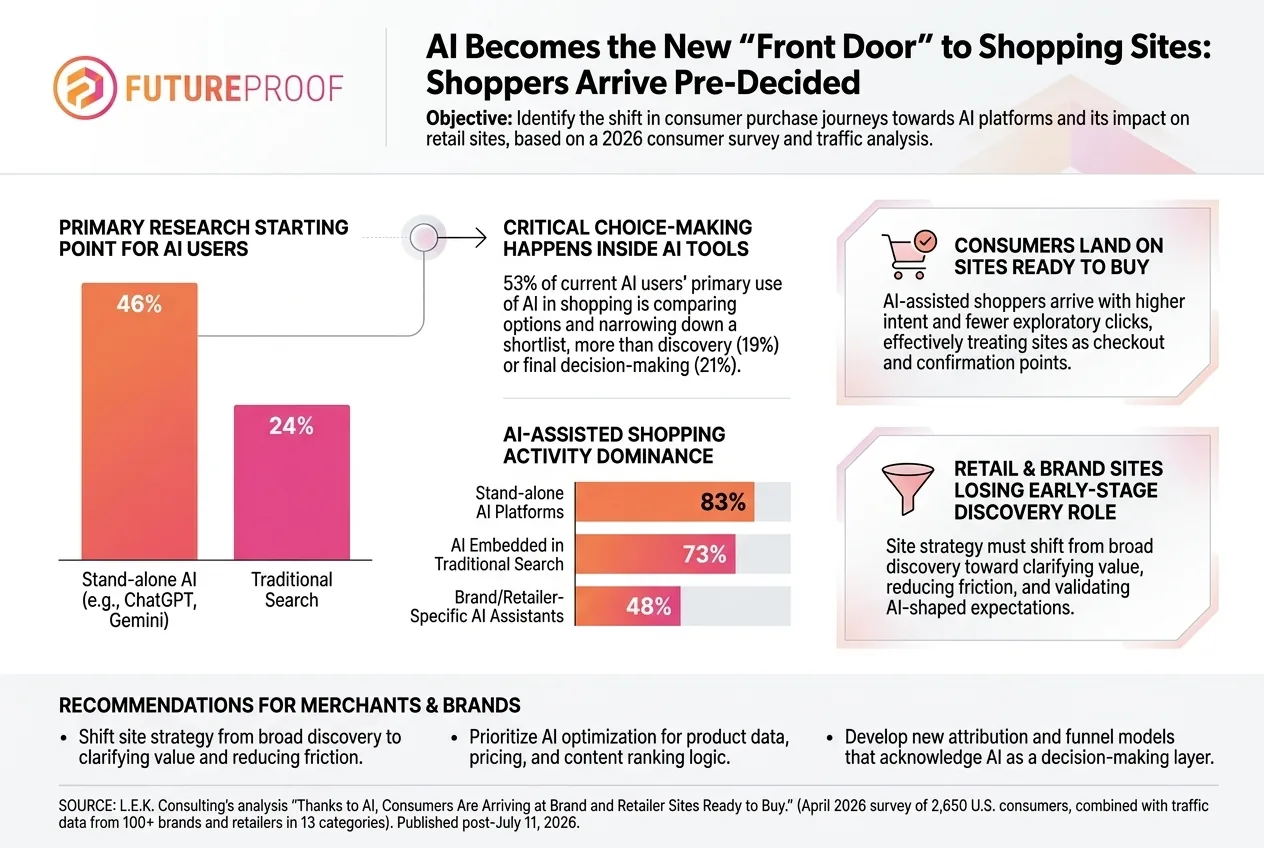
According to L.E.K. Consulting's analysis, based on an April 2026 survey of 2650 U.S. consumers and traffic data from over 100 brands and retailers across 13 categories, artificial intelligence platforms have definitively claimed the pole position as the new front door to commerce. A striking 46 percent of U.S. AI users now initiate their purchase research on stand-alone AI platforms such as ChatGPT, Gemini, Perplexity, and Claude. This figure dramatically overshadows the mere 24 percent who still begin their journey on traditional search engines. This isn't just a marginal trend; it signifies a complete inversion of the established purchasing funnel, pushing critical comparison and shortlisting processes off-site, long before a shopper ever engages directly with a brand or retailer’s digital presence.
For years, search engine optimization (SEO) has been the bedrock of digital marketing, dictating brand visibility and customer acquisition strategies. Businesses painstakingly crafted content, optimized keywords, and built backlinks to climb Google's rankings, understanding that being on the first page was paramount for discovery. Now, AI optimization (AIO) is emerging as an equally, if not more, critical imperative. The new battleground for consumer consideration is being fought within the algorithms of AI platforms, where being included in an AI-curated shortlist means the difference between being seen and becoming digitally invisible.
The implications of this shift are multi-faceted and profound. Brand and retailer sites are no longer serving as primary discovery channels where consumers browse broadly and explore options. Instead, their function has narrowed, evolving into sophisticated validation and checkout points. When a shopper arrives on a site having already utilized an AI platform, they are not there to explore; they are there to confirm, verify details, review trust signals, and finalize a purchase decision that is largely already made. These high-intent visitors exhibit clearer expectations, fewer exploratory clicks, and demonstrably faster paths to purchase. The luxury of guiding a consumer through an extensive discovery phase on-site is rapidly diminishing.
The Rise of AI Platforms as the Primary Research Hub
The compelling L.E.K. data underscores a fundamental shift in consumer behavior driven by the capabilities of advanced AI. Why are consumers increasingly turning to AI platforms like ChatGPT, Gemini, Perplexity, and Claude for their initial purchase research? The answer lies in efficiency, synthesis, and personalization. Traditional search engines, while powerful, often present a deluge of information – links, ads, articles – requiring significant user effort to sift through and synthesize. AI platforms, in contrast, offer a streamlined, conversational experience. They can understand complex queries, summarize vast amounts of data, compare products across multiple criteria, highlight pros and cons, and even suggest personalized recommendations based on stated preferences or past interactions.
Imagine a consumer looking for "the best noise-cancelling headphones for remote work under $300 that are comfortable for long periods and have excellent microphone quality." A traditional search might yield hundreds of results, each requiring a separate click, review, and comparison. An AI platform, however, can digest these specific requirements, cross-reference product specifications, analyze user reviews, and present a concise, curated shortlist with direct comparisons, often explaining why certain products meet those criteria. This immediate value proposition – saving time, reducing cognitive load, and providing actionable insights – is incredibly powerful and addictive for modern, time-poor consumers. This is where the critical comparison and shortlisting now happen, off-site, shaping the consumer's perception and preference before they ever reach a brand's direct touchpoint.
The Transformation of Brand and Retailer Sites: From Discovery to Validation
This shift profoundly redefines the purpose and design of brand and retailer websites. No longer the initial point of contact for broad product exploration, sites are increasingly functioning as dedicated validation and transaction hubs. This doesn't diminish their importance; it merely alters their role within the evolved buying journey. When a shopper arrives, they are already armed with specific product knowledge, having likely already shortlisted one or two options based on AI recommendations. Their goal is not broad browsing but targeted confirmation.
Consequently, brand sites must excel at providing immediate, authoritative answers to specific questions, showcasing detailed product specifications, and building trust. The user experience must be frictionless, intuitive, and geared towards conversion. Pages should load instantly, product information must be meticulously accurate and easy to find, and the checkout process must be seamless. The emphasis shifts from "What do we offer?" to "Why are we the best choice for this specific product that you've already identified?" Trust signals – robust customer reviews, clear return policies, security certifications, transparent pricing, and responsive customer service information – become paramount. The ability to quickly validate the AI's recommendation and move to purchase is the new measure of a site's effectiveness. Brands must recognize that they are no longer competing solely for initial attention but for final confirmation in a race to conversion.
The New Battleground: AI Optimization (AIO)
With AI platforms acting as the gatekeepers of initial consideration, optimizing for AI inclusion is no longer optional; it's existential. AI optimization (AIO) becomes as critical as search engine optimization (SEO) was a decade ago. But what exactly does AIO entail? It's about structuring and presenting your brand and product information in a way that AI models can easily understand, process, summarize, and ultimately recommend. Just as SEO involved understanding Google's algorithms, AIO requires understanding how AI platforms ingest, interpret, and prioritize information.
Being featured in an AI-curated shortlist is the new "page one." If a brand's products or services aren't effectively surfacing within these AI recommendations, they risk becoming invisible to nearly half of potential U.S. consumers who start their research journey there. This isn't merely about keywords anymore; it's about context, comprehensive data, authority, and trustworthiness. AI models are trained on vast datasets and are designed to provide accurate, helpful, and unbiased information (though biases can exist in training data). Therefore, brands must proactively optimize their digital footprint to resonate with these sophisticated algorithms.
Strategic Imperatives for Brands and Retailers in the AI-First Era
A. Mastering Data Hygiene and Structured Information:
The foundational element of AIO is impeccable data. AI models thrive on structured, clean, and comprehensive data. This means meticulously maintaining product feeds with accurate specifications, pricing, availability, and high-quality imagery. Implementing schema markup (structured data) across websites becomes non-negotiable, as it provides clear, machine-readable context about products, reviews, prices, and more. Consistent data across all digital touchpoints – your website, marketplaces, social media, and any third-party directories – is crucial. Discrepancies can confuse AI models, leading to exclusion from shortlists. Think of your product data as the building blocks that AI uses to construct its recommendations; if the blocks are mismatched or missing, the structure will fail.
B. Crafting AI-Centric Content:
Content strategy must evolve from simply attracting clicks to providing definitive answers that AI can easily parse, summarize, and synthesize. This involves creating authoritative, long-form content that directly addresses common consumer questions, comparative guides, detailed product feature explanations, and comprehensive FAQs. Focus on natural language processing (NLP) considerations – write content in a conversational, easy-to-understand manner, using clear headings, bullet points, and summaries that an AI model can readily digest and re-present to a user. Instead of keyword stuffing, focus on topical authority and comprehensive coverage of subjects relevant to your products. Provide not just features, but also benefits, use cases, and comparisons with competitors (objectively, if possible) to empower AI to paint a complete picture for the consumer.
C. Elevating Brand Reputation and Trust Signals:
AI models are increasingly sophisticated in evaluating brand reputation and sentiment. User-generated content (UGC), such as customer reviews and ratings, becomes an even more critical component of your AIO strategy. Positive reviews, high ratings, and consistent customer satisfaction are powerful signals to AI that your brand is trustworthy and offers quality products. Brands must invest heavily in managing their online reputation, encouraging reviews, responding to feedback (both positive and negative) transparently, and ensuring exceptional customer service. Ethical business practices, clear privacy policies, and demonstrable corporate social responsibility can also contribute to a positive brand perception that AI may factor into its recommendations.
D. Understanding AI's Selection Criteria:
While the precise algorithms of AI platforms remain proprietary, we can infer some key selection criteria based on their stated goals of providing useful, accurate, and relevant information. AI likely prioritizes:
- Relevance: How well a product matches the user's specific query and expressed needs.
- Authority: The perceived credibility and expertise of the brand.
- Availability & Price Competitiveness: Up-to-date information on stock and competitive pricing.
- Positive Sentiment: High ratings, positive reviews, and general brand reputation.
- Factual Accuracy: Consistent and verifiable product information.
- Completeness: Comprehensive data points that allow AI to fully describe and compare.
Brands must actively work to meet these implied criteria, understanding that a holistic approach to digital excellence will improve their chances of AI inclusion.
E. Rethinking Site Experience for Validation:
Once a shopper arrives at your site, having been pre-qualified by an AI, the site's primary role shifts to validation and conversion. This necessitates a hyper-optimized user experience (UX) and user interface (UI). Product pages must be exceptionally clear, concise, and visually appealing, confirming all details provided by the AI. High-resolution imagery, 360-degree views, and even augmented reality (AR) features can enhance the validation process. Testimonials, trust badges, clear shipping and return policies, and readily accessible customer support options must be prominently displayed. The path to purchase should be utterly frictionless, with minimal clicks, intuitive navigation, and a secure, streamlined checkout process. Personalization, in this context, might shift from initial discovery to offering relevant add-ons or upsells after the primary product decision has been validated.
F. Exploring Direct AI Integrations and Partnerships:
As the AI commerce landscape matures, brands and retailers should proactively explore opportunities for direct integration or partnerships with major AI platforms. This could involve providing direct data feeds via APIs, participating in pilot programs, or even developing custom AI agents that can represent your brand within these platforms. Early adopters who establish these direct channels may gain a significant advantage in ensuring their products are optimally presented and recommended. Staying abreast of developments in AI platform capabilities and potential monetization models will be crucial.
The Evolving Consumer: Pre-Decided, Efficient, and Demanding
The consumer emerging from this AI-driven evolution is distinct. They are less patient for discovery and more focused on validation. They value efficiency above all else, expecting immediate, accurate, and personalized information. They are highly discerning, having already leveraged sophisticated AI to filter and compare options. Their trust, initially placed in the AI's recommendations, then seeks corroboration from the brand's own site. This means that brands must meet these heightened expectations with a seamless, authoritative, and trustworthy digital experience. The psychological shift implies that consumers are increasingly reliant on AI to act as their personal shopping assistant, making the initial choices for them.
The Urgency of Adaptation: What Happens if Brands Don't Act?
The L.E.K. Consulting data is not merely an interesting observation; it's a stark warning. Brands and retailers who fail to adapt to this AI-first reality face the grave risk of becoming invisible in the new buying journey. If nearly half of U.S. AI users are skipping traditional search and going straight to AI platforms for their initial research, and your brand isn't optimized to appear in those AI-curated shortlists, you are effectively missing out on a massive segment of high-intent traffic. This directly translates to lost market share, diminished brand relevance, and a widening gap between agile, AI-optimized competitors and those clinging to outdated digital strategies. The time for deliberation is over; the era of AI optimization is here, demanding immediate, strategic action.
Conclusion: Embracing the AI-Powered Future of Commerce
The shift described by L.E.K. Consulting is not a fleeting trend but a fundamental re-architecture of the consumer buying journey. AI has undeniably become the new front door to commerce, empowering shoppers to arrive at brand and retailer sites already pre-decided and ready to buy. For businesses, this necessitates a complete paradigm shift, moving beyond traditional SEO to embrace the comprehensive demands of AI optimization.
Success in this new era hinges on mastering data hygiene, crafting AI-centric content, cultivating an impeccable online reputation, designing sites for validation rather than discovery, and proactively engaging with the evolving capabilities of AI platforms. The future of commerce belongs to those brands and retailers who not only understand this profound transformation but strategically adapt their digital strategies to meet the pre-decided, efficient, and demanding consumer of the AI-first world. It's no longer just about being found; it's about being chosen by AI, and then flawlessly validating that choice for the consumer. The time to optimize for AI is now.