
AI is Collapsing the Distance Between Ideas and Execution
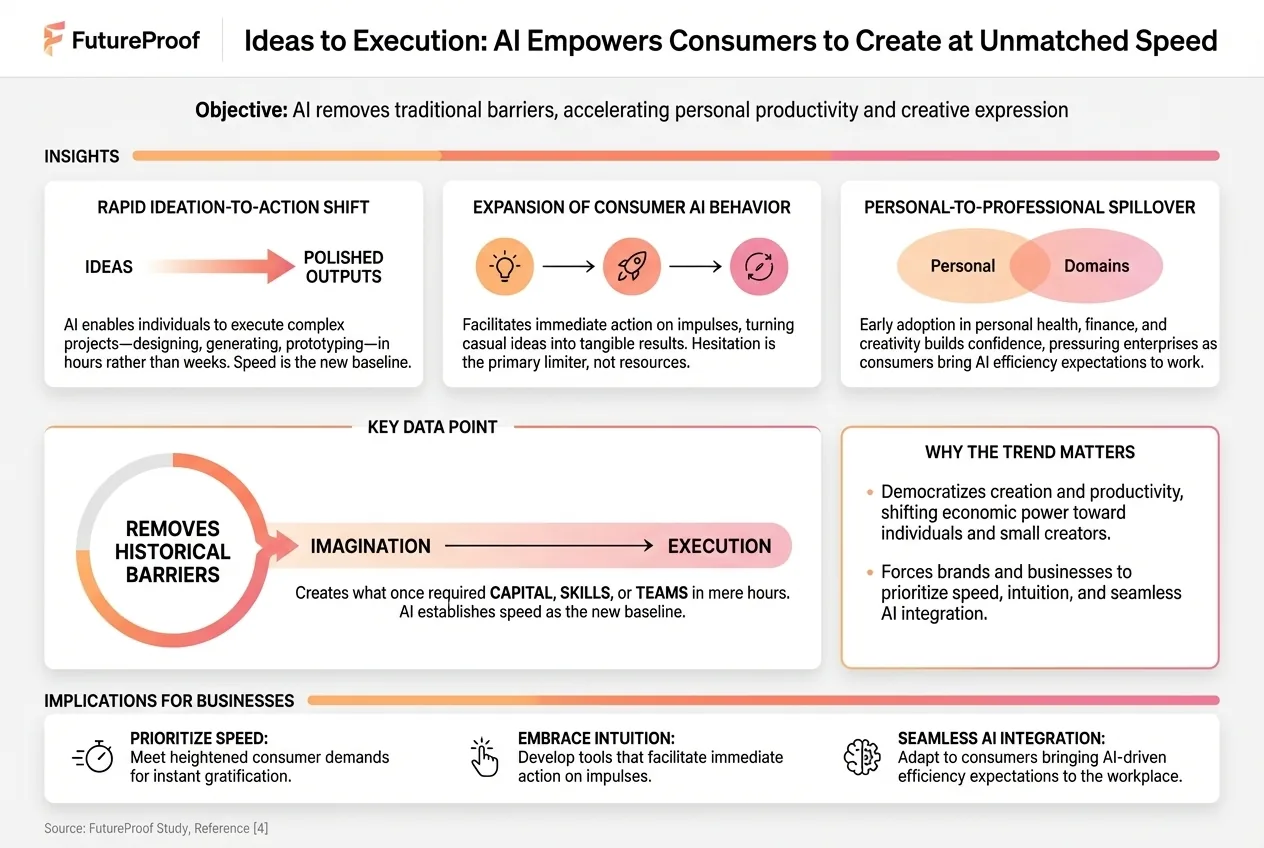
The landscape of innovation and creation is undergoing a seismic shift, propelled by the relentless advance of artificial intelligence. What was once a protracted journey from a nascent thought to a tangible output—fraught with skill gaps, team dependencies, and significant capital outlays—is now collapsing into mere hours. AI tools are dismantling these traditional barriers, empowering individuals and small entities to design products, generate captivating content, and even prototype entire businesses with unprecedented speed and efficiency. This acceleration isn't just a technological marvel; it's a fundamental redefinition of productivity and possibility, fostering new behaviors where the immediate gratification of creative impulse becomes the norm. As the a16z 2024 Consumer AI Report aptly observes, individuals are now acting on their impulses instantly, transforming casual ideas into finished outputs, with hesitation emerging as the sole remaining limiter.
This transformative wave is far from confined to personal projects and casual experimentation. Its powerful currents are undeniably spilling into professional settings, establishing a new benchmark for operational efficiency and output. Employees and leaders, accustomed to the lightning-fast capabilities of AI in their personal lives, are naturally bringing these elevated expectations of speed and seamlessness into their workplaces. This creates immense pressure on organizations to not only keep pace but to strategically integrate AI into their core operations to remain competitive and relevant. The ripple effect is profound, catalyzing a significant redistribution of economic power. Individuals and agile small creators are increasingly gaining leverage, setting a new, higher bar for established brands. To thrive in this evolving environment, businesses must urgently prioritize delivering unparalleled speed, intuitive AI-driven workflows, and a truly seamless integration of artificial intelligence into every facet of their offerings. At the heart of this revolution lies a singular, powerful truth: AI is collapsing the gap between imagination and execution, enabling consumers to produce work that once required capital or specialized skills within hours. This isn't just an enhancement; it's an entirely new paradigm.
The AI Revolution: From Idea to Instant Reality
The advent of sophisticated AI tools marks a pivotal moment in human creativity and productivity, effectively ushering in an era where the chasm between imagination and execution has dramatically narrowed. This isn't just about automation; it's about empowerment on an unprecedented scale. Suddenly, individuals who lack specialized skills in areas like graphic design, coding, or video production can leverage AI to manifest their visions. Complex tasks that once demanded years of training or the hiring of expensive specialists are now within reach of virtually anyone with an internet connection and an idea. The skills barrier, a long-standing impediment to individual entrepreneurship and creative expression, is rapidly dissolving.
Moreover, the need for extensive teams has been significantly mitigated. A single individual, armed with an arsenal of AI tools, can now perform the roles of a designer, a copywriter, a market researcher, and even a basic software developer. This capacity for solo-preneurship is not merely a convenience; it's a profound economic shift, enabling a degree of agility and autonomy previously unimaginable. The capital barrier, historically a major hurdle for launching new ventures or large-scale creative projects, is also diminishing. Prototyping physical products, developing minimum viable products (MVPs) for software, generating high-quality marketing content, and conducting sophisticated market research can now be achieved with minimal financial investment, often using free or low-cost AI subscriptions. This democratization of high-quality output is radically changing who can participate in the global economy and what they can achieve.
Consider the tangible examples of this accelerated creation. An aspiring entrepreneur can now use AI to generate multiple product design mockups in minutes, iterating on concepts faster than ever before. A content creator can prompt an AI to draft a full-length article, a compelling video script, or even a unique musical composition, transforming a casual thought into a polished piece within the same afternoon. Business prototyping, once an arduous process of market analysis, branding, and technical development, can be expedited dramatically. AI can assist in generating business plans, designing logos, crafting website copy, and even simulating customer interactions, allowing entrepreneurs to validate concepts and launch quickly. This "no hesitation" mindset, where creative impulses are acted upon immediately and turned into finished outputs, cultivates an environment of rapid experimentation and instant gratification for creative endeavors. This sentiment is powerfully underscored by the a16z 2024 Consumer AI Report, which highlights how "AI is collapsing the gap between imagination and execution, enabling consumers to produce work that once required capital or specialized skills within hours." This statement is not hyperbole; it is the new reality.
Shifting Expectations: Personal Use Bleeds into Professional Realms
The profound impact of AI on individual productivity and creative output is fundamentally reshaping expectations across the board. What begins as a personal experience with AI-driven efficiency — effortlessly generating social media content, summarizing dense documents, or refining personal projects — inevitably permeates into professional environments. When individuals encounter the seamless, instantaneous, and high-quality results produced by AI tools in their daily lives, they naturally begin to expect the same level of performance and support in their professional workflows. This "consumerization of AI efficiency" is creating significant pressure on organizations to adapt or risk being perceived as slow, outdated, and ultimately inefficient.
This expectation manifests in several critical demands placed upon businesses. Employees are increasingly seeking intuitive AI tools integrated directly into their existing software ecosystems, eliminating cumbersome manual processes and tedious tasks. The promise of AI is not merely automation, but intelligent augmentation, allowing human workers to focus on higher-value, more strategic activities. There's a growing demand for AI solutions that offer seamless integration, meaning AI capabilities should feel like an organic extension of existing applications, rather than a separate, clunky add-on. For instance, rather than switching between a word processor and an AI content generator, employees now expect AI writing assistance to be embedded directly within their document creation tools.
The expectation of instant results and significantly higher productivity is perhaps the most forceful driver of change. In a world where a casual idea can become a finished output in hours, waiting weeks for a report, a design, or a code snippet generated through traditional means feels increasingly archaic. This productivity imperative is not just a wish; it's becoming a necessity for business survival. Organizations that fail to embrace and strategically integrate AI into their operations will inevitably fall behind competitors who leverage these tools to accelerate product development, enhance customer service, optimize marketing campaigns, and streamline internal processes. The ability to iterate rapidly, respond to market changes swiftly, and produce high-quality outputs with unparalleled speed is no longer a luxury but a core competency. Businesses are being compelled to reimagine their entire operational framework, understanding that AI can transform everything from the initial brainstorming phase of a new product to its market launch, from generating personalized customer communications to optimizing supply chain logistics. The pressure is on, and the only viable path forward is embrace and innovation.
The Economic Power Shift: Rise of the Individual Creator
One of the most profound and far-reaching consequences of AI's ability to collapse the gap between imagination and execution is a monumental shift in economic power. For decades, launching a successful business or embarking on a significant creative project required substantial capital, a diverse team of specialists, and often, a network of industry contacts. These prerequisites inherently favored large corporations and well-funded startups. However, AI has fundamentally democratized entrepreneurship, lowering the barrier to entry to an unprecedented degree. What was once the exclusive domain of well-resourced entities is now accessible to individuals and small teams with innovative ideas and the willingness to leverage AI tools.
This seismic shift has heralded the rise of the micro-business and the solopreneur. A single individual can now conceptualize a product, design its branding, generate marketing content, build a rudimentary website, and even manage customer service using an array of AI tools. This enables them to compete effectively, if not outperform, larger, more bureaucratic organizations that are slower to adapt. The agility and lean operational structure of these AI-powered individual creators allow for rapid iteration, niche targeting, and personalized customer engagement that larger entities often struggle to replicate. The gig economy, already a significant force, is becoming supercharged by AI, as freelancers and independent specialists can deliver higher quality work, faster, and across a broader range of disciplines than ever before, further empowering the individual.
This disruption extends across numerous traditional industries. In media and publishing, a single writer augmented by AI can produce content volumes and quality that rival small editorial teams. In design and advertising, a lone creative can generate campaigns, logos, and visual assets that would once have required a full agency. Even in software development, AI code generation and debugging tools are enabling non-developers to build functional applications or empowering small teams to accelerate their development cycles dramatically. The implications for established brands are stark: they are no longer just competing with other large, slow-moving players. They are now in direct competition with an army of highly agile, AI-powered individuals and small teams who can move faster, innovate more freely, and often deliver more personalized experiences. This necessitates a radical rethinking of value propositions beyond mere scale. Brands must now consider how they can foster human connection, provide unique experiences, and cultivate trust in ways that AI-powered individuals, despite their efficiency, might struggle to fully replicate. The economic landscape is being redrawn, placing unprecedented power in the hands of the individual creator.
The New Imperatives for Brands and Organizations
In this rapidly evolving landscape, where individual creators can turn ideas into reality within hours, the pressure on established brands and organizations is immense. To remain competitive and relevant, businesses must fundamentally re-evaluate their operational philosophies and strategic priorities. This new era mandates a heightened focus on several core imperatives: speed, intuitive workflows, and seamless AI integration.
Firstly, speed must become a core competency, not merely an aspiration. This applies across the entire organizational spectrum, from product development cycles to customer service response times. The traditional waterfall model of development, with its protracted phases and infrequent iterations, is increasingly untenable. Instead, businesses must adopt hyper-agile methodologies, leveraging AI to accelerate every stage. This means rapid prototyping with AI-generated designs, expedited code development through AI assistance, and instantaneous market feedback analysis powered by AI. Customer service, too, needs to meet the expectation of immediate gratification, with AI-driven chatbots and virtual assistants providing instant resolutions to common queries, freeing human agents for more complex issues. The ability to iterate rapidly, deploy new features frequently, and respond to market shifts with unparalleled agility is no longer a competitive edge, but a baseline requirement.
Secondly, the demand for intuitive workflows is paramount. As AI becomes ubiquitous, it must simplify, not complicate. The user experience (UX) of AI tools, both for employees and customers, becomes a critical differentiator. AI should seamlessly integrate into existing platforms and processes, making complex tasks feel effortless. Friction in any touchpoint – whether an employee trying to leverage an AI tool for data analysis or a customer interacting with an AI-powered service – will deter adoption and negate the potential benefits. Businesses must design AI solutions that are inherently user-friendly, requiring minimal training and maximizing ease of use. This means focusing on natural language interfaces, predictive capabilities, and personalized experiences that anticipate user needs. The goal is to make AI an invisible yet powerful enabler, enhancing human capabilities without adding cognitive load.
Finally, seamless AI integration is no longer optional; it’s essential. AI features should be embedded deeply and organically within products, services, and internal systems, rather than existing as standalone applications. Think of AI as the intelligent layer permeating every function, offering recommendations, automating routine tasks, and providing insights without requiring explicit activation. This creates a hybrid intelligence model, where human creativity, intuition, and strategic thinking are powerfully augmented by AI's efficiency, analytical prowess, and ability to handle repetitive tasks at scale. Furthermore, delivering value must extend beyond mere automation. While AI excels at efficiency, brands must still foster human connection, ensure ethical AI use, and build trust with both employees and customers. They must focus on leveraging AI to solve genuinely complex problems, empower human innovation, and create truly unique experiences that AI cannot fully replicate on its own. This comprehensive approach to AI integration is what will differentiate leading organizations in the age of accelerated execution.
Navigating the Future: Strategies for Success
In this era defined by AI-driven acceleration, organizations that embrace forward-thinking strategies will be those that not only survive but thrive. The shift from idea to execution in hours, not weeks, demands a proactive and adaptive approach from every business leader.
A fundamental strategy is to embrace a culture of experimentation. The pace of AI development is breathtaking, with new tools and capabilities emerging almost daily. Businesses must foster an environment where employees are encouraged, not just allowed, to experiment with new AI tools and approaches. This means dedicating resources to pilot projects, establishing internal AI champions, and creating safe spaces for exploring how AI can solve specific business challenges or unlock new opportunities. Iteration and learning from both successes and failures will be key to discovering the most impactful AI applications for a given organization. Stagnation is a luxury no business can afford in this rapidly evolving landscape.
Simultaneously, investing in upskilling and reskilling the workforce is non-negotiable. The goal is not to replace human talent with AI, but to empower employees to leverage AI effectively, transforming them into "AI-augmented professionals." This involves providing comprehensive training on how to use various AI tools, understanding AI's capabilities and limitations, and developing new skills like prompt engineering, AI data interpretation, and AI workflow design. Equipping employees with these competencies ensures that the organization can harness AI's full potential, maintain a competitive edge, and retain valuable human capital.
Furthermore, prioritizing data governance and security is paramount. AI's effectiveness is directly tied to the quality and accessibility of data. Organizations must establish robust data strategies, ensuring data accuracy, cleanliness, and ethical collection. Concurrently, with the increased reliance on AI tools that process vast amounts of information, cybersecurity and data privacy cannot be an afterthought. Implementing stringent security protocols, complying with data protection regulations, and building trust with users regarding how their data is used are critical for long-term success and maintaining brand reputation in an AI-powered world.
Looking ahead, businesses should strive to build AI-first products and services. This means designing new offerings with AI integration as a core component from the very outset, rather than attempting to retrofit AI into legacy systems. An AI-first mindset enables the creation of truly intelligent, personalized, and efficient products that anticipate user needs and deliver unprecedented value. This might involve AI-powered personalization engines, predictive analytics features, or generative AI capabilities embedded directly into the user experience.
Finally, fostering a collaborative ecosystem can significantly amplify an organization's AI capabilities. This involves actively seeking partnerships with AI developers, innovative startups, and individual creators. Collaborating with external experts can bring fresh perspectives, access to cutting-edge technologies, and accelerate the adoption of AI solutions without requiring extensive in-house development. Building a network of AI talent and resources will be instrumental in staying ahead of the curve and unlocking new avenues for innovation. By embracing these strategies, businesses can confidently navigate the future, transforming the challenges of AI-driven change into unparalleled opportunities for growth and distinction.
The age of instant execution is upon us, irrevocably altering the creative, professional, and economic landscapes. AI's unparalleled ability to collapse the distance between a nascent idea and a polished reality has empowered individuals, recalibrated expectations for speed and productivity, and fundamentally shifted economic power towards the agile and innovative. For organizations, the message is clear: the future belongs to those who embrace AI's transformative power, integrate it seamlessly, and prioritize speed and intuitive design. Hesitation, once a natural part of the creative process, has become the only real limiter in an AI-augmented world. By adapting to these new demands, investing in human-AI collaboration, and fostering a culture of rapid experimentation, businesses can not only keep pace with this accelerating reality but lead the charge into a future where imagination truly knows no bounds.


